
NGC 6543 – The Cat’s Eye Nebula
In the constellation of Draco, about 3,000 light-years from Earth, lies one of the most famous and studied planetary nebulae: NGC 6543, better known as the Cat’s Eye Nebula. Its unique and complex appearance has fascinated both professional astronomers and amateurs, making it a reference object in the study of planetary nebulae.
The Bright End of a Star
The Cat’s Eye Nebula was formed when a Sun-like star reached the end of its life. After exhausting its nuclear fuel, it expelled its outer layers into space, creating a luminous shell of ionized gas. At its center remains a very hot white dwarf, whose ultraviolet radiation illuminates the nebula, giving it its spectacular appearance.
What makes NGC 6543 particularly interesting are its concentric layers, symmetrical structures, and complex filaments of gas, which make it one of the planetary nebulae with the most intricate morphology known to date.
📸 Images from LilTecan
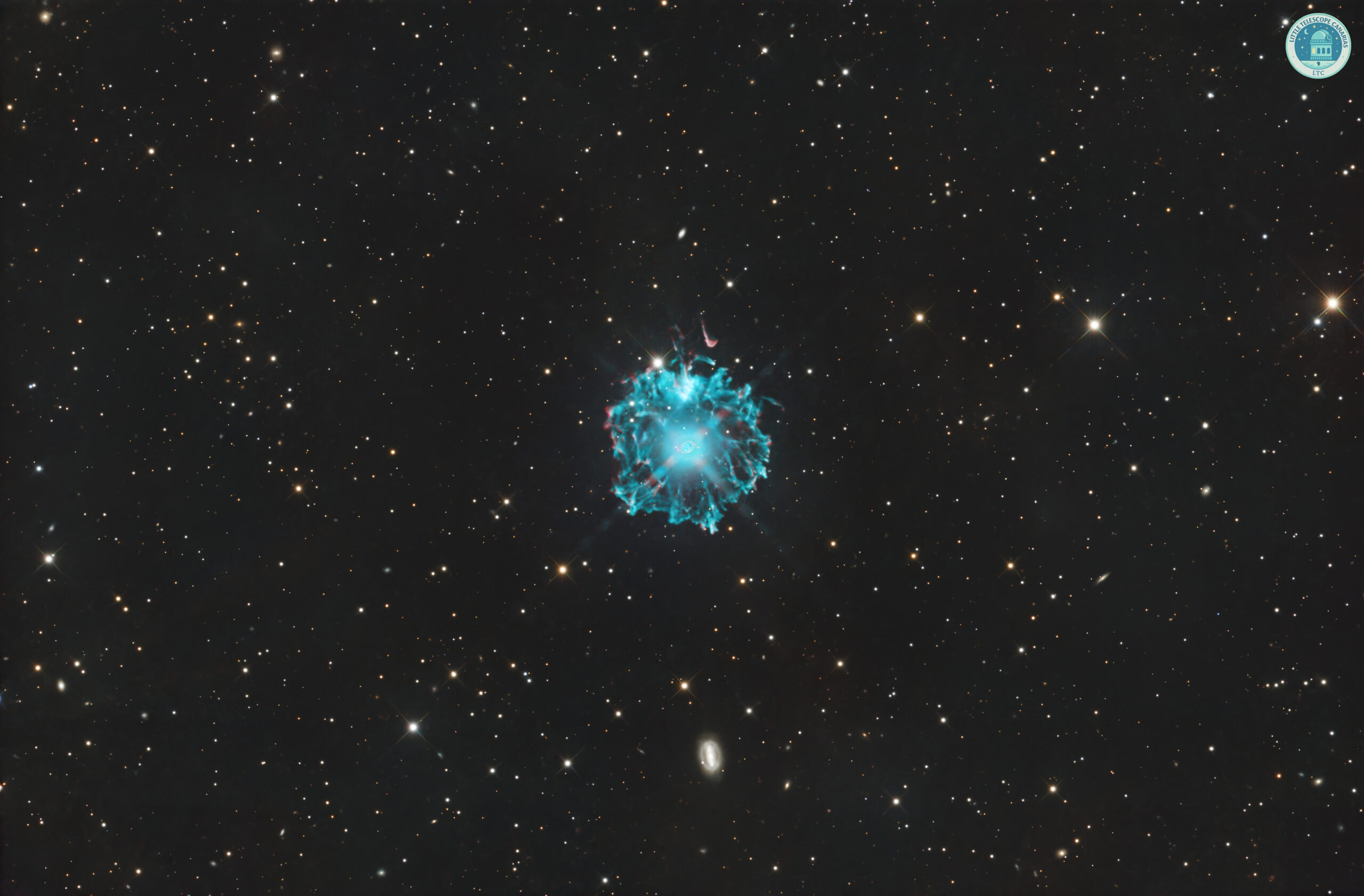
The team at LilTecan has captured the Cat’s Eye Nebula using narrowband filters (Hα and OIII), allowing us to highlight the different gas emissions within the nebula:
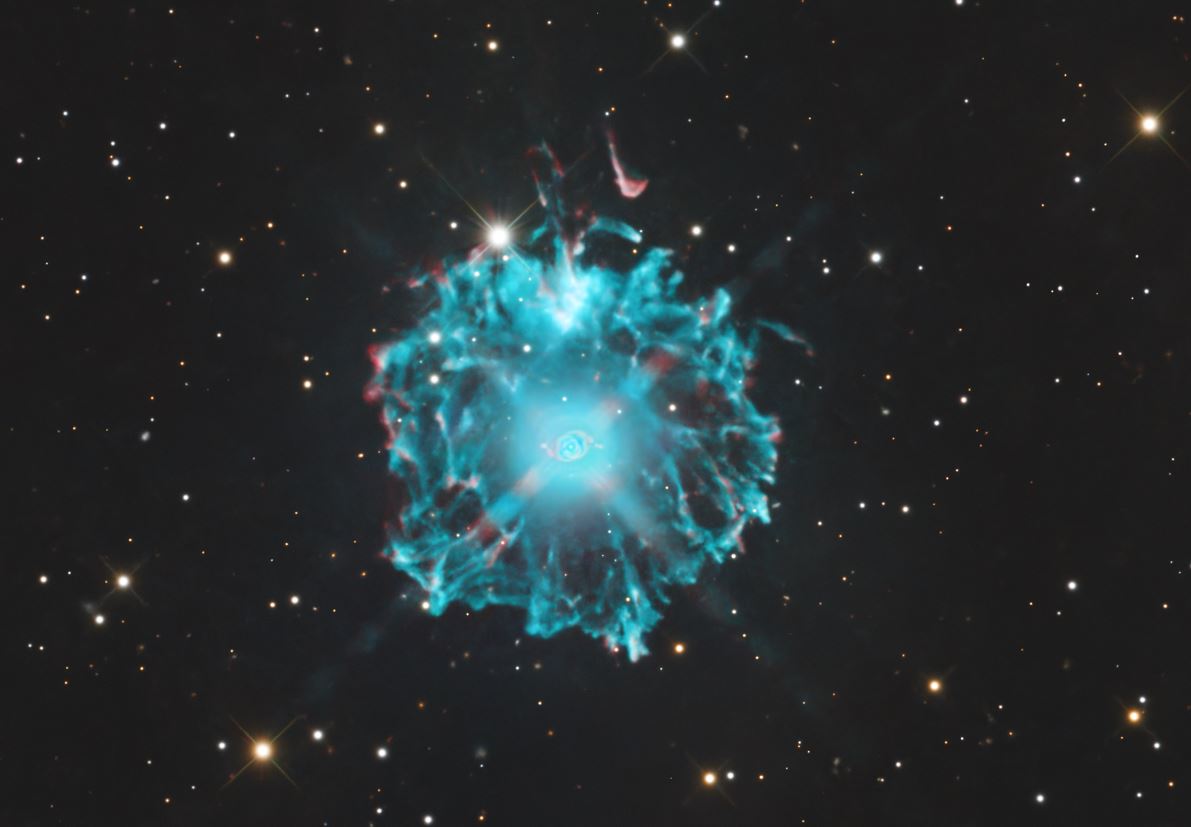
- Hα (Hydrogen-alpha): shows the most extended hydrogen-rich regions.
- OIII (Doubly Ionized Oxygen): produces the characteristic bluish-green glow typical of planetary nebulae.
By combining these images, we achieve a deep and detailed view of NGC 6543, revealing both its striking symmetry and its internal structures.
✨ Science and Cosmic Art
The study of NGC 6543 provides valuable insights into stellar evolution, especially how intermediate-mass stars enrich the interstellar medium with heavy elements. At the same time, its visual beauty reminds us that the universe is not only a cosmic laboratory but also a source of endless natural art.
The Cat’s Eye Nebula is a perfect example of how science and astronomical observation connect us with the fundamental processes of the cosmos.