
NGC 5033 – An Active Spiral in Canes Venatici
The NGC 5033 is a spiral galaxy located in the constellation of Canes Venatici, about 40 million light-years from Earth. It was discovered by William Herschel in 1785 and is known for its active nucleus and somewhat irregular spiral structure.
Although it may not appear as visually striking as some other galaxies, its internal activity makes it an object of great scientific interest.
💥 An active galactic nucleus
NGC 5033 hosts an active galactic nucleus (AGN), powered by the accretion of matter onto a supermassive black hole at its center. This process releases large amounts of energy, detectable across multiple wavelengths.
The galaxy is classified as a Seyfert type, indicating that its nucleus exhibits strong and variable emission due to this energetic activity.
📸 Images from LilTecan
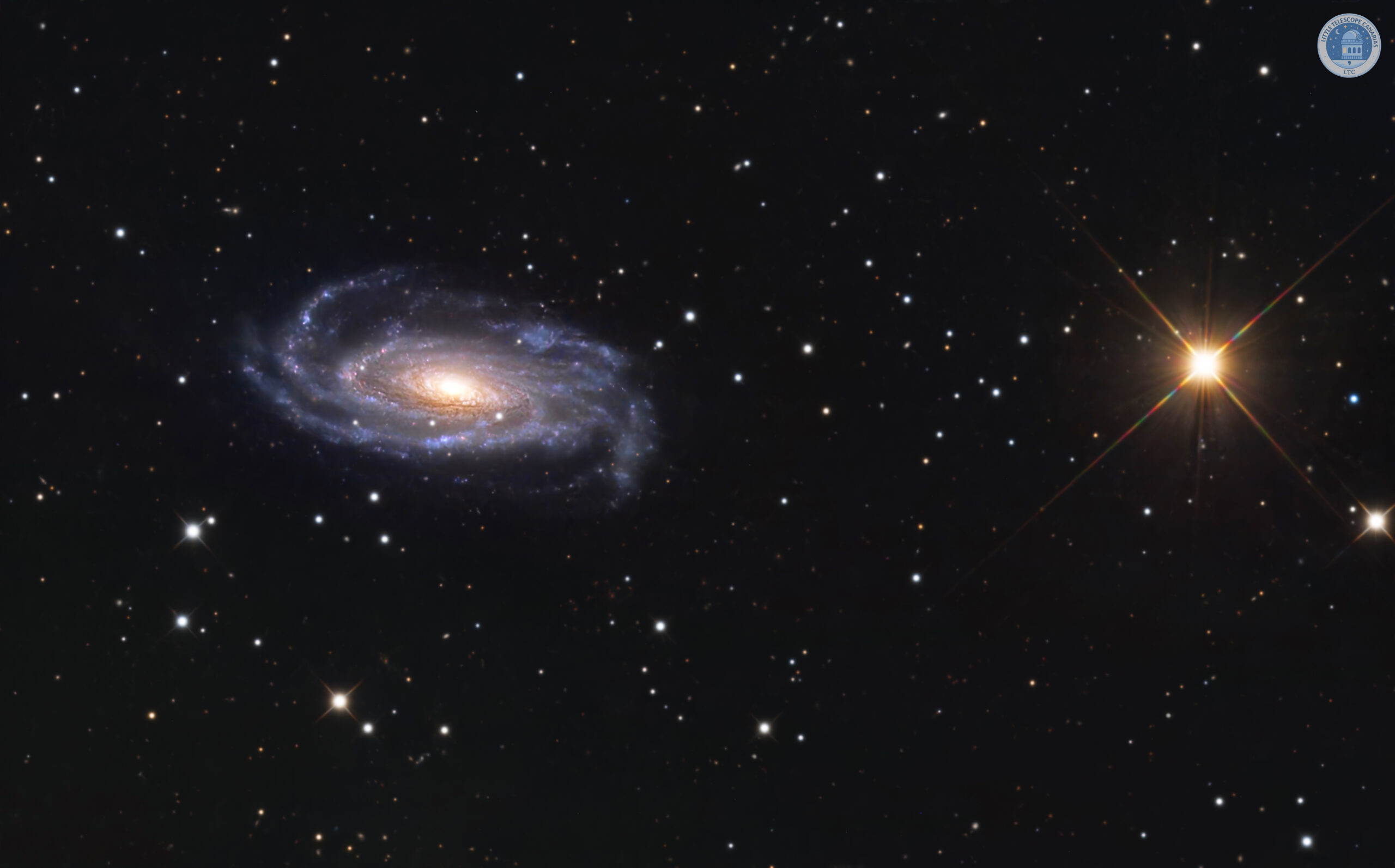
The LilTecan team has captured NGC 5033, highlighting its bright core and the subtle spiral arms extending outward, along with regions of interstellar dust.
🌟 Structure and internal activity
Modern studies have revealed several key features:
- It shows a flocculent spiral structure, with loosely defined arms.
- Its nucleus exhibits strong emission, typical of Seyfert galaxies.
- It contains abundant interstellar gas and dust, visible as dark lanes.
- Star-forming regions are distributed throughout the disk.
- Its inclination relative to our line of sight allows detailed study of its internal dynamics.
NGC 5033 is an interesting example of an active spiral galaxy, where processes in the nucleus and disk coexist and influence its evolution.
Observing it today is like exploring a galaxy whose calm appearance hides intense activity at its core, reminding us that even seemingly quiet systems can harbor extraordinary energetic phenomena.