
Arp 227 – The Shell Galaxy
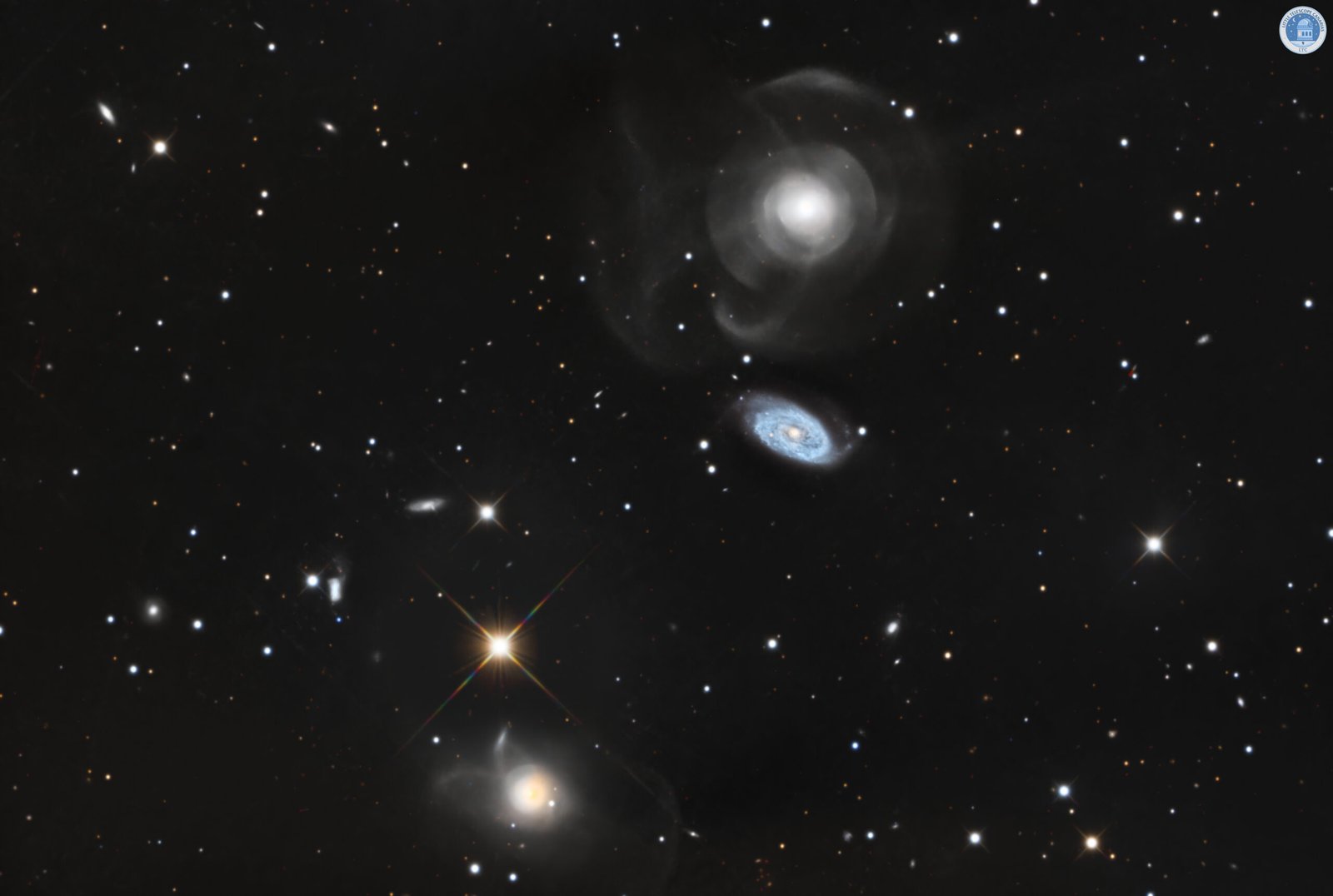
Arp 227 is one of the most interesting galactic structures in the constellation of Pisces. The designation refers to NGC 474, a lenticular galaxy surrounded by a spectacular system of faint stellar shells, arcs, and tidal structures extending around its main body.
NGC 474 forms a system with the spiral galaxy NGC 470. The two galaxies have very similar systemic velocities and are separated on the sky by approximately 5.4 arcminutes, corresponding to a projected separation of roughly 47–50 kpc, depending on the distance adopted.
The feature that makes Arp 227 particularly remarkable is the numerous shell-like structures surrounding NGC 474. These structures are extremely faint and become much more apparent in deep images capable of recording the very low surface brightness of the galaxy’s outer regions.
🌌 A galaxy surrounded by shells
NGC 474 is a lenticular galaxy of type S0 and is the dominant component of the Arp 227 system. Surrounding it is a complex system of stellar shells that has been studied for decades.
These structures appear as large, concentric arcs surrounding the galaxy. Some extend considerable distances from the centre and have extremely low surface brightness, making them difficult to detect in conventional images.
Shell systems are considered important indicators of the formation and evolutionary history of galaxies. Observations and simulations indicate that such structures can arise as a consequence of galaxy mergers or gravitational interactions.
In the case of NGC 474, observations have revealed a particularly complex system consisting not only of shells, but also of structures showing characteristics of tidal tails, loops, and stellar streams.
📸 Images from LilTecan
The Arp 227 system is particularly well suited to deep-field astrophotography.
The main galaxy, NGC 474, is relatively bright, but the structures surrounding it are considerably fainter. The outer shells have very low surface brightness and require deep imaging to be recorded clearly. Deep observations have revealed structures that are barely visible in conventional images.
🌟 Structure and main characteristics
Observational studies of Arp 227 and NGC 474 have revealed several important characteristics:
- Arp 227 corresponds to NGC 474 in Halton Arp’s Atlas of Peculiar Galaxies.
- NGC 474 is a lenticular galaxy (S0).
- It is located in the constellation of Pisces.
- The J2000 coordinates of NGC 474 are approximately 01h 20m 06.69s / +03° 24′ 55.86″.
- NGC 474 forms the Arp 227 system together with the spiral galaxy NGC 470.
- NGC 470 and NGC 474 are separated by approximately 5.4 arcminutes on the sky.
- Their projected separation is approximately 47–50 kpc, depending on the distance adopted by the different studies.
- NGC 474 possesses a system of at least ten stellar shells identified in deep observations.
- The outer structures include shells, stellar streams, and loops.
- SIMBAD also identifies NGC 474 with the designation APG 227.
- NGC 470 shows significant star-forming activity and a weak bar according to studies of the system.
- A structure of neutral hydrogen (H I) has been detected in association with the interaction between NGC 470 and NGC 474.
The peculiar structure of NGC 474 has made it an important target for studying galaxy evolution.
Early investigations already showed that the shells could be associated with interaction or merger processes. Later studies using deeper imaging revealed a much more complex structure surrounding the galaxy.
In particular, observations from the MATLAS survey have made it possible to study the outer regions of NGC 474 and measure the properties of several of its shells. A study published in Astronomy & Astrophysics identified at least ten shells and analysed eight of the largest ones in detail. The study adopted a distance of 30.9 Mpc, equivalent to approximately 101 million light-years.
Other studies have used spectroscopy to investigate the stellar populations of the shells directly. Observations obtained with KCWI on the Keck telescope provided spectra of both the centre of NGC 474 and one of its outer shells.
Observations with MUSE on ESO’s Very Large Telescope have also been used to study the kinematic and chemical properties of the shells and associated objects.
One of the most interesting questions surrounding Arp 227 is how the enormous structures around NGC 474 were formed.
Several scenarios have been proposed over the years. One possibility is that the shells are the result of an interaction with NGC 470. Another possibility is that they originated from the accretion of a lower-mass galaxy that was disrupted by the gravitational forces of NGC 474.
More recent studies of the stellar populations within the shells provide evidence favouring an origin associated with the merger or accretion of a companion galaxy. In particular, a 2020 spectroscopic study found differences between the stellar populations in the centre of NGC 474 and those in an outer shell. The authors considered the results compatible with a merger occurring at least 2 billion years ago, although the exact history of the shell formation remains under investigation.
Another study using MUSE observations found evidence for an intermediate-age stellar population in one of the shells and discussed different possibilities for the mass and nature of the progenitor galaxy. The authors noted that the data did not allow the mass of the progenitor to be determined definitively.
Therefore, there is no single, definitively established explanation for all of the structures in Arp 227. What is well established is that NGC 474 possesses a complex system of stellar structures that preserves evidence of its interaction and assembly history.