
Abell 2197 – A Galaxy Cluster in the Hercules Supercluster
Abell 2197 (ACO 2197) is a galaxy cluster located in the constellation of Hercules, at a distance of more than 400 million light-years. It has a relatively irregular structure and lies approximately 1.5° north of Abell 2199 on the sky. Both clusters have similar redshifts and are associated with the complex large-scale structure known as the Hercules Supercluster.
Abell 2197 is particularly interesting for astronomical imaging because it does not appear as a compact, circular concentration of galaxies. Its distribution extends across approximately 1.5° of sky, with several bright galaxies forming an approximately east-west alignment. Among the most prominent are NGC 6146, NGC 6160, and NGC 6173.
💥 An Irregular Cluster with Two Main Concentrations
Unlike compact clusters such as Abell 2199, Abell 2197 has a more irregular structure. Classic studies of the Abell clusters described it as a somewhat irregular system located north of Abell 2199.
The distribution of its galaxies shows two main concentrations, commonly referred to as Abell 2197E and Abell 2197W. This structure gives the cluster an elongated appearance when observed in wide-field images.
Among the most prominent galaxies in the system are NGC 6146, NGC 6160, and NGC 6173, three large elliptical galaxies that dominate different regions of the cluster. Deep surface-photometry studies have investigated these giant galaxies and their extensive outer envelopes.
The Bautz-Morgan classification places Abell 2197 as a Type II cluster, a classification related to the concentration and luminosity of its central galaxies.
📸 Images from LilTecan
The LilTecan team has captured Abell 2197, revealing the large number of galaxies distributed across this extensive field. The angular extent of the cluster makes it possible to record numerous galaxies of different sizes and morphologies within the same image, while deep exposures reveal much fainter members.
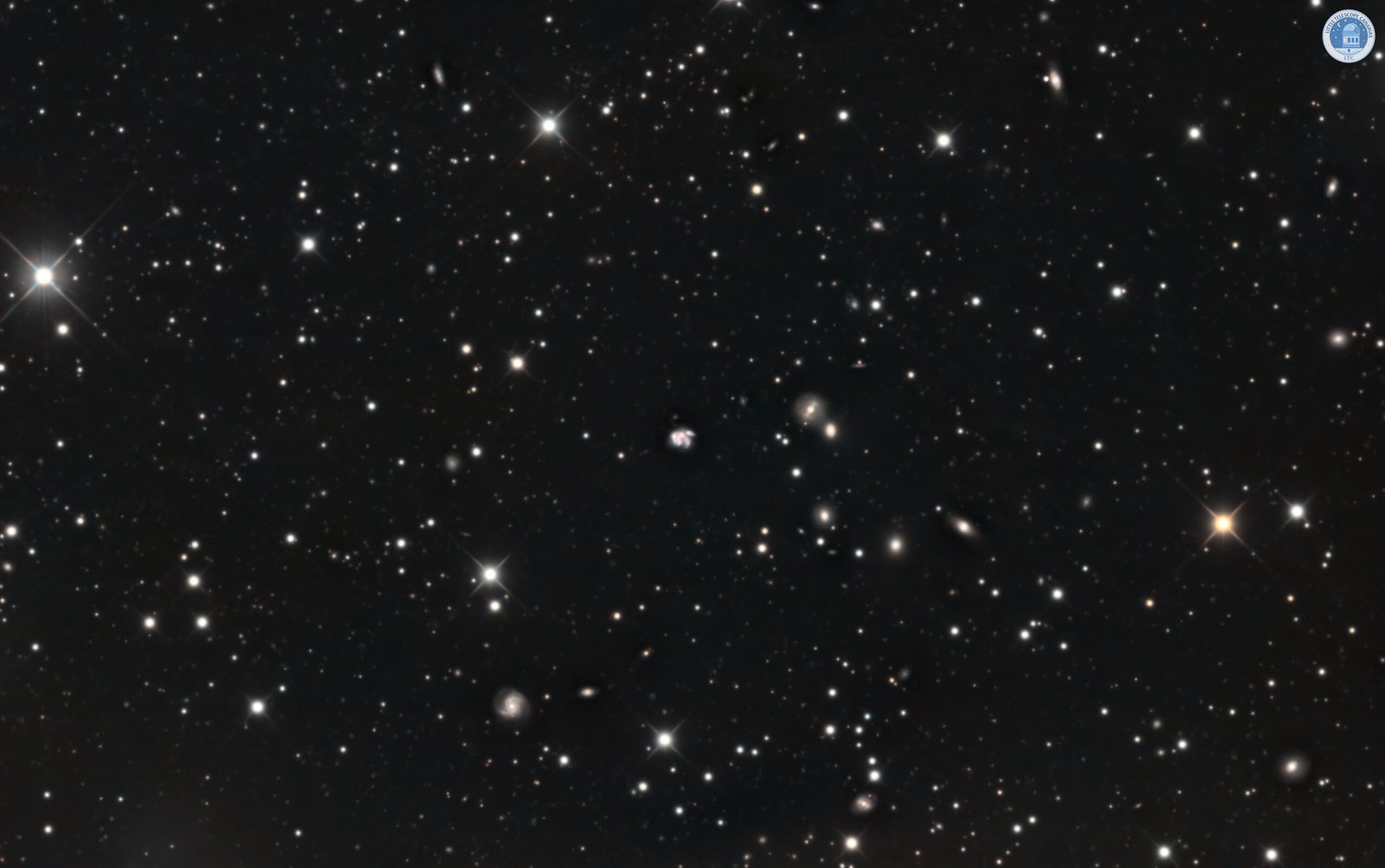
The extended nature of Abell 2197 makes it particularly attractive for deep-sky astrophotography. Rather than photographing a single galaxy, the image captures an entire concentration of galaxies located hundreds of millions of light-years away.
🌟 Structure and Main Characteristics
Astronomical studies and catalogs have identified several notable characteristics:
- It is a galaxy cluster included in the catalog compiled by George O. Abell.
- It is located in the constellation of Hercules.
- It has a redshift of approximately z = 0.030 in galaxy-cluster compilations.
- Its distance is on the order of more than 400 million light-years, depending on the cosmological model and distance method used.
- It has a relatively irregular structure.
- Its observable distribution extends across approximately 1.5° of sky.
- It contains two main concentrations commonly referred to as Abell 2197E and Abell 2197W.
- Among its most prominent galaxies are NGC 6146, NGC 6160, and NGC 6173.
- It forms part of the large-scale environment associated with the Hercules Supercluster, together with Abell 2199 and other galaxy clusters in the region.
- Its morphological classification according to the Bautz-Morgan system is Type II.
Abell 2197 is an excellent example of the enormous variety of structures found among galaxy clusters. Rather than being a compact concentration dominated by a single central galaxy, it is an extended and relatively irregular system, with large elliptical galaxies distributed throughout an elongated structure.
Its close angular proximity to Abell 2199 is particularly interesting. Both systems have similar redshifts and a relatively small projected separation. Classic studies considered the possibility that they might be physically related, although they also noted that there was insufficient evidence to conclude that they constitute a single gravitationally bound system.
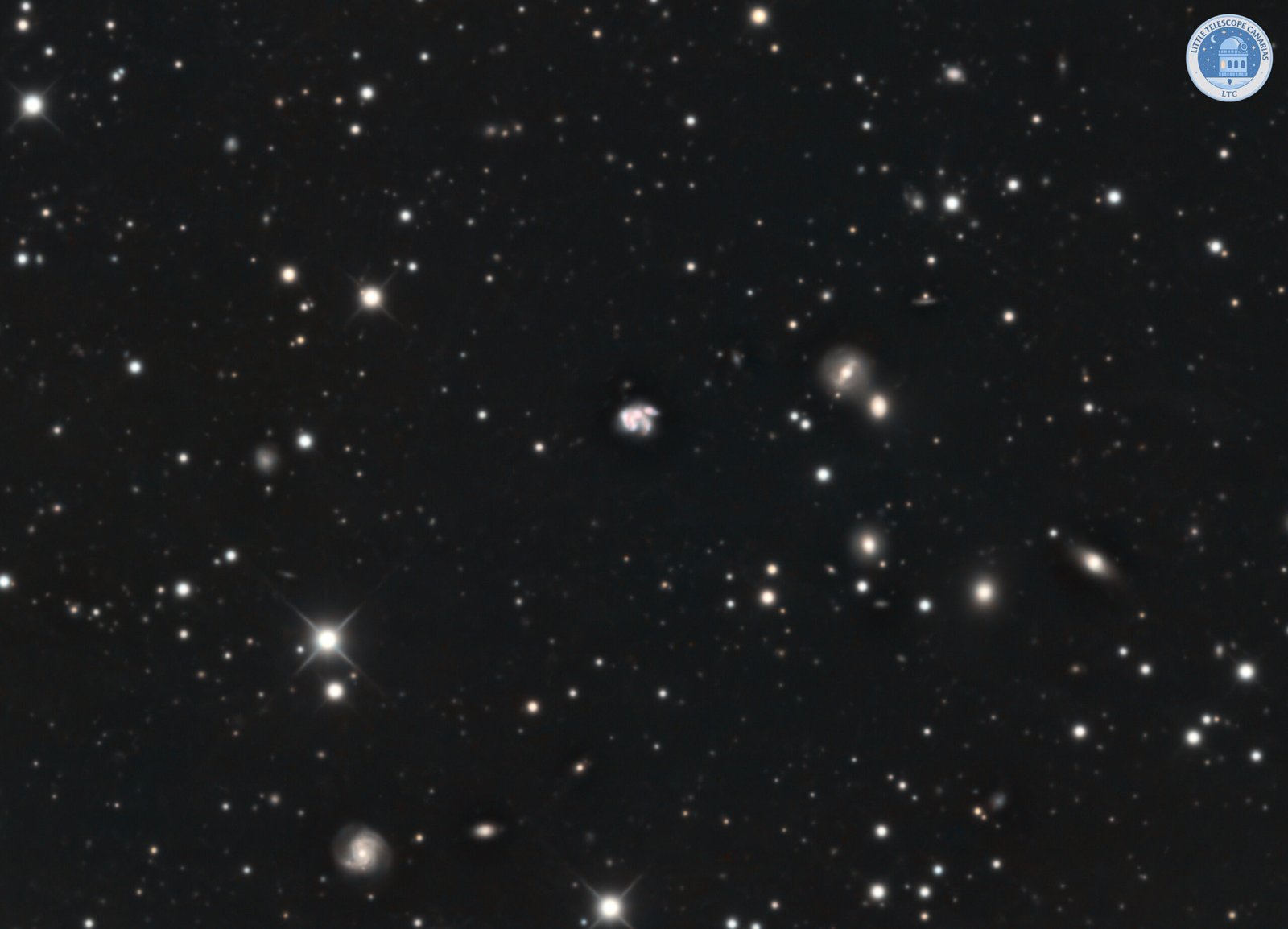
Observing Abell 2197 is like looking toward a region of the Universe where galaxies do not exist in isolation, but are gathered into a gigantic structure extending across millions of light-years.
Every small point of light recorded in a deep exposure may correspond to a galaxy hundreds of millions of light-years away. Together, they provide a glimpse of the large-scale structure of the Universe and show how gravity has gathered countless galaxies into the enormous cosmic web we observe today.