
NGC 2244 – The Young Star Cluster at the Heart of the Rosette Nebula
NGC 2244 is a very young open star cluster located in the constellation of Monoceros, at the center of the famous Rosette Nebula. The cluster is composed of a population of young, massive stars that ionize the surrounding gas and play a fundamental role in the present appearance of the region.
Although NGC 2244 is commonly referred to when discussing the central region of the Rosette Nebula, it is important to distinguish the two objects: NGC 2244 is the star cluster, while the Rosette Nebula is the extensive region of ionized gas surrounding it. SIMBAD classifies NGC 2244 as an open cluster.
Modern studies place the cluster at approximately 1,440–1,600 parsecs from Earth, depending on the study and the method used. Studies based on Gaia data have obtained a distance of 1,440 ± 32 pc, while earlier investigations found values close to 1.6 kpc.
💥 A Cluster Illuminating the Rosette Nebula
NGC 2244 is an extremely young stellar association. Photometric and spectroscopic studies place its age at a few million years, with different investigations obtaining estimates ranging from approximately 1 to 6 million years.
Among its stars are several extremely hot and luminous O-type stars. A study dedicated to the O-star population of NGC 2244 identified seven O-type stars, while other studies have particularly highlighted HD 46150 and HD 46223.
The intense ultraviolet radiation emitted by these stars ionizes the hydrogen gas surrounding the cluster. This process produces the characteristic emission of the Rosette Nebula. At the same time, the powerful stellar winds generated by massive stars contribute to reshaping and gradually clearing the material surrounding the cluster.
📸 Images from LilTecan
The LilTecan team has captured the NGC 2244 region, showing the stellar cluster embedded within the extensive structure of the Rosette Nebula.
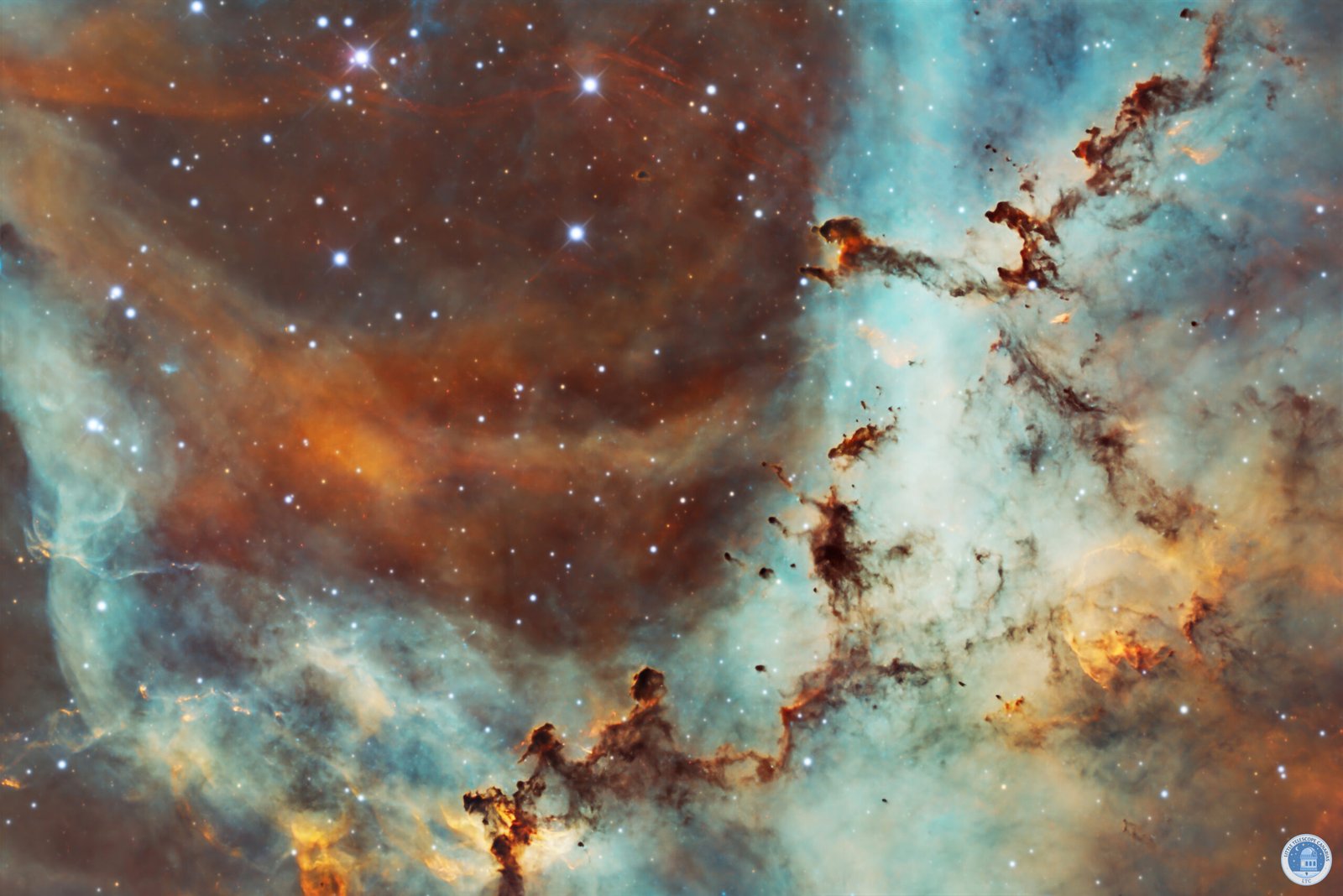
Narrowband images emphasize the ionized gas surrounding the cluster, while RGB exposures reveal the concentration of young stars that forms the heart of this spectacular star-forming region.
🌟 Structure and Main Characteristics
Astronomical studies have identified several notable properties:
- It is a very young open star cluster.
- It is located in the constellation of Monoceros.
- It is directly associated with the Rosette Nebula, an H II region and star-forming complex.
- Its estimated distance is approximately 1,440–1,600 parsecs, equivalent to around 4,700–5,200 light-years.
- Its age is approximately a few million years; different studies have obtained values between 1 and 6 million years.
- It contains numerous young, massive stars, including several O-type stars.
- HD 46150, an O5-type star, is one of the most prominent stars in the cluster.
- HD 46223 is another early O-type star associated with NGC 2244.
- The ultraviolet radiation from its massive stars ionizes the surrounding gas, contributing to the characteristic emission of the Rosette Nebula.
- The winds from its massive stars also contribute to modifying the distribution of gas and dust around the cluster.
NGC 2244 is an excellent example of how massive stars can profoundly transform the environment in which they are born. In just a few million years, the cluster’s most luminous stars have already begun ionizing and modifying the molecular cloud surrounding them.
The relationship between the cluster and the Rosette Nebula allows astronomers to study massive-star formation, the evolution of young clusters, and the interaction between stellar radiation, stellar winds, and interstellar gas.
Modern studies also show that NGC 2244 should not simply be regarded as a static collection of stars. Its structure and motions indicate that it is still in a very early stage of its dynamical evolution.
Observing NGC 2244 is like looking at a stellar cluster that has only recently been born. Its massive stars illuminate and transform the cloud of gas surrounding them, while the younger stars remain as witnesses to the recent formation of this system.
At the center of the Rosette Nebula, NGC 2244 represents one of the most spectacular manifestations of star formation: a group of young stars whose radiation is slowly sculpting the enormous cloud of gas from which they were born