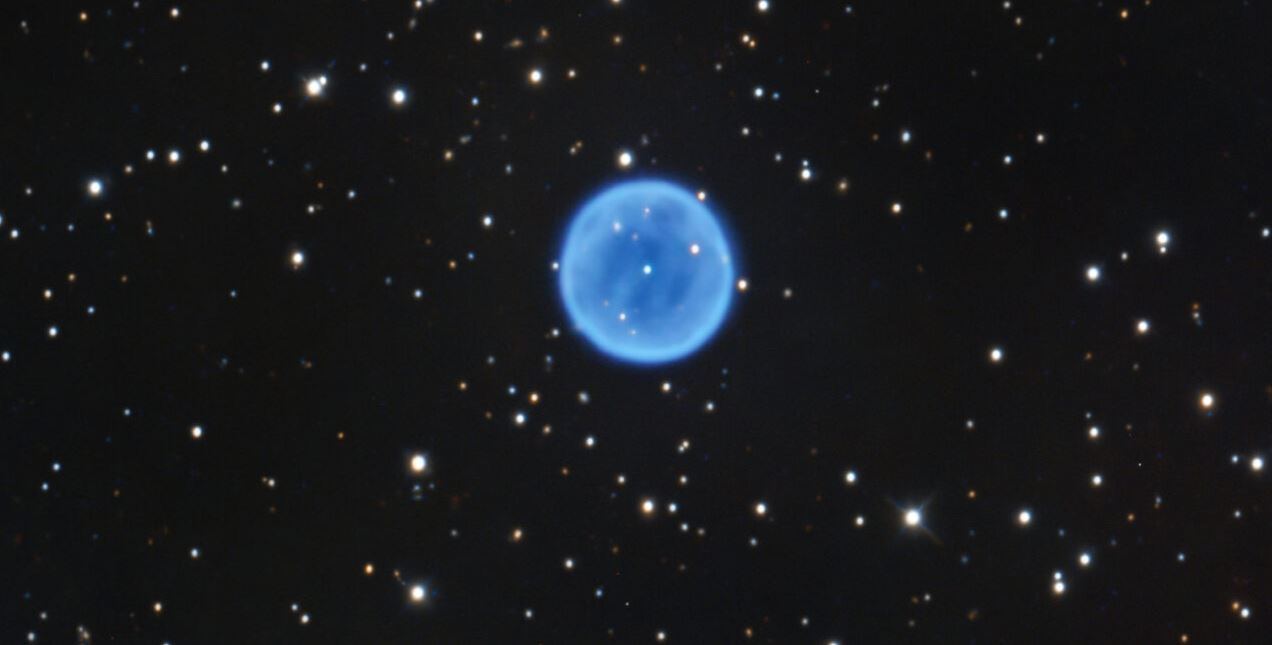
Abell 39 – The Perfect Sphere in the Cosmos
In the constellation of Hercules, about 7,000 light-years away, lies one of the most remarkable examples of symmetry in the universe: the planetary nebula Abell 39. Discovered by George Abell in 1966, this nebula is famous for its almost perfectly spherical shape, making it a reference object for both astronomical research and outreach.
A nearly perfect cosmic sphere
Abell 39 is a planetary nebula, the result of the final stages in the life of a Sun-like star. Once the star exhausted its nuclear fuel, it expelled its outer gas layers into space, forming a luminous shell that slowly expands.
What sets it apart from other planetary nebulae is its extraordinary geometric regularity: a gaseous shell about 5 light-years in diameter, with a homogeneous and symmetric glow. At its center still shines the white dwarf remnant, the stellar core that ionizes the gas and gives it its characteristic glow.
📸 Images from LilTecan
The LilTecan team has photographed Abell 39 using LRGB and OIII filters to reveal both its overall structure and the delicate details of the ionized gas.
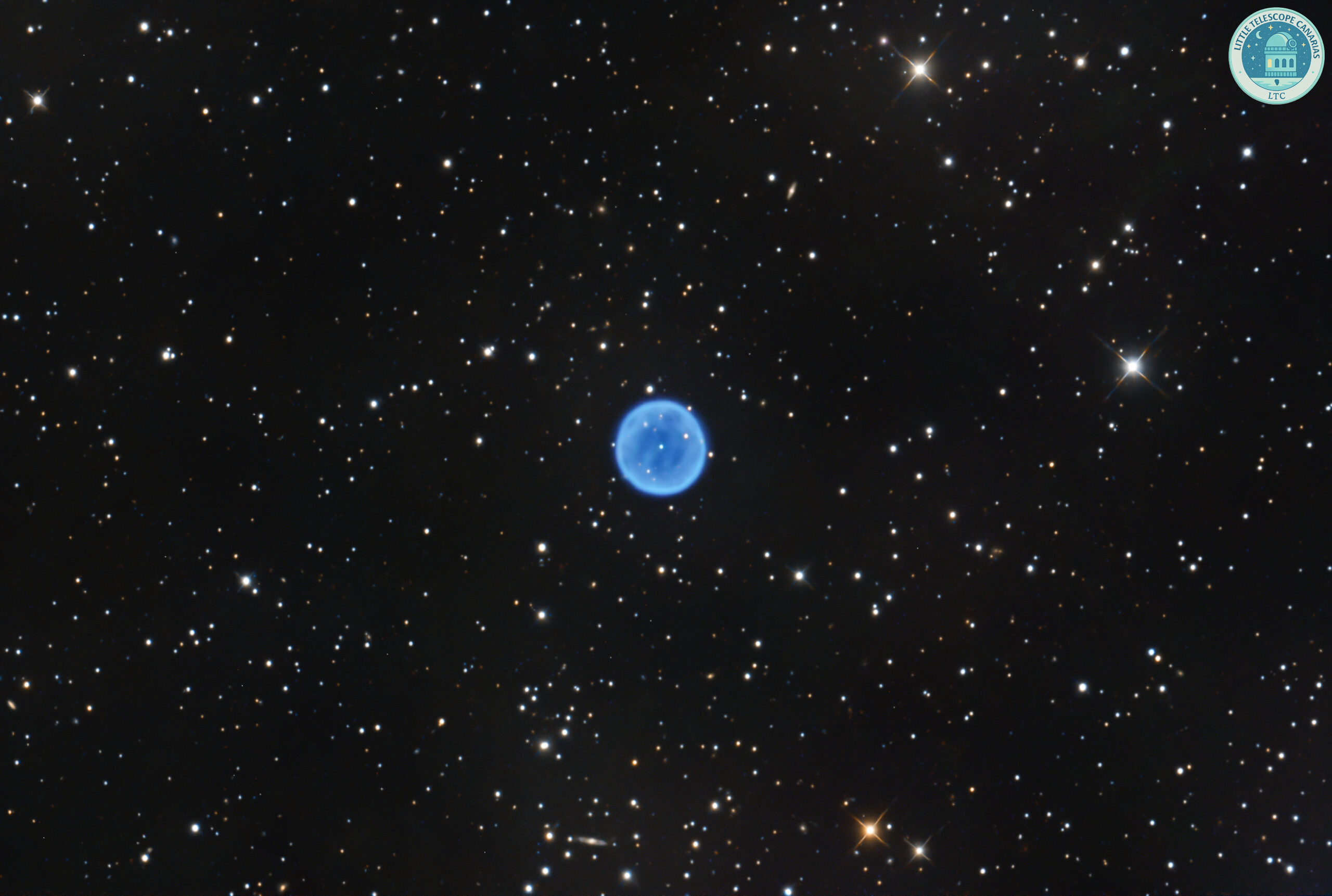
- LRGB (Luminance + Red, Green, Blue): highlights the natural beauty of the spherical shell and its contrast against the cosmic background.
- OIII (Doubly ionized oxygen): emphasizes the brightest regions of the nebula and clearly reveals the uniformity of its expansion.
The result is a deep and detailed image that showcases the subtlety of its diffuse gas and the perfection of its symmetry.
✨ Science and natural art
Abell 39 is a reminder of how astrophysical processes—born from the death of a star—can give rise to one of the simplest yet most beautiful forms in the cosmos: a perfect sphere. Studying nebulae like this helps us better understand the evolution of low- and medium-mass stars, as well as the dynamics of gases that enrich the interstellar medium.