
Arp 214 – A Peculiar Galaxy in Transformation
The Arp 214 system, primarily associated with the galaxy NGC 3718, is one of the most fascinating examples of galaxies distorted by gravitational interaction. Located in the constellation of Ursa Major, about 52 million light-years from Earth, it was included by Halton Arp in his famous Atlas of Peculiar Galaxies because of its extraordinary morphology.
NGC 3718 is accompanied by the galaxy NGC 3729, forming a system in which gravitational forces have profoundly distorted the galactic structure.
💥 A galaxy shaped by gravity
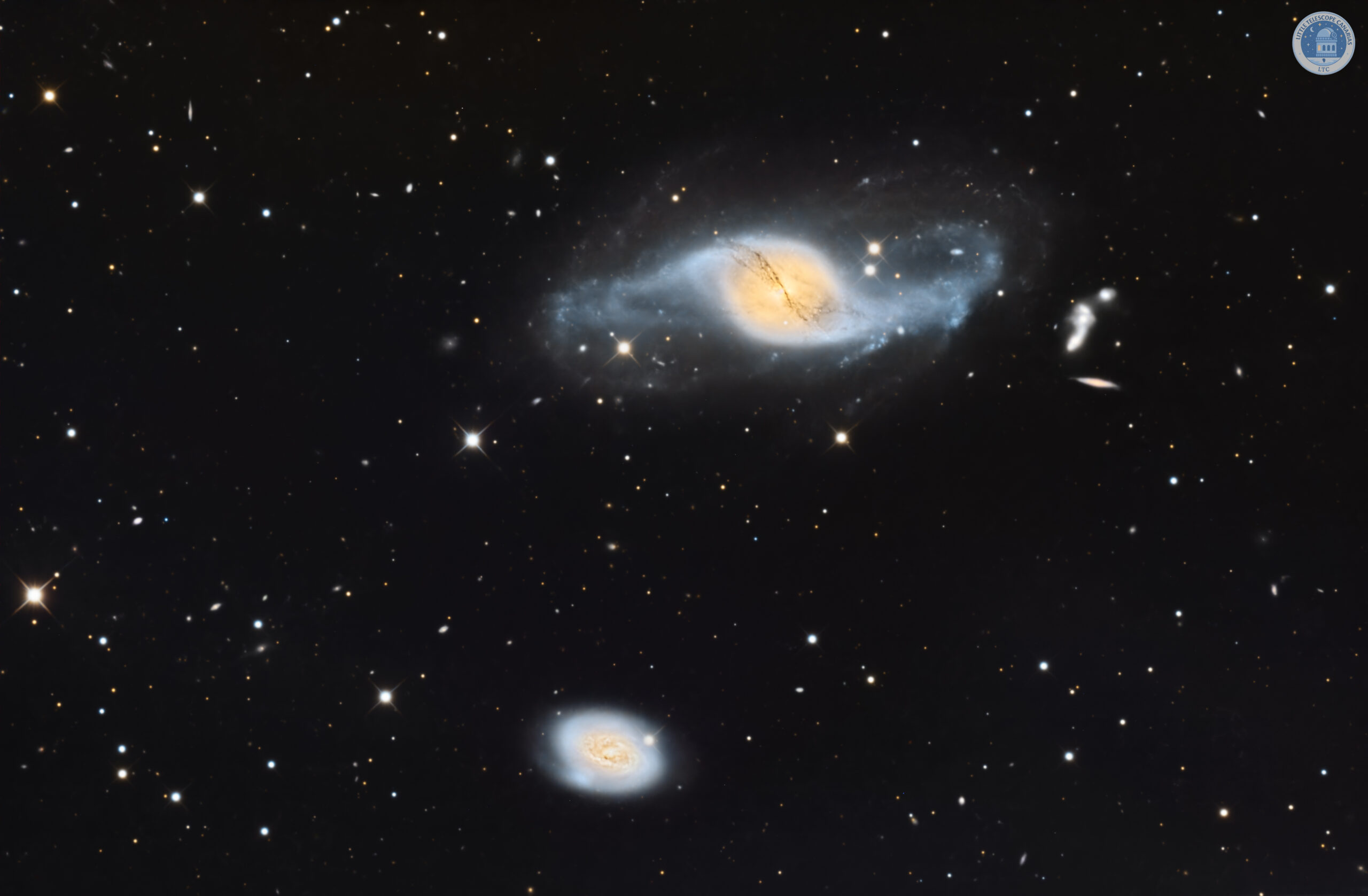
NGC 3718 stands out for its spectacular warped disk and prominent dust lane, which appears curved and unusually distorted. These deformations are the result of prolonged gravitational interactions with neighboring galaxies.
Studies indicate that the system has undergone tidal processes capable of altering the distribution of gas, dust, and stars, generating chaotic structures and possibly triggering episodes of nuclear activity.
📸 Images from LilTecan
The LilTecan team has captured Arp 214, highlighting the complex dust lane of NGC 3718, as well as the distortions in the galactic disk and the delicate halo surrounding the system.
🌟 Structure and dynamics of the system
Modern observations have revealed numerous details about this peculiar object:
- It exhibits a strongly warped disk, with a twisted structure visible in both gas and dust.
- The dust lane appears curved and asymmetric, something unusual in spiral galaxies.
- The gravitational interaction with NGC 3729 may be responsible for these perturbations.
- Large amounts of neutral hydrogen (HI) have been detected extending beyond the visible disk.
- The nucleus shows signs of moderate galactic activity, possibly fueled by gas flows toward the center.
- Its morphology bears some resemblance to Centaurus A, although at a different evolutionary stage.
Arp 214 is an extraordinary cosmic laboratory for studying how gravitational interactions transform entire galaxies. Its chaotic yet elegant structure demonstrates that galaxies are dynamic systems in constant evolution.
Observing this object today is like witnessing gravity at work on a galactic scale, slowly shaping the fate of billions of stars and revealing the dynamic nature of the universe.