
Arp 269 – A Cosmic Dance Between Two Galaxies
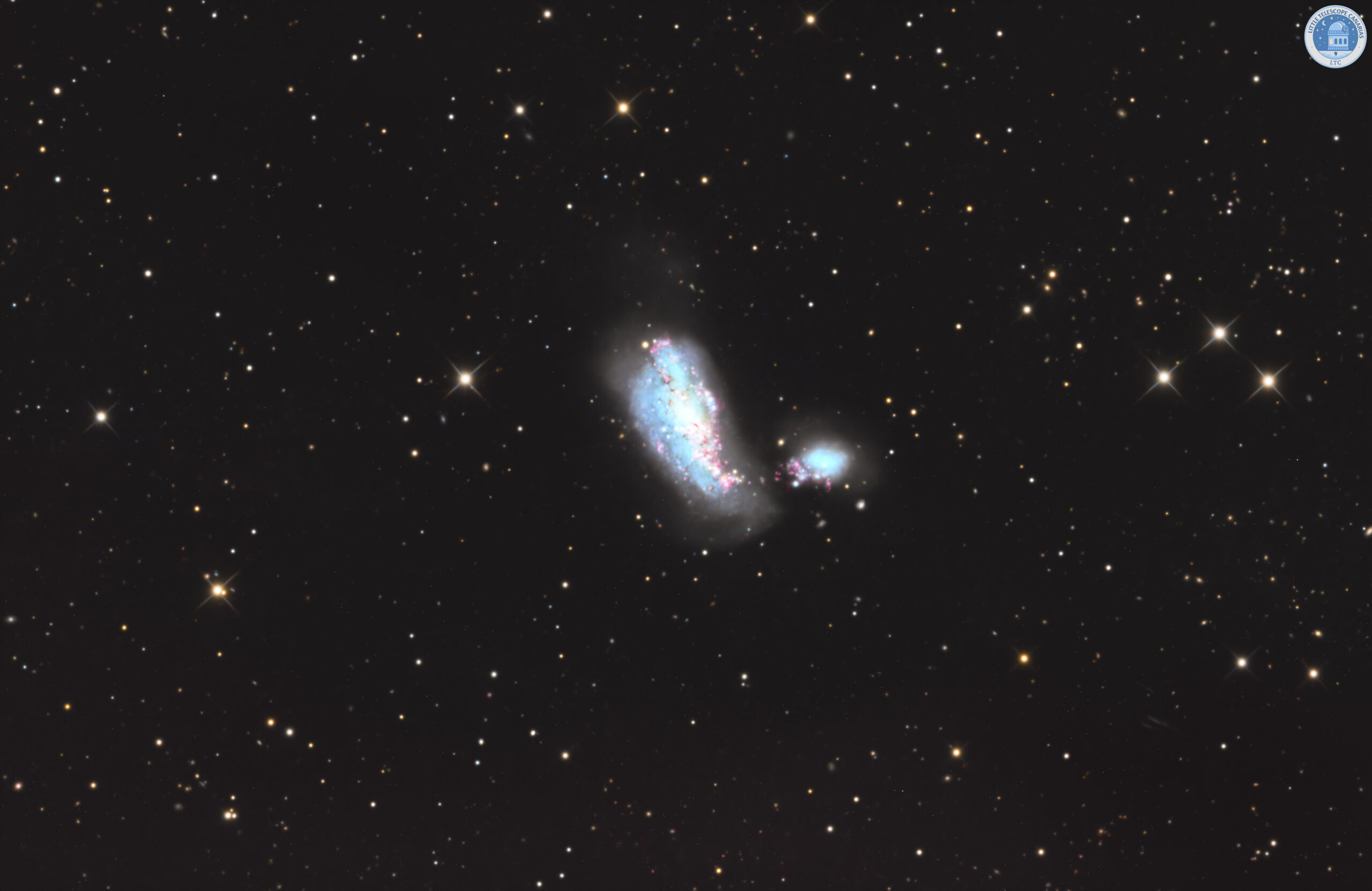
Arp 269 is one of the closest and most spectacular interacting galaxy systems in the sky. Located in the constellation of Canes Venatici, at an approximate distance of 24 million light-years, it is composed of the galaxies NGC 4490 and NGC 4485. It was included by Halton Arp in his famous Atlas of Peculiar Galaxies because of the dramatic distortions produced by their gravitational interaction.
Also known as the Cocoon Galaxies, Arp 269 is one of the finest nearby laboratories for studying how galaxy encounters trigger intense episodes of star formation and reshape the structure of galaxies.
💥 Two Galaxies Shaped by Gravity
The primary galaxy, NGC 4490, is a gas-rich barred spiral experiencing vigorous star formation. Its companion, NGC 4485, is a smaller irregular galaxy that has been strongly distorted by its close gravitational encounter.
The interaction between the two galaxies has produced a remarkable bridge of gas and stars connecting them, along with an enormous envelope of neutral hydrogen (H I) extending tens of thousands of light-years around the system. These structures provide direct evidence of the tidal forces generated during their close passage.
Dynamical simulations indicate that the galaxies have already passed their point of closest approach and continue to evolve after the encounter, while their interaction continues to fuel new regions of star formation.
📸 Images from LilTecan
The LilTecan team has captured Arp 269, revealing the spectacular morphology of both galaxies, the bridge of material linking them, and the numerous bluish star-forming regions where new generations of stars continue to emerge as a result of their gravitational interaction.
🌟 Structure and Main Characteristics
Observational studies have revealed numerous remarkable features of the system:
- It is composed of the interacting galaxies NGC 4490 and NGC 4485.
- It is located approximately 24 million light-years from Earth.
- A bridge of gas and stars connects the two galaxies, providing clear evidence of their recent interaction.
- The system is surrounded by a vast neutral hydrogen (H I) envelope extending approximately 90 kpc.
- NGC 4490 exhibits a high rate of star formation, likely triggered by its interaction with its companion.
- X-ray observations have identified numerous ultraluminous X-ray sources (ULXs) associated with the system’s star-forming regions.
- Recent observations with the James Webb Space Telescope have resolved individual stellar populations, helping astronomers reconstruct the interaction history of the two galaxies.
Arp 269 is one of the closest and best-studied examples of an interaction between relatively low-mass galaxies. Its proximity allows astronomers to investigate in remarkable detail how gravitational forces redistribute gas, trigger bursts of star formation, and profoundly alter the evolution of both galaxies.
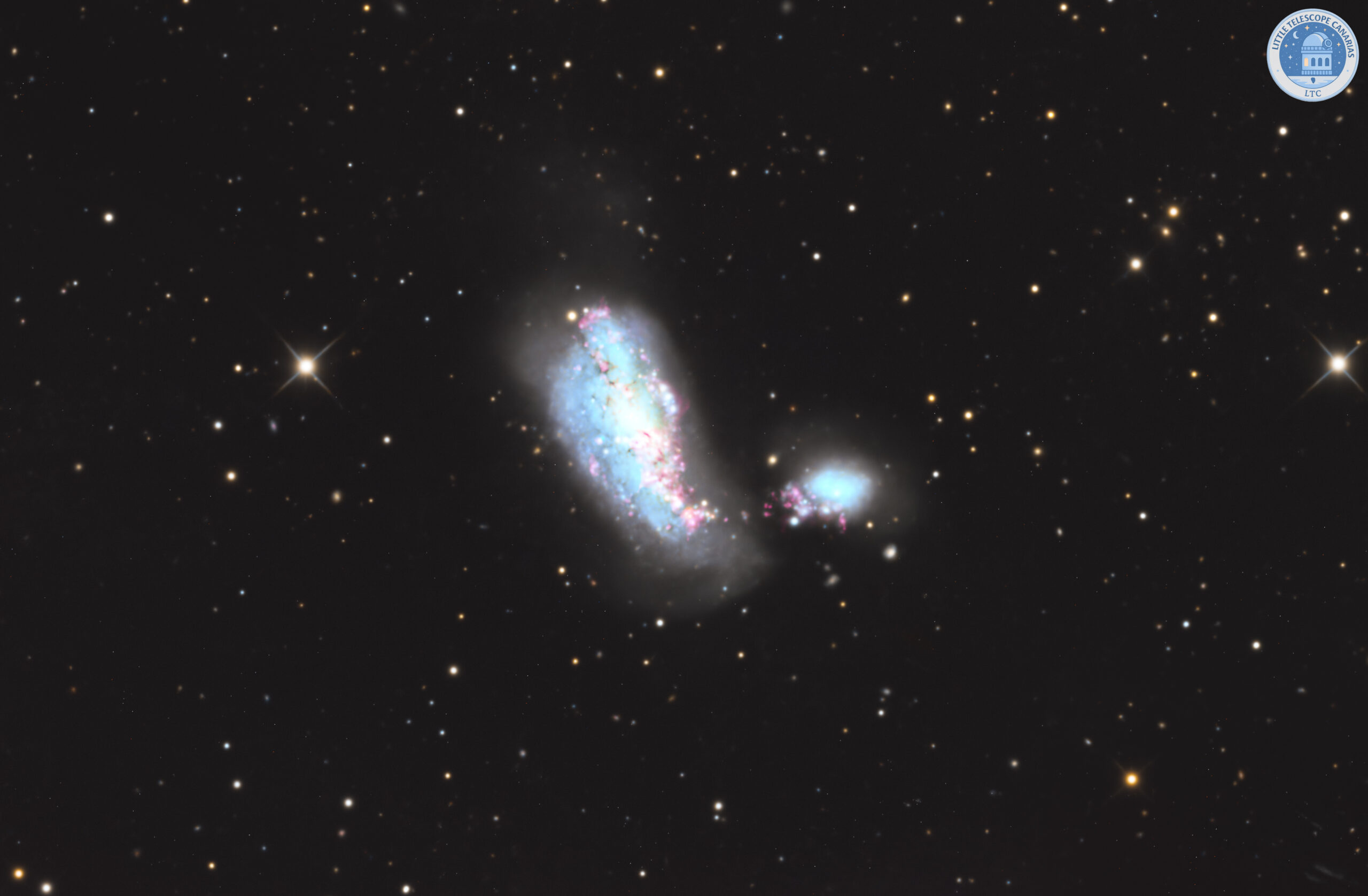
Observing Arp 269 today is like witnessing a cosmic dance that began hundreds of millions of years ago. As gravity intertwines the two galaxies through bridges of gas and stars, new stellar clusters are born within the compressed regions created by the collision, offering a unique window into the processes that shape the evolution of galaxies throughout the universe.