
Arp 65 – A Pair of Galaxies in Gravitational Interaction
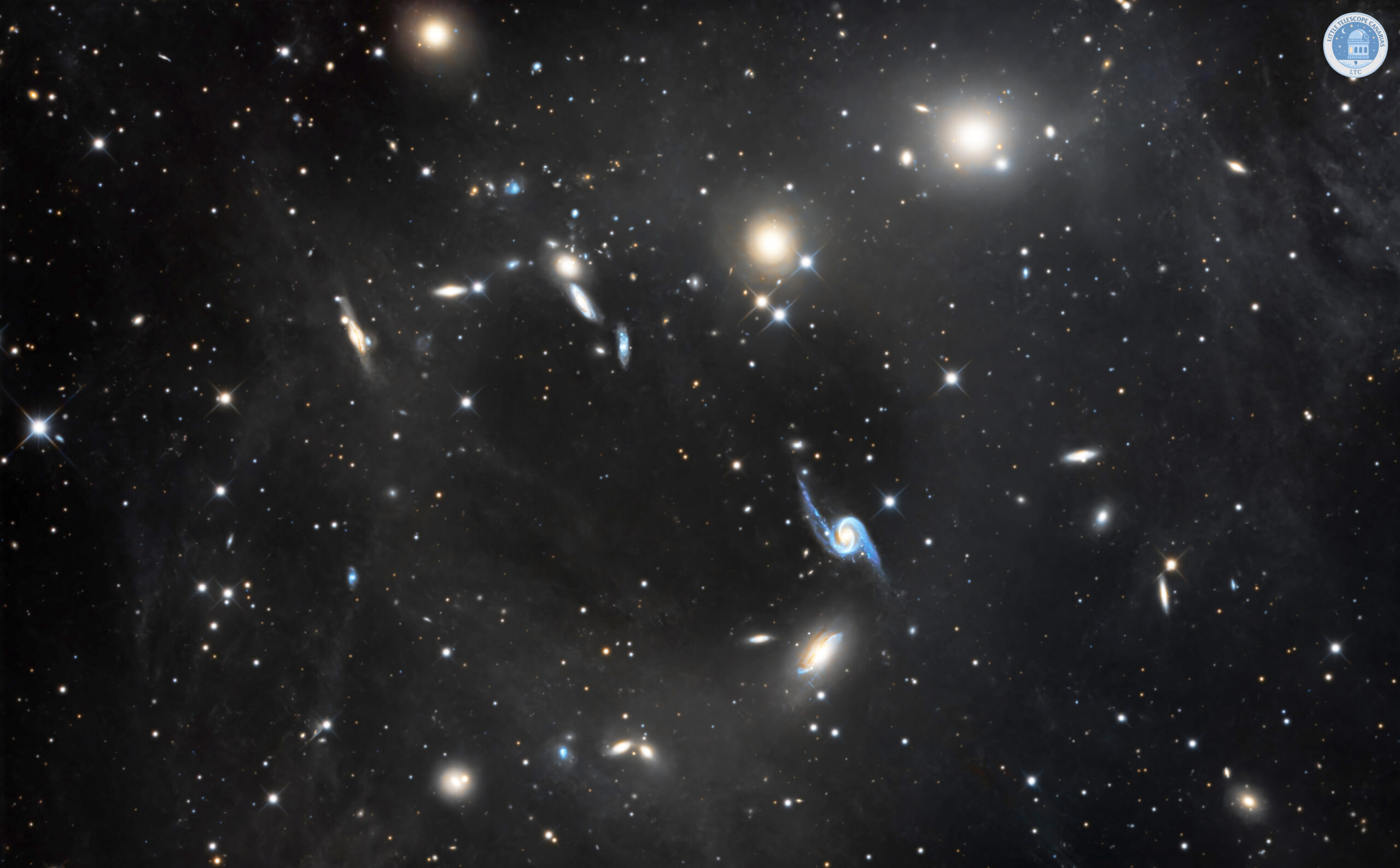
The Arp 65 system corresponds to the spectacular interacting pair formed by NGC 90 and NGC 93, located in the constellation of Andromeda, about 240 million light-years from Earth. The system was included by Halton Arp in his famous Atlas of Peculiar Galaxies because of the strong distortions visible in both galaxies.
The gravitational interaction between these two systems has created distorted structures and tidal tails, making Arp 65 an excellent example of galactic evolution in action.
💥 Gravity reshaping galaxies
Arp 65 represents a dynamic phase in which gravitational forces profoundly alter the morphology of the galaxies involved.
NGC 90 displays extremely distorted and asymmetric spiral arms, rich in gas and star-forming regions. NGC 93, on the other hand, appears more compact and brighter, although it is also affected by the interaction.
These galactic encounters can trigger intense episodes of star formation and redistribute enormous amounts of gas, dust, and stars.
📸 Images from LilTecan
The LilTecan team has captured Arp 65, revealing in detail the distorted arms of NGC 90, the structural contrast with NGC 93, and the delicate streams of matter produced by the gravitational interaction.
🌟 Structure and dynamics of the system
Observational studies have revealed numerous fascinating aspects of this system:
- NGC 90 exhibits strongly distorted spiral arms, a direct result of tidal forces.
- Tidal tails and streams of matter can be seen extending from the main galaxy.
- NGC 93 has a more compact structure, although it is also gravitationally disturbed.
- Numerous ionized hydrogen (H II) regions associated with star formation are present.
- Large amounts of neutral hydrogen (HI) have been detected throughout the system.
- The interaction may eventually lead to a future galactic merger within hundreds of millions of years.
Arp 65 is a magnificent natural laboratory for studying how galactic collisions transform the structure and evolution of galaxies. Its chaotic appearance reflects the enormous influence of gravity on cosmic scales.
Observing this system today is like witnessing a colossal gravitational dance, where billions of stars and enormous clouds of gas are slowly reshaped by the invisible force that governs the universe.