
NGC 253 – the Sculptor Galaxy, a Cosmic Star Factory
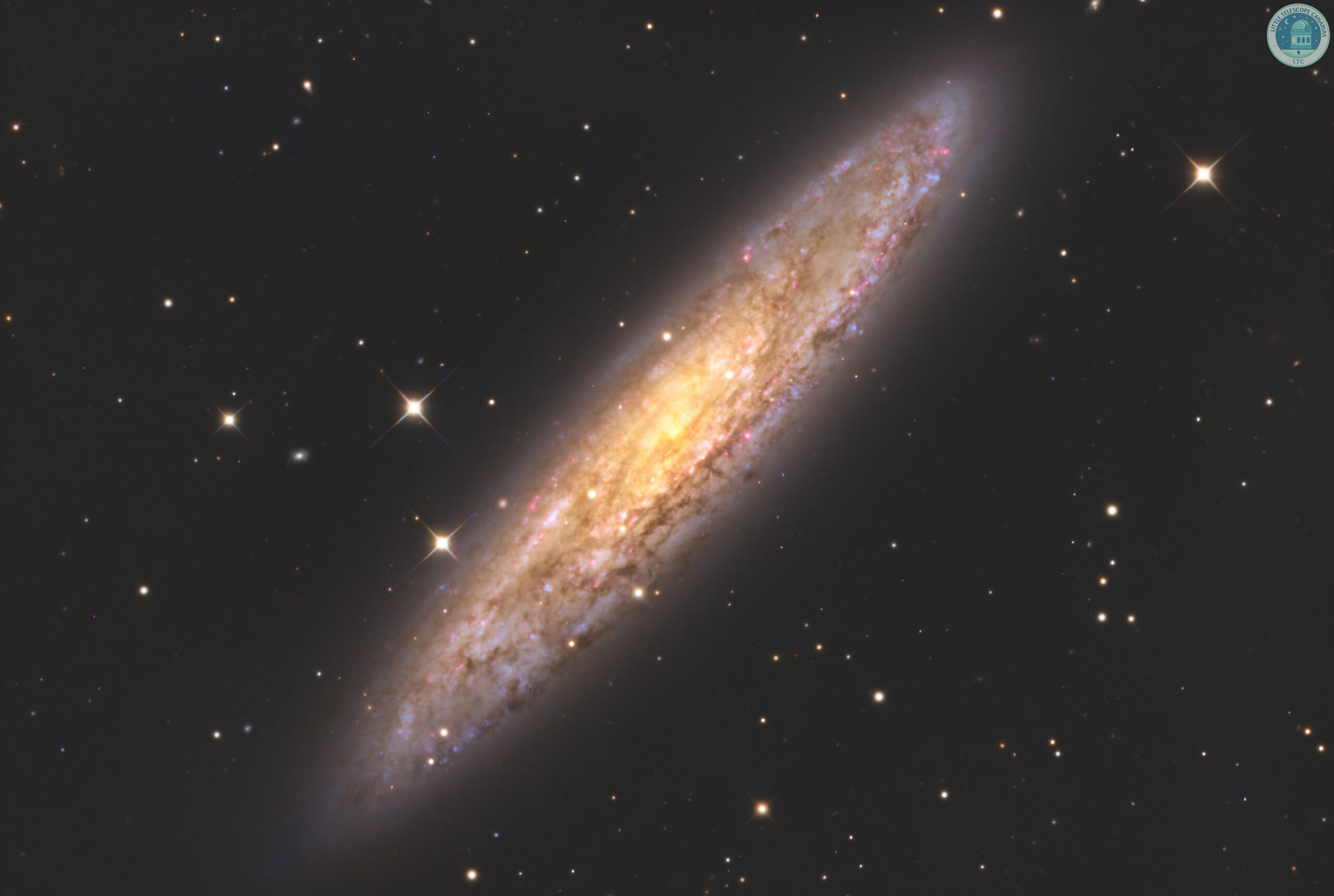
NGC 253, commonly known as the Sculptor Galaxy, it is not only one of the brightest galaxies beyond the Milky Way, but also one of the most active and fascinating objects studied by astronomers.
🌌 A nearby neighbor… on a cosmic scale
NGC 253 lies at a distance of about 11–13 million light-years, in the constellation of Sculptor. In astronomical terms, this makes it a nearby neighbor, and a prominent member of the Sculptor Group, a collection of galaxies close to our own Local Group.
It is a barred spiral galaxy seen almost edge-on, giving it an elongated appearance crossed by striking dust lanes.
📸 Images from LilTecan
The LilTecan team has photographed the galaxy NGC 253 in different wavelengths to highlight the richness of detail in its morphology.
⭐ A galaxy in the midst of stellar frenzy
What truly sets NGC 253 apart is the fact that it is a starburst galaxy—a galaxy forming stars at a rate far higher than normal.
- In its central regions, stars are born several times faster than in the Milky Way.
- It contains vast molecular gas clouds and numerous H II regions, genuine stellar nurseries.
- Many of these newborn stars are massive and short-lived, leading to frequent supernova explosions.
In short: NGC 253 is a star-forming factory operating at full capacity.
💥 Galactic winds and extreme energy
Such intense activity comes at a cost. Supernovae and massive stars generate powerful galactic winds that push gas out from the nucleus into intergalactic space.
These outflows have been observed in:
- X-rays (with telescopes such as Chandra)
- Radio wavelengths
- The infrared, where heated dust shines brightly
This process is crucial for understanding how galaxies regulate their own growth: forming stars too rapidly can eventually starve a galaxy of fuel and shut star formation down.
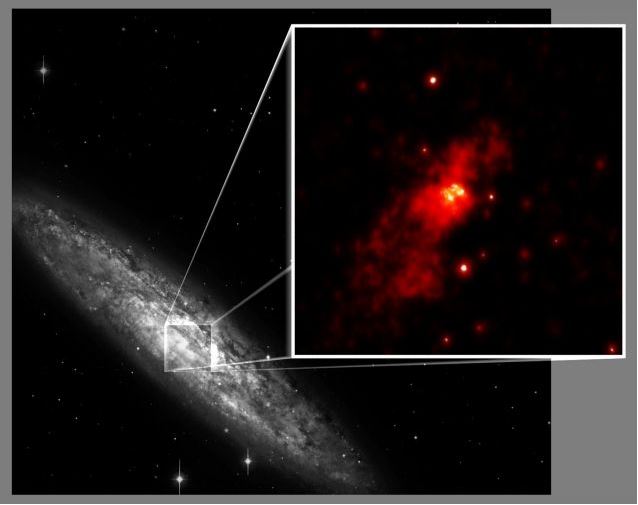
Credits : K. Weaver(LHEA/GSFC), et al.;X-ray Image:SAO,CXC,NASA;Optical Image: ESO
🔭 A first-class astronomical laboratory
Thanks to its proximity and brightness, NGC 253 is a benchmark object for modern astrophysics:
- It emits gamma rays, revealing extremely energetic processes.
- It serves as a key target for studying the interplay between star formation, supernovae, and magnetic fields.
- It acts as a local analogue for distant starburst galaxies, similar to those seen when the Universe was much younger.