
NGC 4565 – The Needle Galaxy
NGC 4565, popularly known as the Needle Galaxy, is one of the most spectacular edge-on spiral galaxies in the night sky. Located in the constellation of Coma Berenices, at an approximate distance of 40–50 million light-years from Earth, it is considered one of the finest examples of a spiral galaxy viewed almost perfectly edge-on. It was discovered by William Herschel on April 6, 1785, and has since become the subject of numerous studies on the structure of galactic disks and central bulges.
Its remarkable orientation allows astronomers to observe in exceptional detail the thin dust lane running across the entire galactic disk, making it a benchmark object for understanding the distribution of gas, dust, and stellar populations in spiral galaxies.
💥 A Spiral Galaxy Seen Perfectly Edge-On
NGC 4565 is classified as a type Sb spiral galaxy viewed at an inclination close to 90°, allowing its vertical structure to be studied in a level of detail that is impossible to achieve in face-on galaxies.
Its most distinctive feature is the spectacular equatorial dust lane, which visually divides the bright stellar disk into two halves. This dark band absorbs light from the central bulge and inner disk, revealing the distribution of interstellar material throughout the galaxy.
Observations across multiple wavelengths have shown that NGC 4565 possesses a box/peanut-shaped bulge, a structure widely interpreted as the signature of a galactic bar viewed edge-on. This characteristic has made NGC 4565 an important laboratory for investigating the secular evolution of spiral galaxies.
📸 Images from LilTecan
The LilTecan team has captured NGC 4565, revealing the extraordinary thinness of its stellar disk, the prominent dust lane crossing its nucleus, and the extensive stellar halo surrounding the galaxy. Long-exposure imaging also reveals numerous distant background galaxies scattered across the field, creating an impressive sense of cosmic depth.
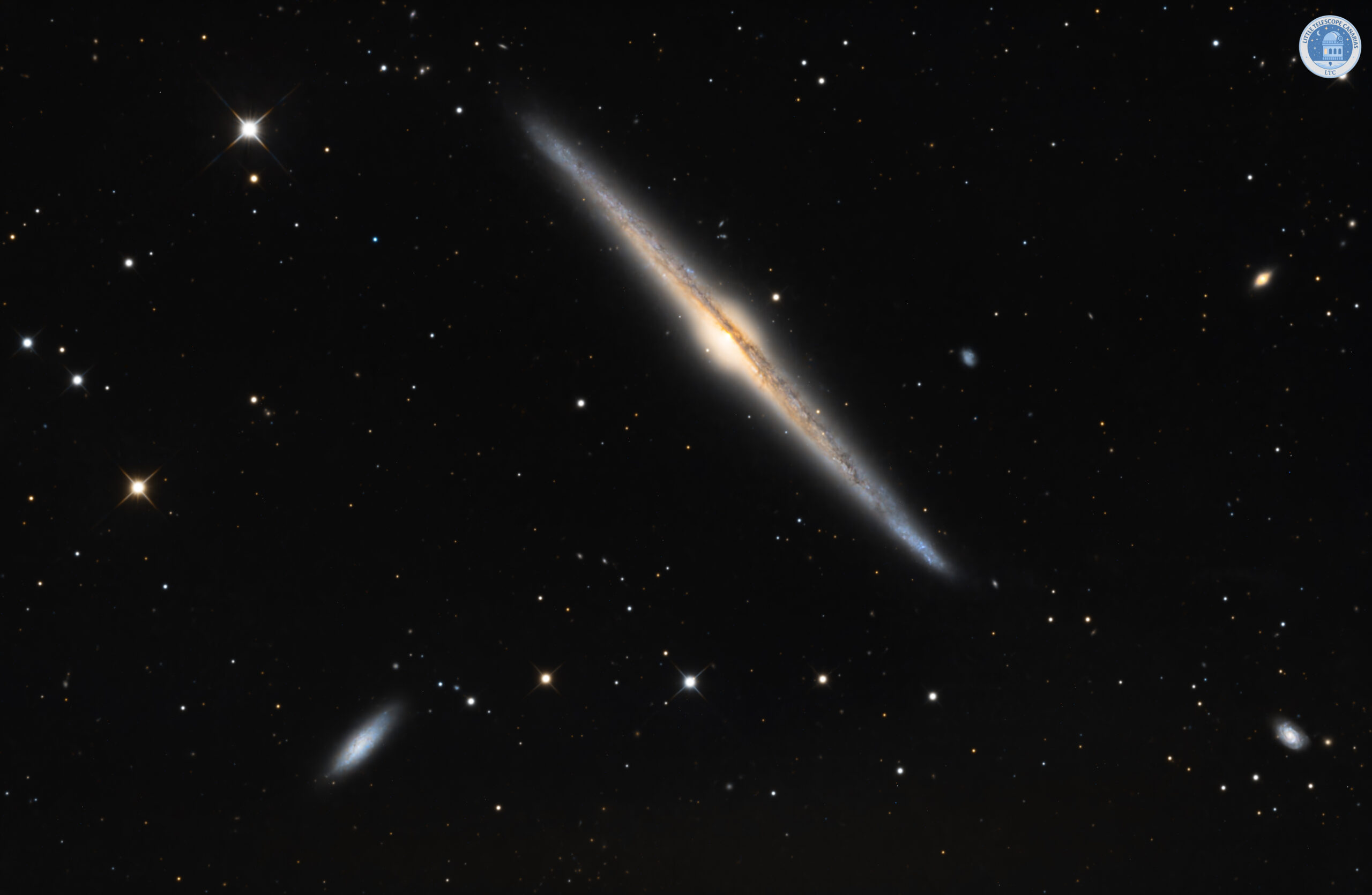
🌟 Structure and Main Characteristics
Observational studies have identified several remarkable properties of this galaxy:
- It is classified as an SA(s)b spiral galaxy viewed almost perfectly edge-on.
- It is located in the constellation of Coma Berenices, approximately 40–50 million light-years from Earth.
- It was discovered by William Herschel on April 6, 1785.
- It exhibits one of the most prominent equatorial dust lanes known in any spiral galaxy.
- Its central bulge has a distinctive box/peanut morphology, considered strong evidence for an edge-on galactic bar.
- It is surrounded by an extensive stellar halo and a rich system of globular clusters, which are used to study the formation and evolution of massive galaxies.
- Its nearly perfect edge-on orientation makes it one of the most important objects for investigating the three-dimensional structure of galactic disks.
NGC 4565 is one of the finest known examples of an edge-on spiral galaxy. Its spectacular geometry has enabled astronomers to study the distribution of interstellar dust, the structure of galactic bulges, and the dynamical evolution of spiral disks with remarkable precision. More than simply a beautiful deep-sky object, it serves as a natural laboratory for understanding the architecture of galaxies similar to our own Milky Way.
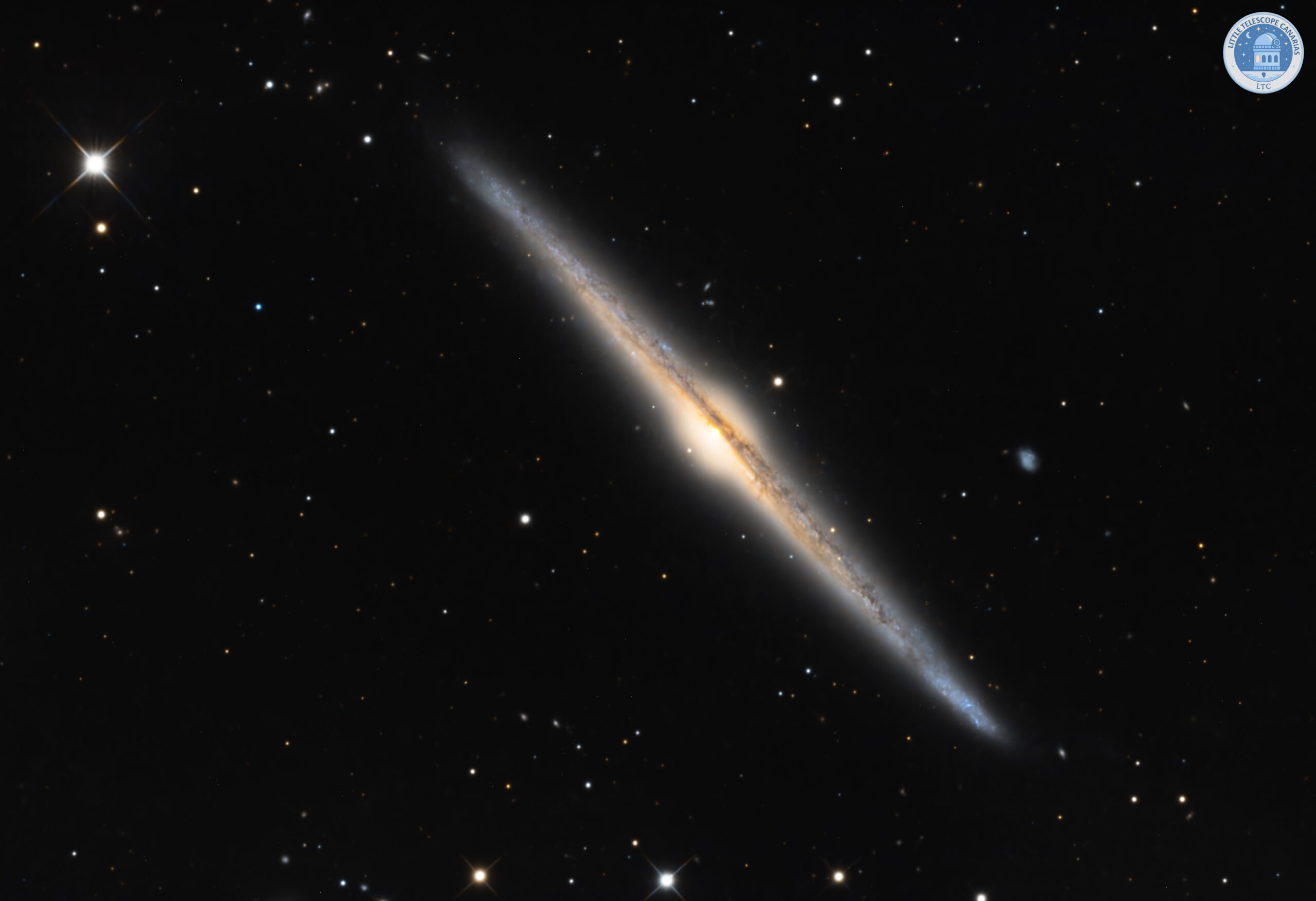
Observing NGC 4565 today is like viewing an immense city of hundreds of billions of stars from a privileged perspective. Its razor-thin luminous disk, bisected by a dark ribbon of dust, offers a view that may closely resemble what our own Milky Way would look like if seen from tens of millions of light-years away.