
NGC 5139 – Omega Centauri, the Giant of the Globular Clusters
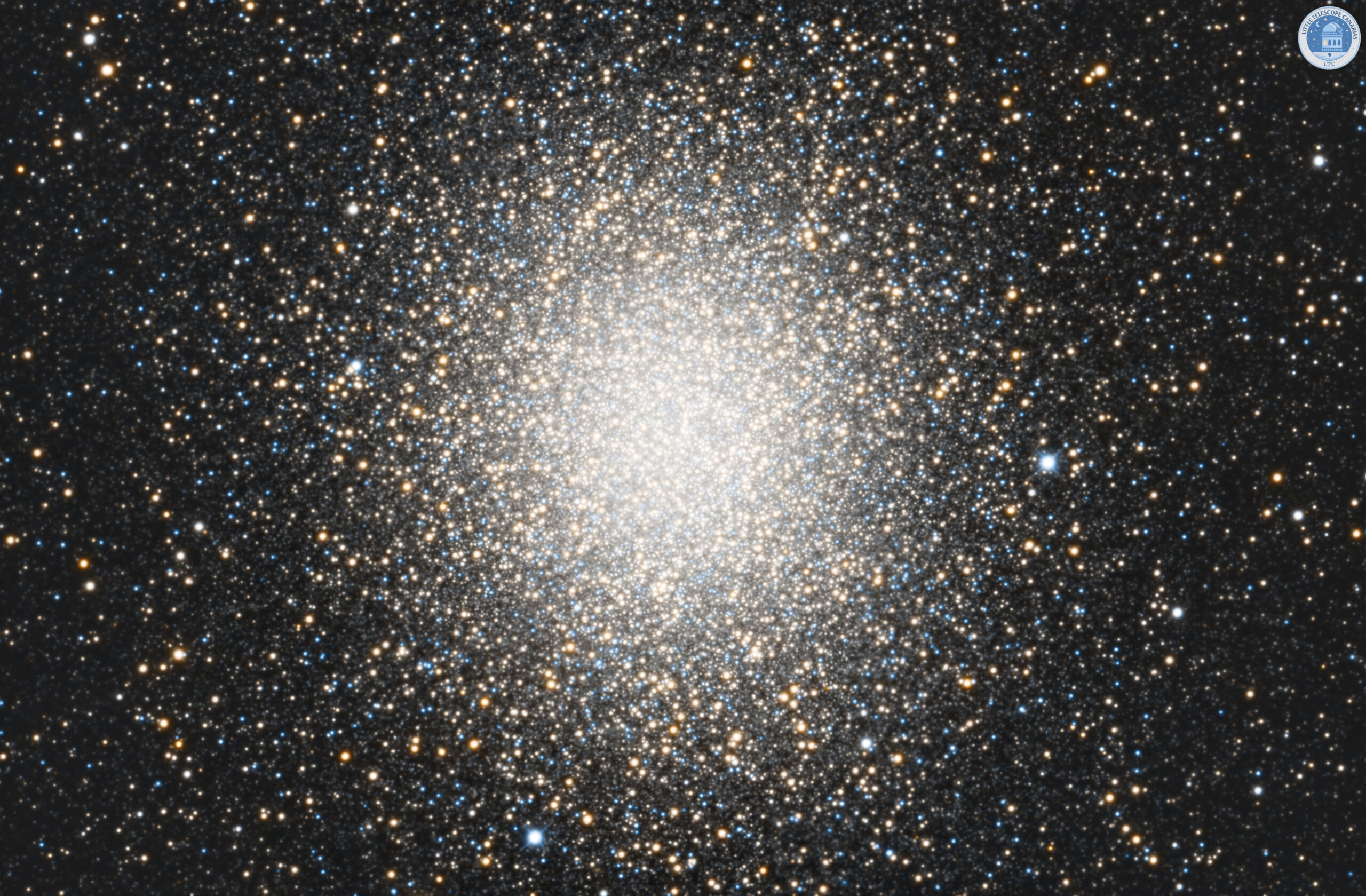
NGC 5139, popularly known as Omega Centauri, is the largest and brightest globular cluster in the Milky Way. Located in the constellation of Centaurus, about 15,800 light-years from Earth, it contains several million stars concentrated within an enormous gravitational sphere.
With an approximate diameter of 150 light-years, Omega Centauri is visible to the naked eye from dark southern hemisphere skies and has been studied for centuries because of its unique characteristics..
💥 A globular cluster… or the core of a galaxy?
Omega Centauri is extraordinary because it exhibits properties unusual for a classical globular cluster. Its stars show different ages and chemical compositions, something not normally found in this type of object.
For this reason, many astronomers believe it could actually be the remaining core of an ancient dwarf galaxy that was absorbed by the Milky Way billions of years ago.
In addition, some studies suggest the possible presence of an intermediate-mass black hole in its central region, although this remains an active topic of research.
📸 Images from LilTecan
The LilTecan team has captured Omega Centauri, revealing its impressive stellar concentration, where countless stars form a brilliant core surrounded by extensive outer regions.
🌟 Structure and main characteristics
Observational studies have identified numerous remarkable aspects of this object:
- It is the most massive globular cluster in the Milky Way.
- It contains several million gravitationally bound stars.
- It displays multiple stellar populations with different ages and metallicities.
- Its diameter is approximately 150 light-years.
- Some research suggests the possible existence of an intermediate-mass black hole in its core.
- It may be the remnant core of a dwarf galaxy absorbed by the Milky Way.
Omega Centauri is one of the most fascinating objects in the southern sky and a key piece in understanding the formation and evolution of our galaxy. Its structural and chemical complexity challenges the classical definition of a globular cluster.
Observing this gigantic stellar swarm today is like contemplating a relic of the early universe, where millions of ancient stars have remained bound together for billions of years, revealing clues about the deepest history of the Milky Way.