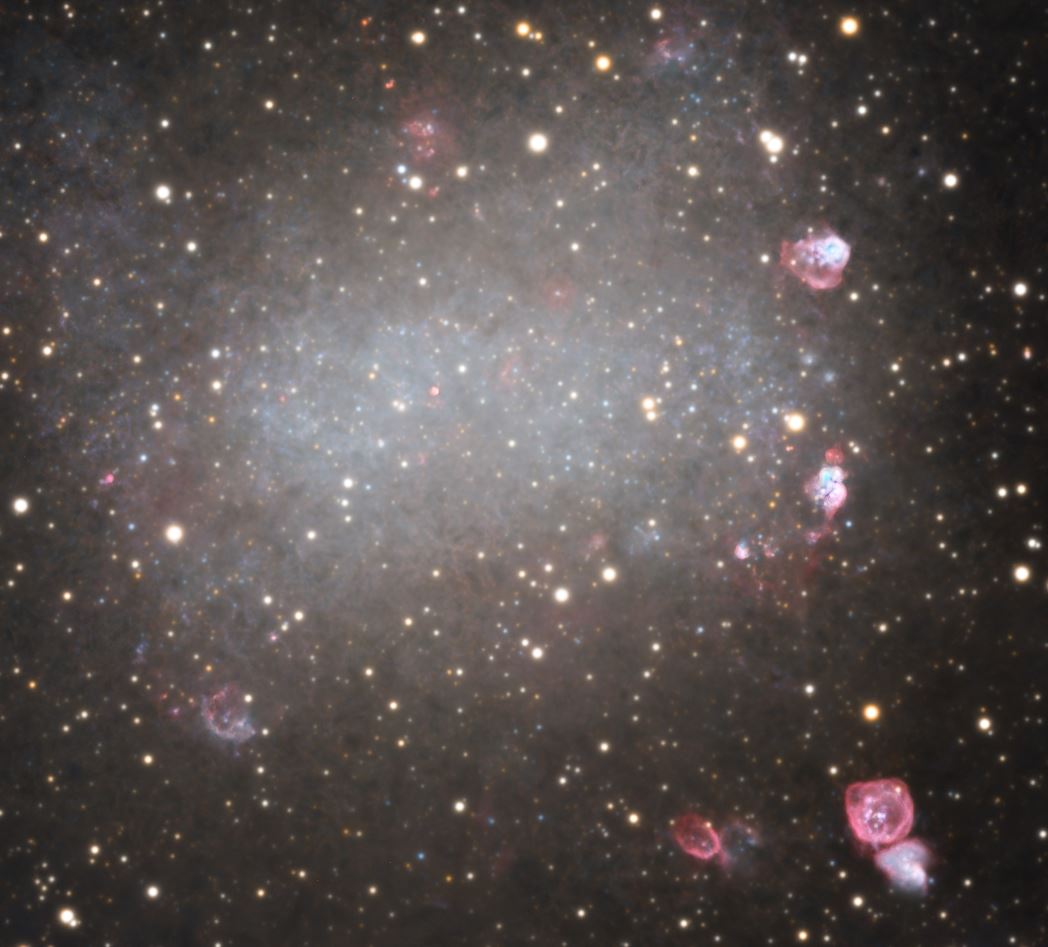
NGC 6822 – Barnard’s Galaxy and Its Nebular Treasures
In the constellation of Sagittarius, just 1.6 million light-years from Earth, lies one of the closest and most fascinating dwarf galaxies: NGC 6822, also known as Barnard’s Galaxy. Discovered in 1884 by Edward Emerson Barnard, this Local Group object is a true window into the cosmic past and a laboratory for studying star formation.
A dwarf galaxy with intense activity
NGC 6822 is an irregular dwarf galaxy, smaller than the Milky Way but remarkably rich in emission nebulae and star-forming regions. Its irregular shape, far from being a flaw, reflects the intense internal processes that drive its evolution and make it an excellent example of the primitive galaxies that populated the early universe.
Within it, massive HII regions (clouds of ionized hydrogen) and supernova remnants stand out, illuminating its structure and making this galaxy an object of both scientific interest and visual beauty.
📸 Images from LilTecan
The team at LilTecan has captured NGC 6822 using a combination of LRGB and narrowband filters (Hα, SII, and OIII).
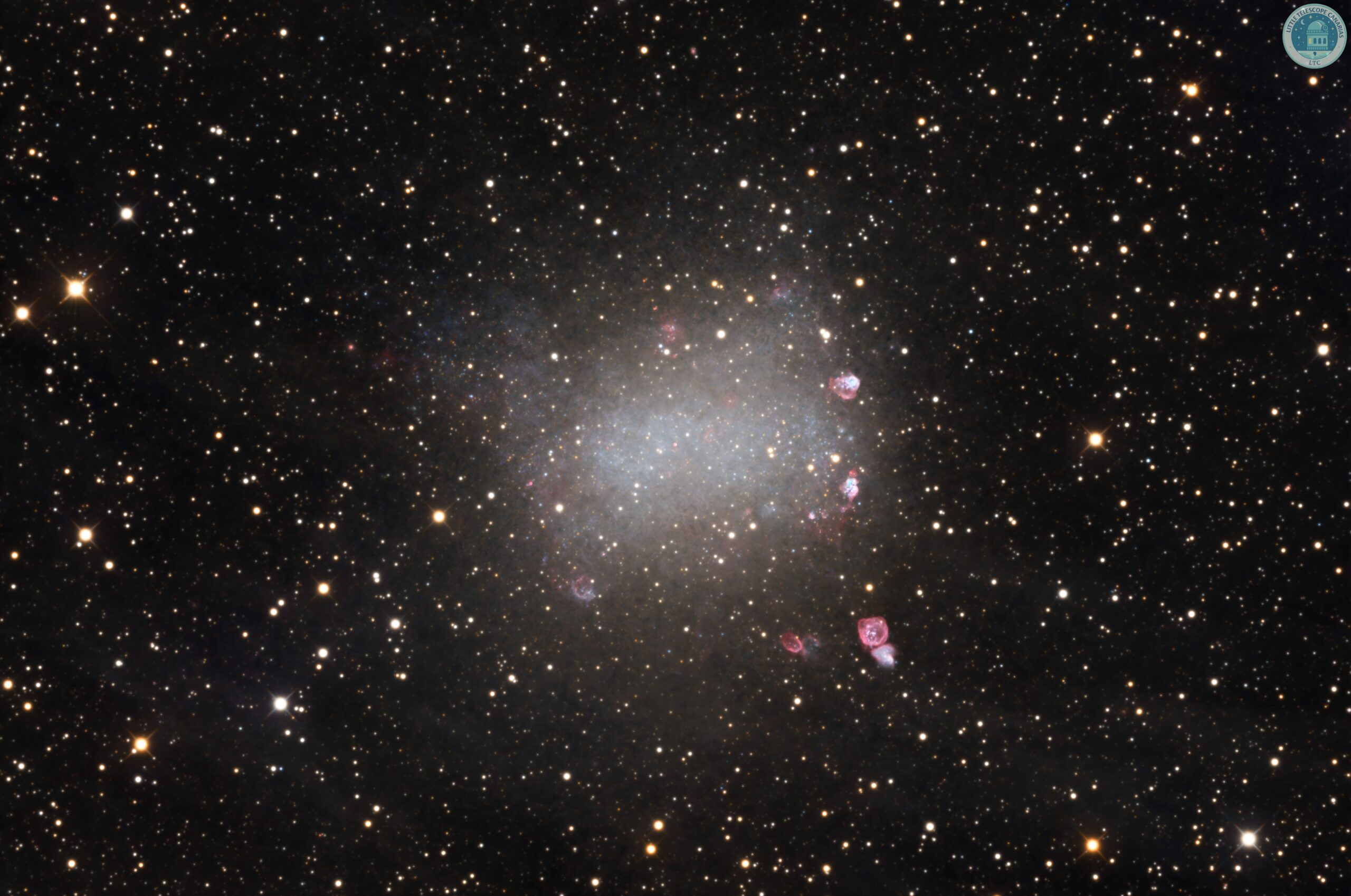
- LRGB (Luminance + Red, Green, Blue): reveals the natural appearance of the galaxy, with its young blue stars and faint stellar arms.
- Hα (Hydrogen-alpha): highlights the emission nebulae and regions of intense star formation.
- SII (Ionized Sulfur): complements the HII regions, providing details on the ionization processes in the most active environments.
- OIII (Doubly Ionized Oxygen): reveals energetic filaments and areas where gas glows under the radiation of massive stars.
This combination of imaging techniques allows us to appreciate both the overall structure of the galaxy and the internal nebulae, which make it a gem for observation and scientific analysis.
✨ Cosmic science and beauty
The study of NGC 6822 helps us understand how dwarf galaxies evolve, how stars are born and destroyed, and how these processes enrich the interstellar medium with new chemical elements. Visually, its internal nebulae turn it into a unique spectacle where science meets the natural beauty of the cosmos.