
NGC 6905 – The “Blue Flash” Nebula in Delphinus
The planetary nebula NGC 6905, known as the “Blue Flash Nebula,” is located in the constellation Delphinus and was discovered by William Herschel in 1784. Its spectacular blue hue and elongated shape make it a fascinating deep-sky object.
💥 The end of star
Planetary nebulae like NGC 6905 are capsules of destiny for stars similar to the Sun: once they exhaust their nuclear fuel, they expel their outer layers and leave behind a hot core that illuminates them.
At the heart of NGC 6905 lies a Wolf–Rayet–type star, classified as [WO2], with an effective temperature exceeding 150,000 K. This immense ultraviolet energy ionizes the expelled gas, producing the distinctive blue glow that gives the nebula its nickname.
📸 Images from LilTecan
The LilTecan team has photographed the planetary nebula NGC 6905 in different wavelengths to highlight the richness of detail in its morphology.
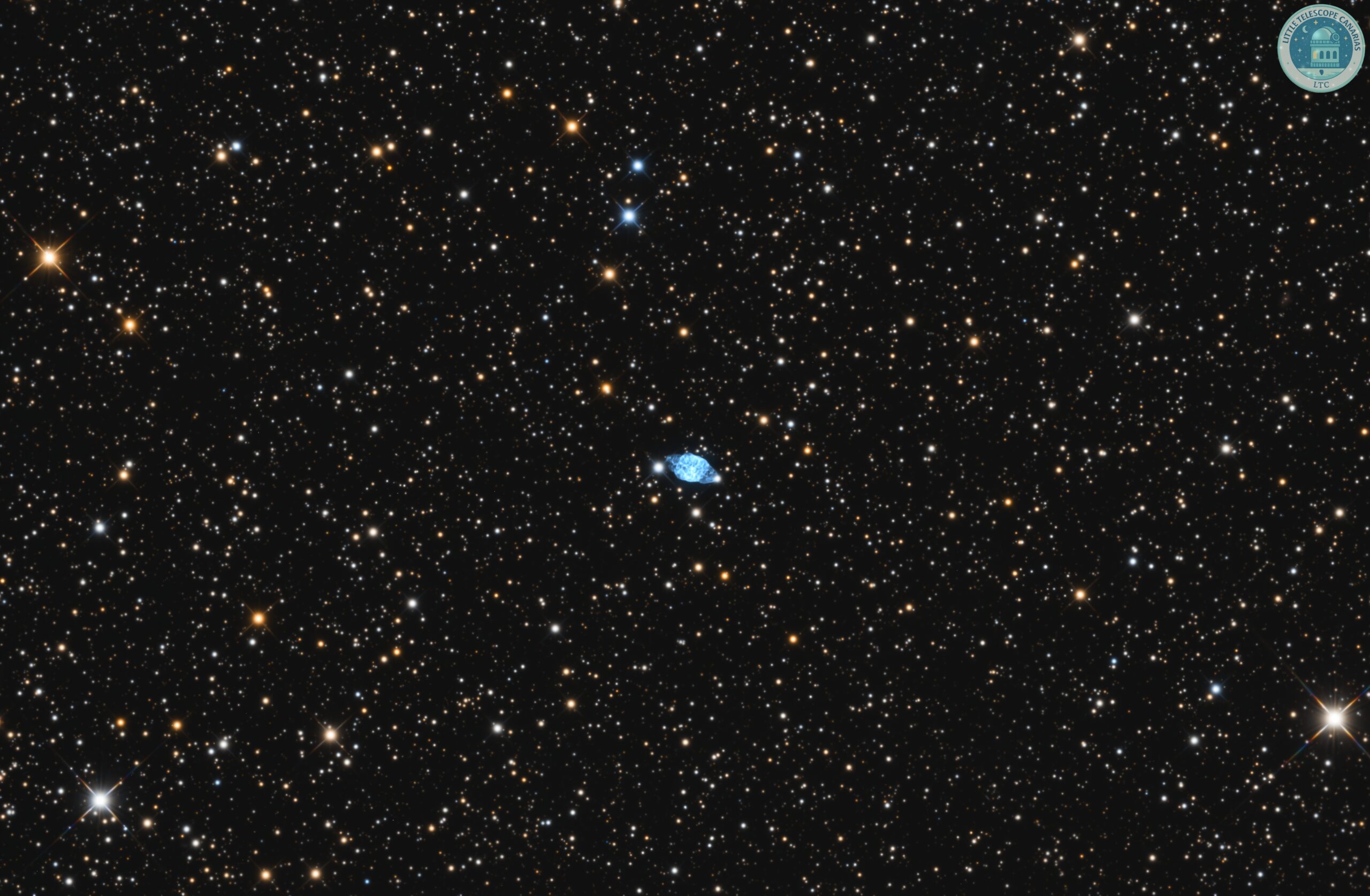
A High-Ionization Spectacle
The most recent study, based on observations with the Nordic Optical Telescope (NOT), has revealed in detail the structure of NGC 6905:
- The nebula shows a rounded central cavity, surrounded by V-shaped structures oriented northwest and southeast, with a total extension of about 80 arcseconds (≈ 1 pc).
- It presents low-ionization knots at the ends of these V’s, which expand faster than the rest of the nebula.
- More than 20 emission lines characteristic of the Wolf–Rayet type have been identified, as well as the typical “WR bumps” (violet, blue, red), confirming the [WO2] classification of the central star — HD 193949.
- The average electron density is around 500 cm⁻³, and the gas temperature is about 13,000 K.
- Photoionization modeling (using CLOUDY) estimates a total gas mass between 0.31 and 0.47 M☉, and a dust mass of ≈ 0.002 M☉, equivalent to a dust-to-gas ratio of 0.4–0.7%.
All of this suggests that the progenitor star had an initial mass of approximately 1 M☉, placing NGC 6905 among the Wolf–Rayet planetary nebulae with the lowest initial mass.
NGC 6905 — the Blue Flash Nebula — is a celestial jewel that combines visual beauty with scientific importance. From its morphology and WR spectrum to its mass and internal structure, it teaches us how stars like the Sun die, and how they enrich the cosmos with new elements.
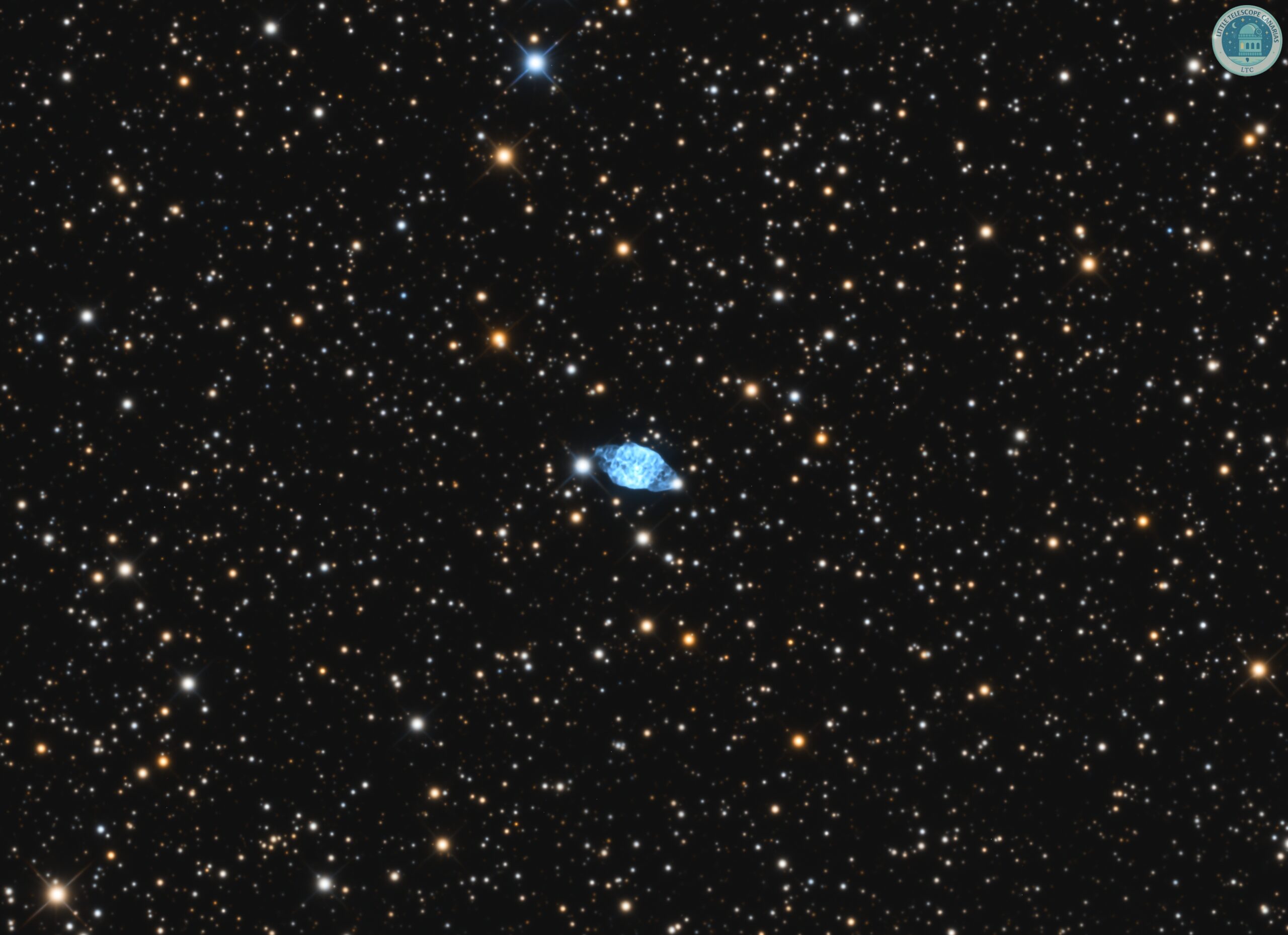
To observe it today is to look toward the future of our own Solar System and admire the endless cycle of stellar matter.