
NGC 6946 – The Fireworks Galaxy
At the border between the constellations of Cepheus and Cygnus, about 22 million light-years away, lies one of the most fascinating galaxies in the deep sky: NGC 6946, popularly known as the Fireworks Galaxy. Its nickname comes from the unusually high number of supernovae observed within it, a cosmic display that lights up its spiral arms and has captivated astronomers for generations.
An active spiral full of life
NGC 6946 is an intermediate spiral galaxy, seen almost face-on, allowing us to clearly admire its spiral arms filled with star-forming regions. In the last century, astronomers have recorded more than ten supernovae in this galaxy—an extraordinarily high number compared to most known galaxies.
This makes NGC 6946 a key object for studying the processes of stellar evolution and the death of massive stars, as well as the impact of these events on the gas and dust that make up its interstellar medium.
📸 Images from LilTecan
The LilTecan team has captured NGC 6946 using advanced astrophotography techniques:
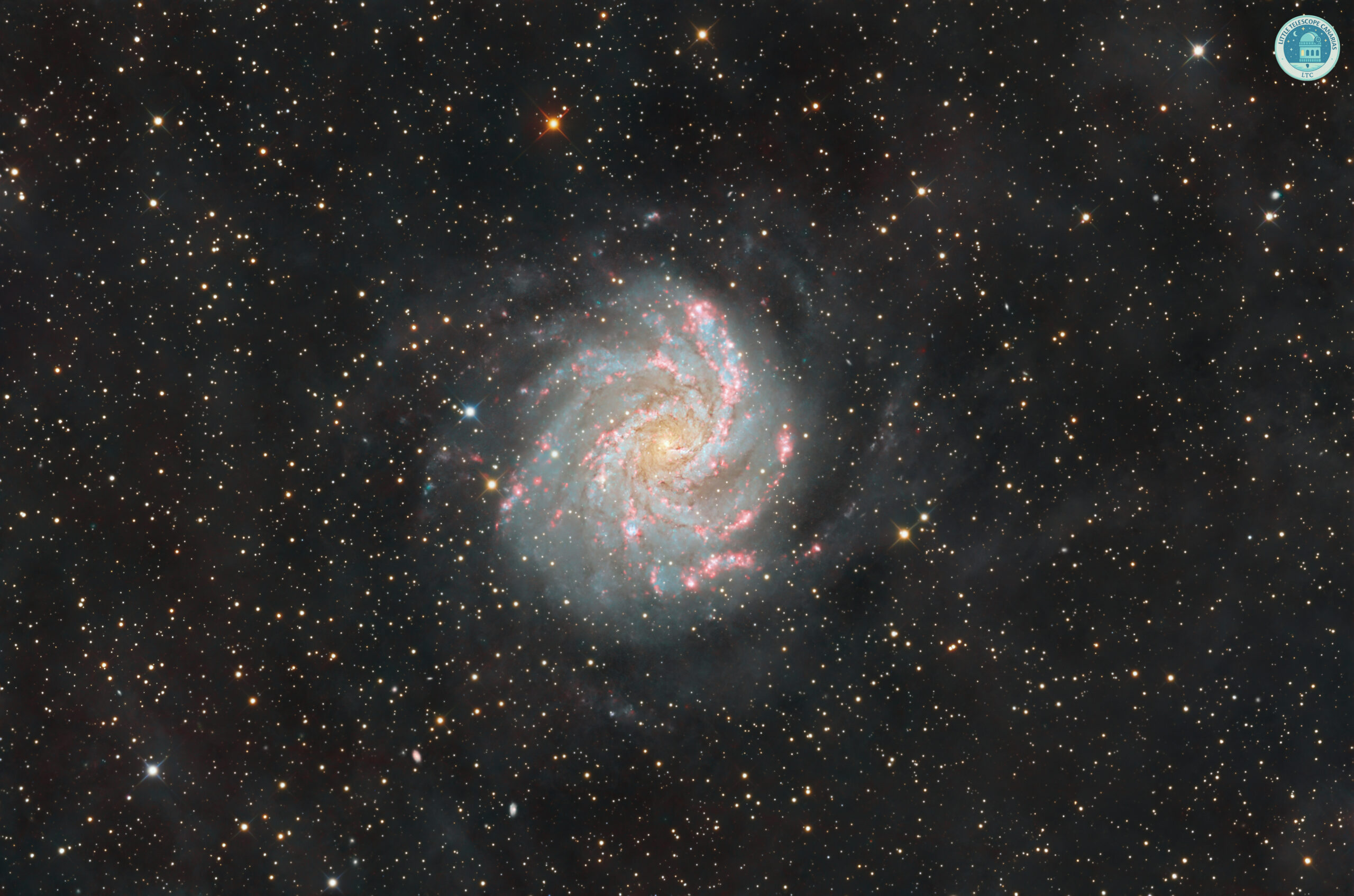
- Broadband filters (RGB and Luminance): reveal the natural beauty of its spiral arms and bright core.
- Narrowband filters (Hα, SII, OIII): highlight the internal emission nebulae and trace the gases surrounding the most active star-forming regions.
- In particular, the SII filter is also valuable for studying high-redshift galaxies, as it provides insights into ionization processes in extreme environments.
By combining these techniques, we can appreciate not only the detailed structure of NGC 6946 but also the dynamics of the gases fueling its intense stellar activity.
✨ Science and cosmic spectacle
The Fireworks Galaxy is a true natural laboratory for studying star formation, galactic evolution, and the frequency of supernovae. At the same time, its dazzling appearance makes NGC 6946 a perfect example of how science and beauty converge in a single celestial object.