NGC 7331 – A Majestic Spiral and Its New Type Ia Supernova
In the constellation of Pegasus, about 40 million light-years from Earth, lies NGC 7331, one of the brightest and most studied spiral galaxies outside our Local Group. Discovered in 1784 by William Herschel, NGC 7331 is often considered a close analog of the Milky Way, making its study especially valuable for understanding the evolution of our own galaxy.
A Spiral Reflecting the Milky Way
With a diameter of approximately 100,000 light-years, NGC 7331 displays a well-defined spiral structure, with arms rich in star-forming regions. It is the dominant member of the so-called “Deer Lick Group” of galaxies, a collection that appears clustered in the sky but lies at very different distances.
Its brightness and wealth of detail make it a prime target for both scientific research and advanced astrophotography.
💥 The Supernova SN 2025rbs
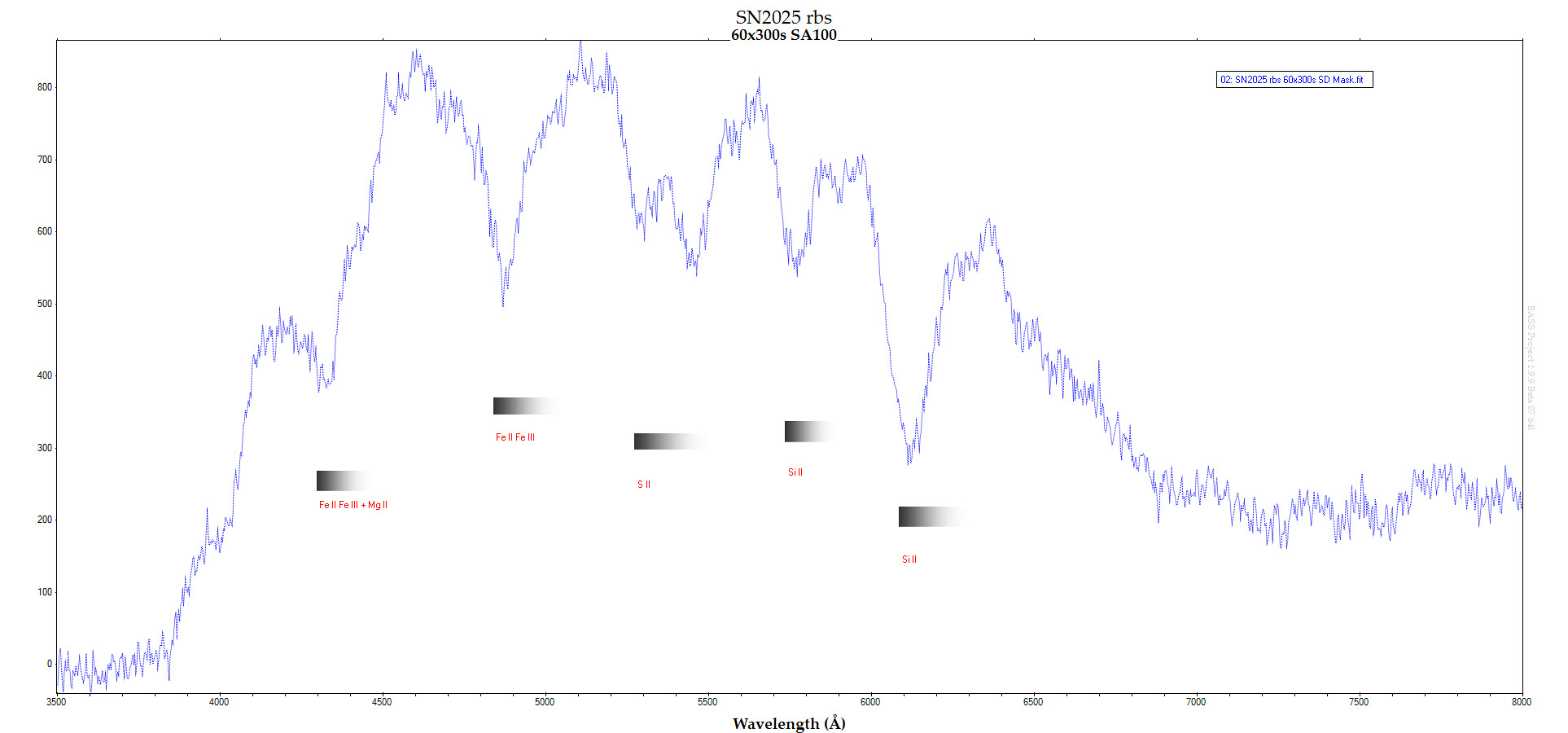
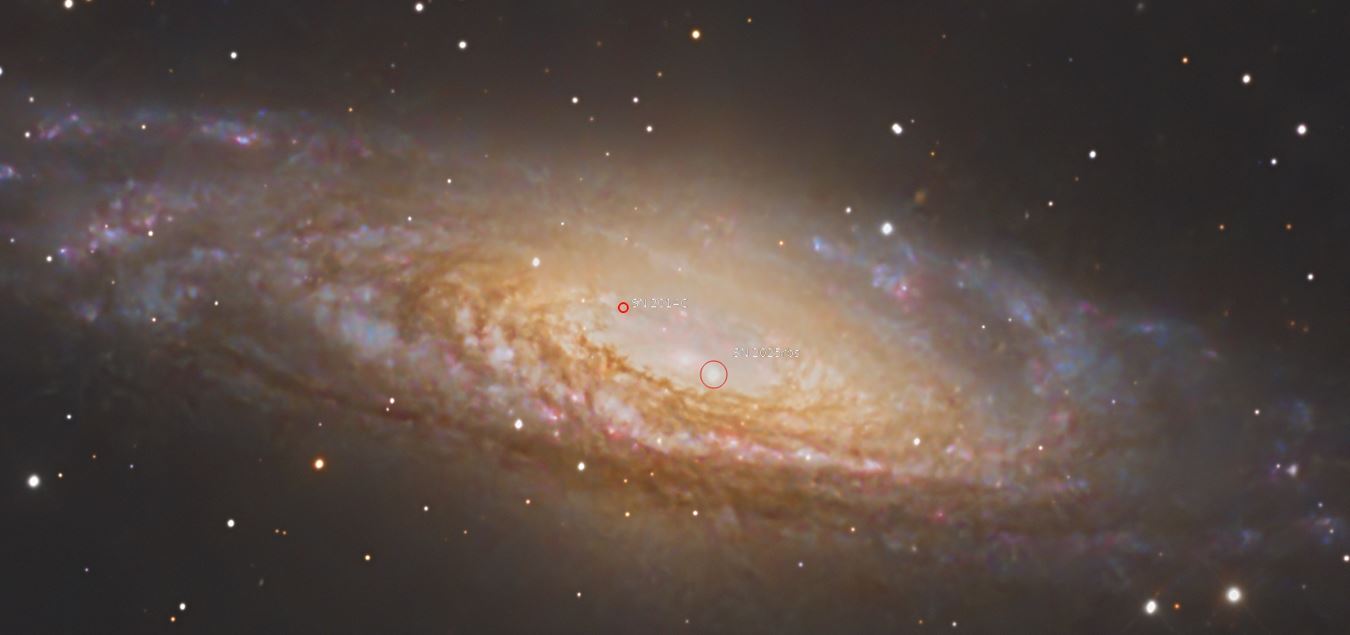
In 2025, astronomers detected in NGC 7331 a Type Ia supernova, designated SN 2025rbs. This type of supernova occurs when a white dwarf in a binary system accumulates enough matter from its companion star to reach a critical threshold, triggering a thermonuclear explosion.
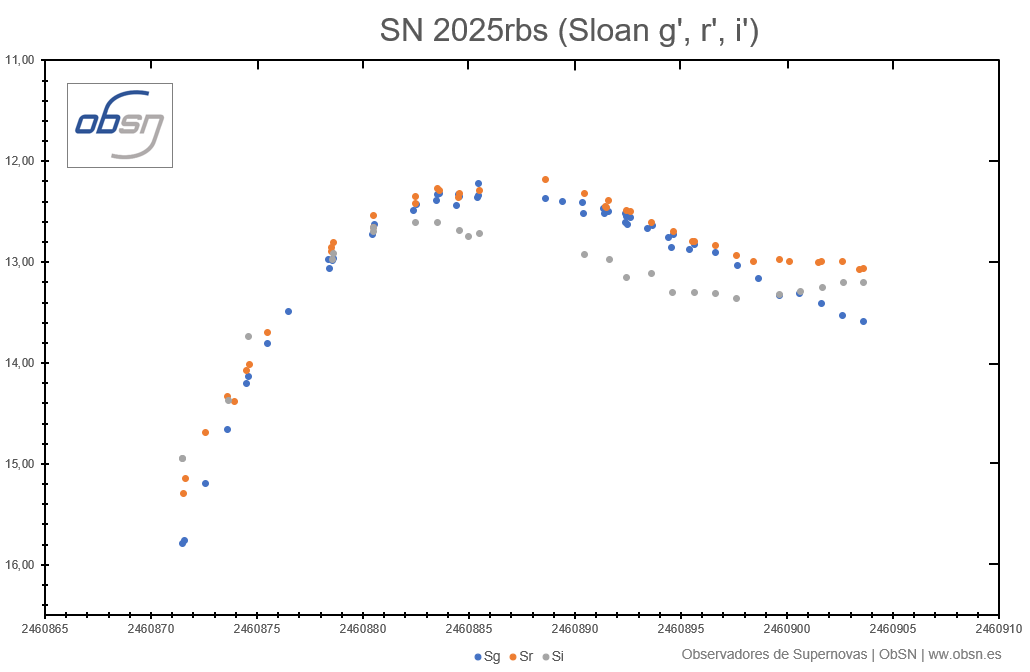
(ObSN)
Type Ia supernovae are crucial in astrophysics because they serve as “standard candles”, allowing scientists to measure cosmic distances and study the expansion of the universe. The appearance of SN 2025rbs in NGC 7331 provides a unique opportunity to analyze the physics of these explosions in a galaxy so similar to our own.
📸 Images from LilTecan
The team at LilTecan has captured stunning images of NGC 7331 using LRGB, Hα, and SII filters, highlighting both the galaxy’s structure and the phenomena associated with the recent supernova.
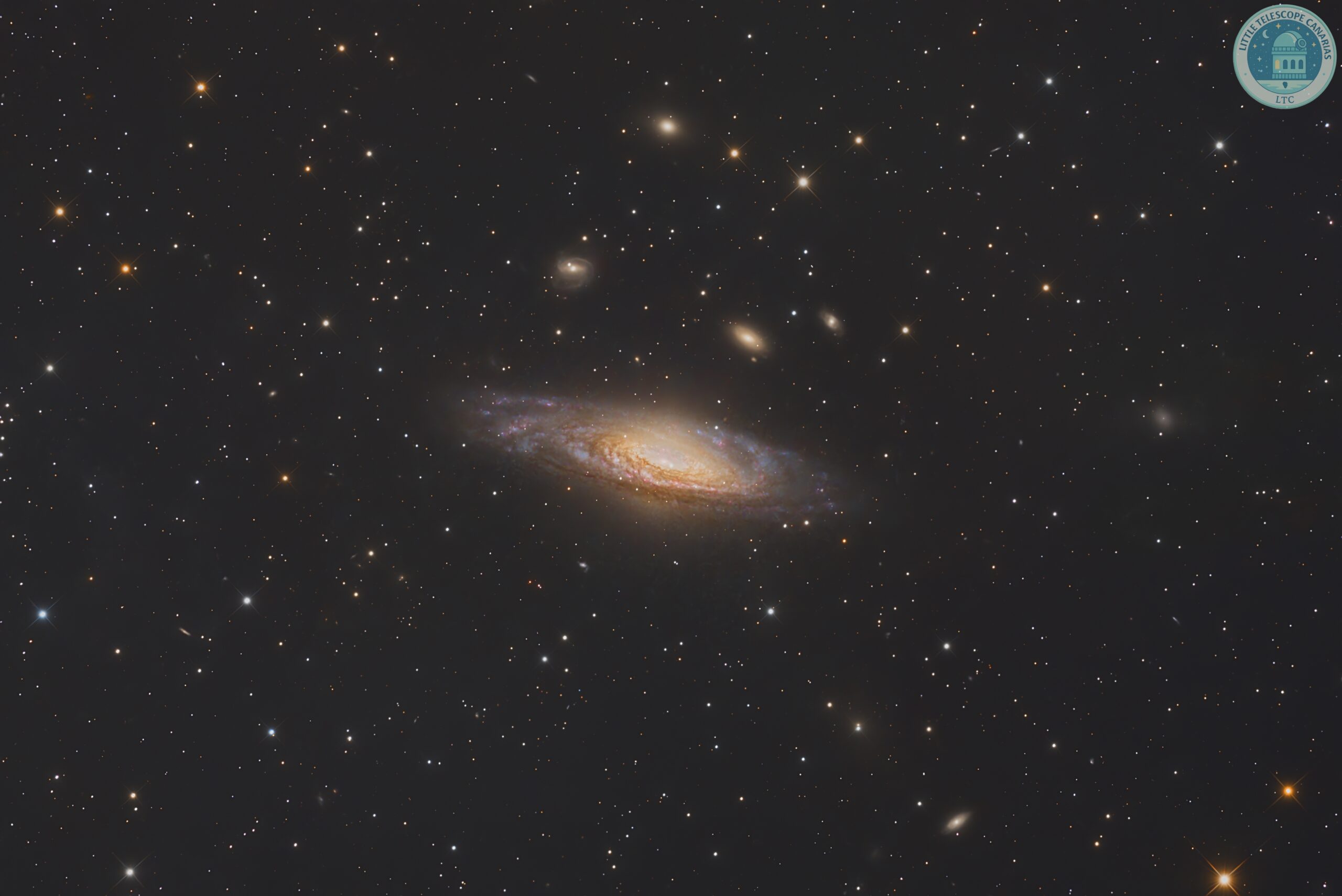
- LRGB (Luminance + Red, Green, Blue): reveals the full spiral structure, with its arms and bright core.
- Hα (Hydrogen-alpha): emphasizes the active star-forming regions in the spiral arms.
- SII (Ionized Sulfur): provides additional insight into the ionized gases in high-energy regions, complementing the view of the supernova and other internal stellar processes.
Thanks to these techniques, it is possible to highlight both the aesthetic beauty of the galaxy and the astrophysical phenomena of great scientific interest that it hosts.
✨ Cosmic Science and Wonder
NGC 7331 is much more than a bright spiral galaxy: it is a natural laboratory for studying star formation, galactic evolution, and the physics of supernovae. The observation of SN 2025rbs not only reminds us of the destructive and creative power of stars but also of the utility of these events as cosmic beacons that help us measure the universe.
At LilTecan, we combine research, outreach, and professional astrophotography to bring the most fascinating cosmic objects closer to everyone.