
Draco Triplet – An Elegant Group of Galaxies
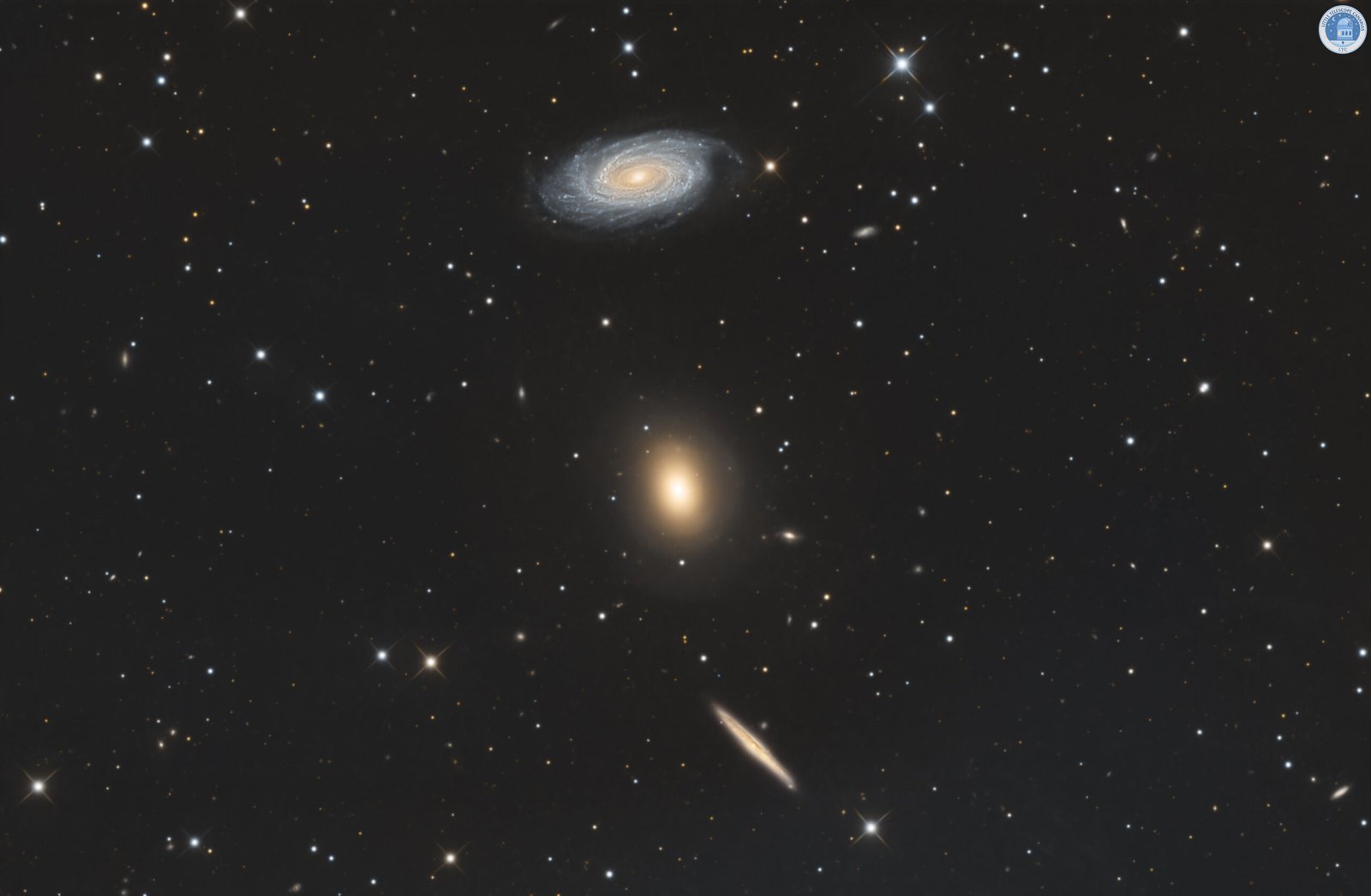
The Triplete de Draco, known as the Draco Triplet, is a striking group of galaxies located in the constellation of Draco, about 100 million light-years from Earth. This group is mainly composed of three galaxies: NGC 5981, NGC 5982, and NGC 5985, which appear aligned in the sky, offering a very attractive visual contrast.
Although they are not undergoing strong interactions, their apparent proximity makes them a classic deep-sky target.
💥 Galactic diversity in a single frame
The Draco Triplet is particularly interesting because it brings together different types of galaxies in the same region:
- NGC 5981 is an edge-on spiral galaxy with a prominent dust lane.
- NGC 5982 is a dominant elliptical galaxy with a smooth profile and no visible spiral structure.
- NGC 5985 is a nearly face-on spiral galaxy with well-defined arms.
This contrast allows astronomers to study how different galactic morphologies coexist in the universe.
📸 Images from LilTecan
The LilTecan team has captured the Draco Triplet, highlighting the alignment of its galaxies and the structural differences between each of them.
🌟 Structure and group characteristics
Observational studies highlight several key aspects:
- The three galaxies show a very aesthetic apparent alignment in the sky.
- There is a strong morphological diversity, from spirals to ellipticals.
- No clear signs of strong gravitational interaction are observed, though subtle influences may exist.
- Their different inclinations allow the study of various galactic viewing angles.
- It is an excellent example of a visual group rather than a strongly interacting physical system, although their distances are comparable.
The Draco Triplet is a deep-sky gem that combines visual beauty with scientific value. Its composition makes it an ideal target for both astrophotography and comparative galaxy studies.
Observing it today is like seeing three distinct galaxies sharing the same cosmic stage, reminding us of the immense diversity of forms that galaxies can take in the universe.