
NGC 6804 – A Blue-Green Jewel in the Heart of Aquila
NGC 6804 is a planetary nebula located in the constellation of Aquila, at an estimated distance of 4,000 to 5,000 light-years from Earth. It was discovered by William Herschel on July 25, 1791, and was later included in the New General Catalogue (NGC) compiled by John Louis Emil Dreyer. Although relatively small, it stands out for its high surface brightness and intricate internal structure, making it an excellent target for medium-sized telescopes and high-resolution astrophotography.
NGC 6804 represents one of the final stages in the evolution of a Sun-like star. After exhausting its nuclear fuel, the progenitor star expelled its outer layers into space, creating an expanding shell of gas while its remaining core continues its evolution toward becoming a white dwarf.
💥 A Gaseous Shell Rich in Fine Details
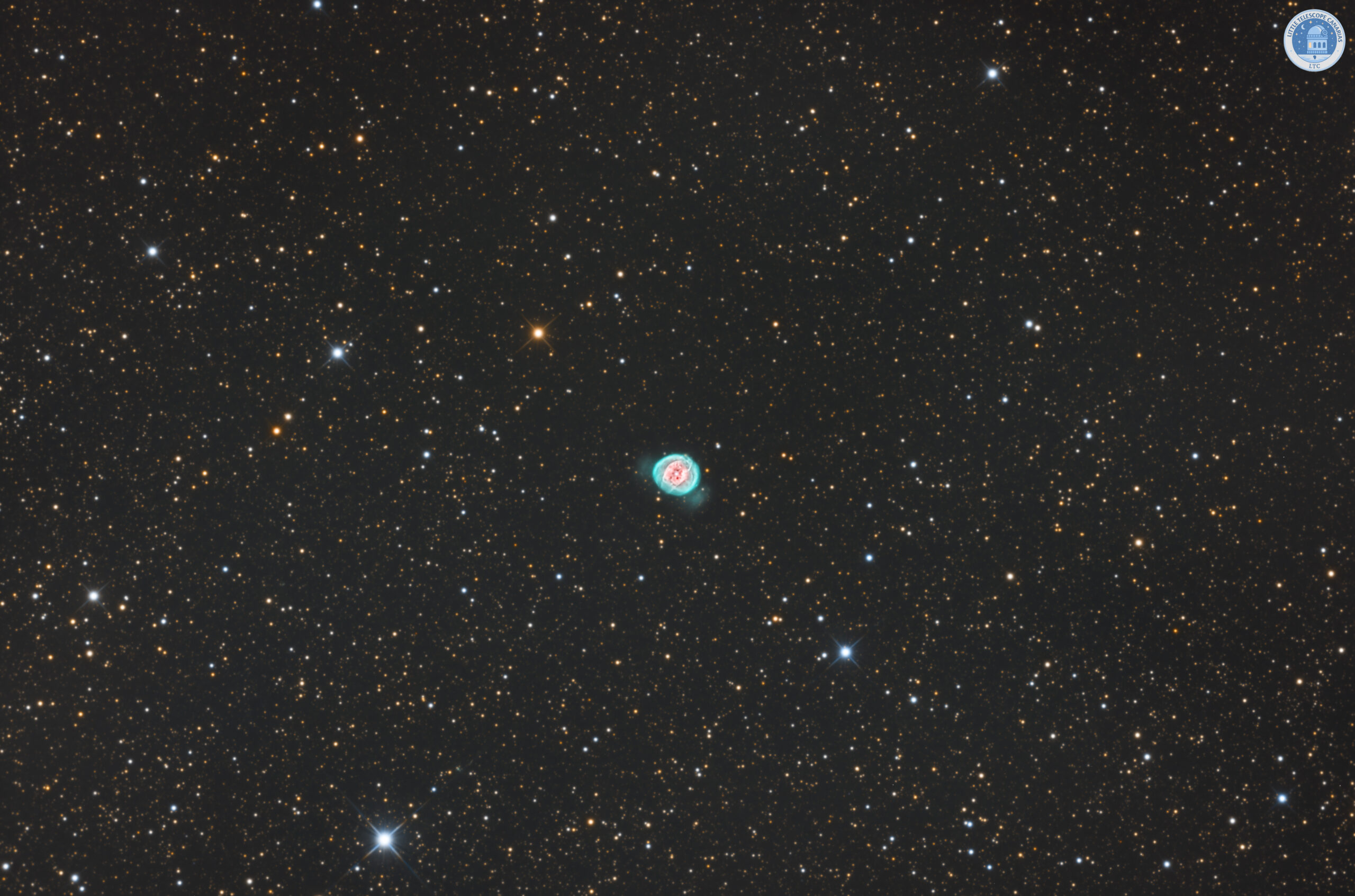
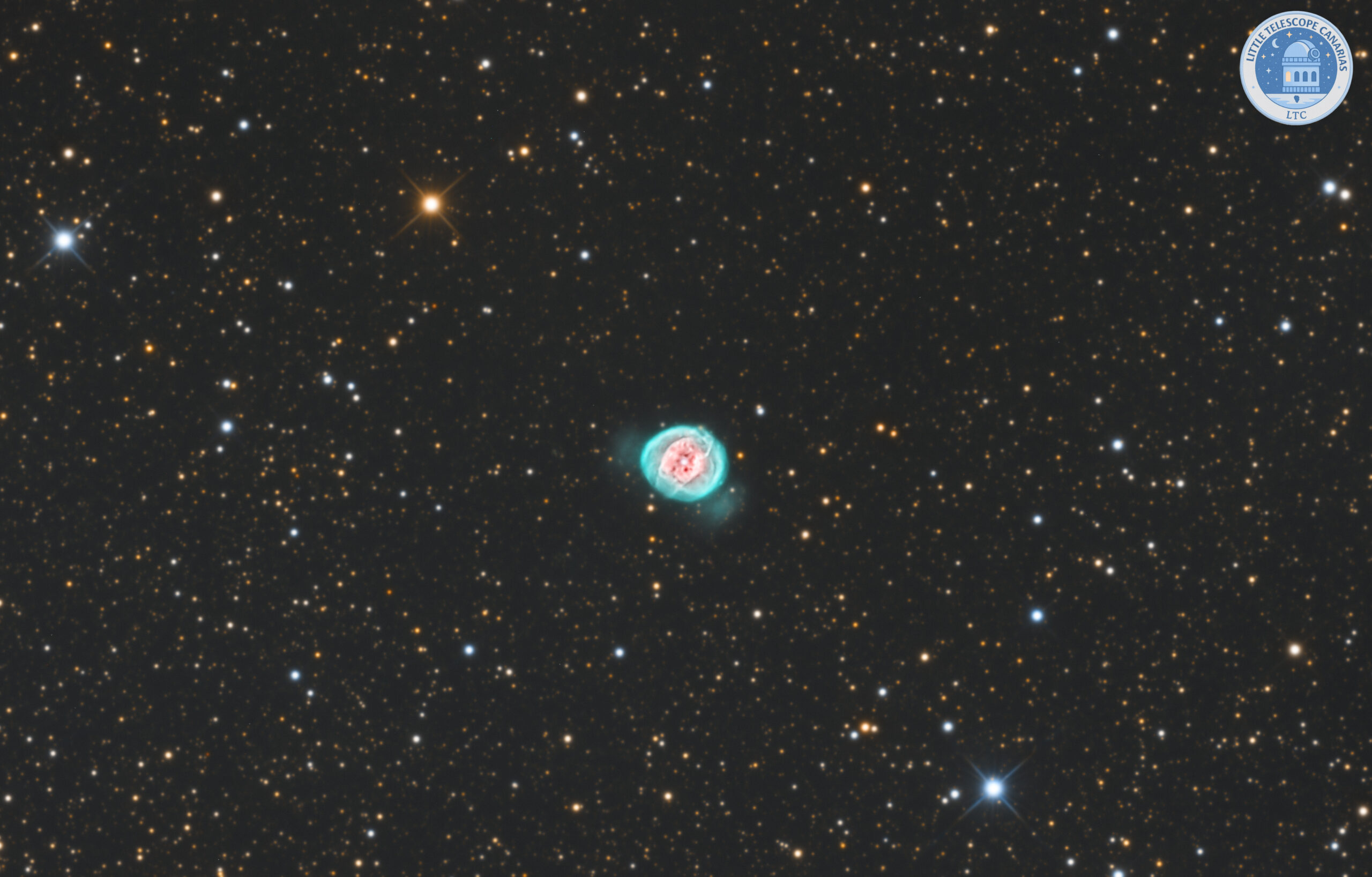
Unlike many planetary nebulae that appear nearly spherical, NGC 6804 exhibits an irregular structure featuring a bright inner ring surrounded by fainter outer regions and diffuse filaments. Images obtained with the Hubble Space Telescope reveal small knots of gas, condensations, and subtle brightness variations that reflect the complexity of the mass-loss process during the final stages of the progenitor star’s evolution.
Its characteristic blue-green color is produced primarily by the strong emission of doubly ionized oxygen ([O III]), while ionized hydrogen and nitrogen contribute to the reddish hues visible in narrowband images. These emission lines make NGC 6804 an excellent object for imaging with O III and Hα filters.
📸 Images from LilTecan
The LilTecan team has captured NGC 6804, revealing its bright gaseous core surrounded by a delicate emission shell. Long integration times bring out the intricate texture of the main ring as well as the subtle irregularities that are barely visible in lower-resolution observations.
🌟 Structure and Main Characteristics
Observational studies have identified several notable properties of this planetary nebula:
- It is classified as a planetary nebula located in the constellation of Aquila.
- It was discovered by William Herschel on July 25, 1791.
- It lies at an estimated distance of 4,000–5,000 light-years, although published distance estimates vary.
- It features a bright inner ring surrounded by a fainter outer shell containing filaments and small condensations.
- Its emission is dominated by [O III], accompanied by strong Hα and [N II] emission lines characteristic of planetary nebulae.
- At its center lies a hot central star evolving into a white dwarf, whose intense ultraviolet radiation ionizes the surrounding gas.
NGC 6804 is an excellent example of how a star with a mass similar to that of the Sun enriches the interstellar medium at the end of its life. Although less famous than some of the best-known planetary nebulae, its complex morphology and high surface brightness make it an outstanding laboratory for studying stellar mass loss and the evolution of expanding gaseous shells.
Observing NGC 6804 today is like witnessing the future that likely awaits our own Sun several billion years from now. Its delicate ring of glowing gas, illuminated by the intense radiation of its central star, is a reminder that even the final chapter of a star’s life can produce some of the most beautiful structures in the universe