
IC 434 – The Horsehead Nebula
IC 434, popularly known as the Horsehead Nebula, is an emission region located in the constellation of Orion, within the Orion molecular cloud complex. The dark silhouette that gives the object its name actually corresponds to Barnard 33 (B33), a cold, dark cloud of gas and dust projected against the bright emission region IC 434.
The Horsehead lies approximately 1,400 light-years from Earth and forms part of an extensive region of gas and dust associated with the Orion molecular cloud complex. ESO describes Barnard 33 as a protrusion of dust located in the southern region of the dense Lynds 1630 cloud, on the edge of the IC 434 H II region.
Although the name IC 434 is often used to describe the entire structure visible in astrophotographs, the famous horse-shaped silhouette specifically corresponds to Barnard 33, which is classified as a dark nebula.
🐴 A silhouette created by dust
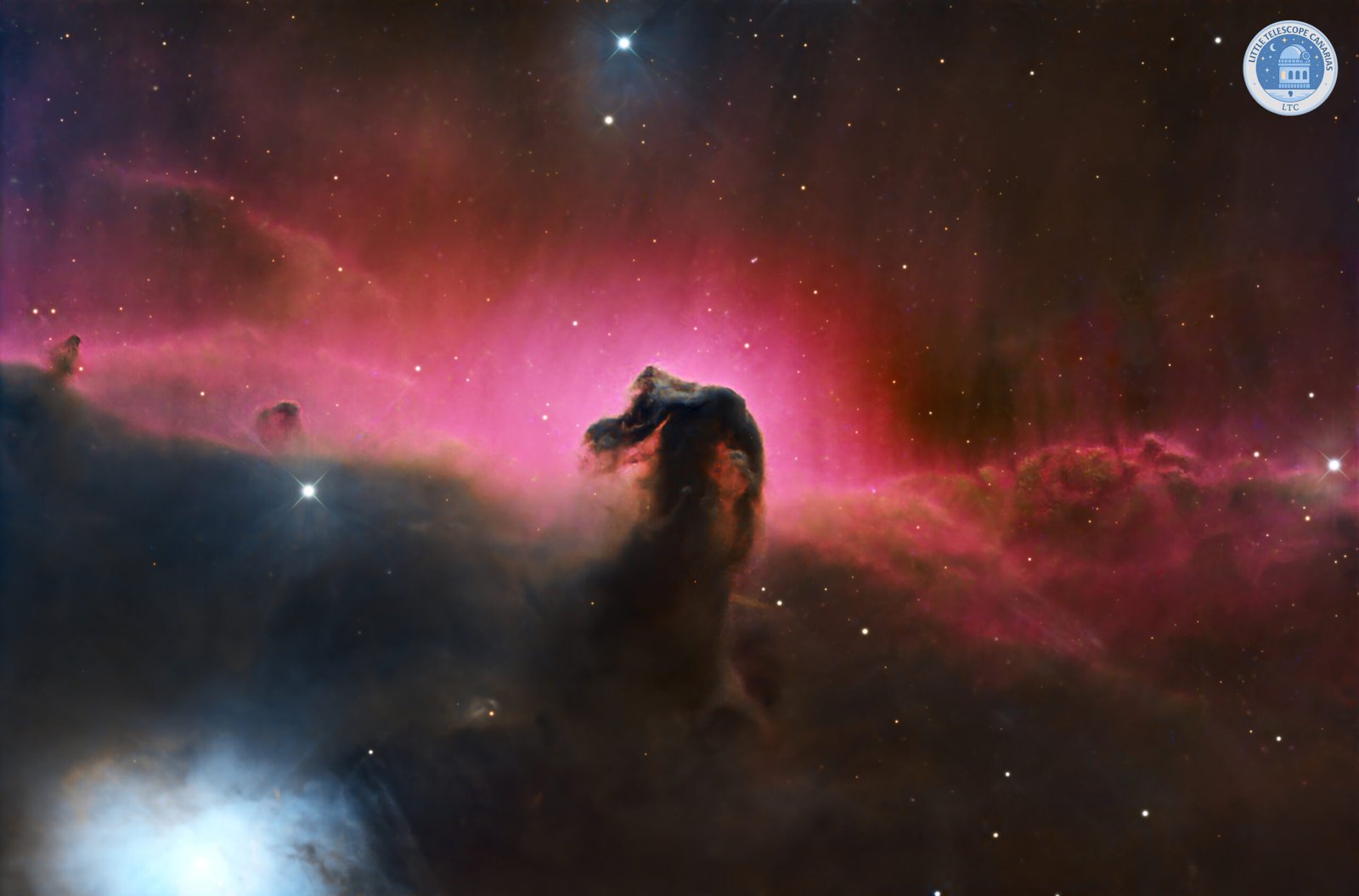
The most spectacular feature of the region is the dark silhouette of Barnard 33, which stands out against the reddish glow of IC 434.
The cloud contains gas and dust that absorb and block light from the bright nebula behind it. From our perspective, this combination produces the distinctive shape that resembles a horse’s head. NASA describes the Horsehead, also known as Barnard 33, as a cold, dark cloud of gas and dust silhouetted against the bright IC 434 nebula.
The shape of the nebula is largely a matter of perspective. The structure was not created to resemble a horse; its appearance results from the three-dimensional distribution of gas and dust and our viewing angle toward the luminous region behind it.
Radiation from nearby young and massive stars is progressively eroding the gas and dust structures. Hubble observations have revealed in detail how this radiation is shaping the edges of the cloud.
📸 Images from LilTecan
The LilTecan team has captured the Horsehead region, showing the contrast between the emission from IC 434 and the dark silhouette of Barnard 33.
Narrowband imaging is particularly effective at revealing the emission structures surrounding the dark cloud, while combining different filters allows the complex distribution of gas around the Horsehead to be studied in greater detail.
🌟 Structure and main characteristics
Observations of this region have revealed several important characteristics:
- It is located in the constellation of Orion.
- The famous dark silhouette corresponds to Barnard 33 (B33).
- Barnard 33 is a dark cloud of gas and dust.
- IC 434 is an H II region located in the Orion molecular cloud complex.
- The region is approximately 1,400 light-years away, according to ESO.
- The coordinates given by ESO for Barnard 33 are approximately 05h 40m 58.99s / −02° 27′ 30.14″.
- ESO’s detailed VLT image covers a field of approximately 3.81 × 4.20 arcminutes.
- Barnard 33 lies in the southern region of the dense Lynds 1630 cloud.
- Radiation from nearby massive stars is eroding and shaping the cloud of gas and dust.
- The Horsehead has been observed in infrared wavelengths by the James Webb Space Telescope, revealing details that are not visible in the same way at optical wavelengths.
- The Very Large Telescope (VLT) observed the region using the FORS2 instrument.
The Horsehead Nebula has been observed by some of the most important telescopes in modern astronomy.
The Hubble Space Telescope obtained one of the best-known images of Barnard 33. These observations revealed the intricate structure of the dark cloud and the effects of radiation from nearby stars on the surrounding gas and dust.
In 2000, the FORS2 instrument on ESO’s Very Large Telescope obtained the observations later used to create a high-resolution colour image of the region. The observations were made with the 8.2-metre KUEYEN Unit Telescope at Paranal Observatory in Chile.
More recently, the James Webb Space Telescope observed the Horsehead in infrared wavelengths. Webb’s NIRCam image focuses on part of the nebula’s distinctive “mane”, approximately 0.8 light-years wide, revealing structures with remarkable detail.
The Horsehead Nebula is a spectacular example of how stars can transform the interstellar medium around them.
Young and massive stars produce intense radiation that interacts with clouds of gas and dust. The densest regions can resist erosion for longer periods, while less dense material is progressively dispersed.
Hubble observations show how radiation is eroding the cloud and modifying its edges. The structure we recognize today as the Horsehead is therefore a temporary configuration within the evolution of the Orion molecular cloud complex.
The region is also associated with star formation. Infrared observations allow astronomers to study structures and young objects that are not easily visible at optical wavelengths. NASA classifies Barnard 33 as part of a star-forming region.
NASA estimates that the Horsehead structure will eventually disappear in approximately 5 to 10 million years as stellar radiation continues to erode the cloud.