
NGC 6888 – The Crescent Nebula
NGC 6888, popularly known as the Crescent Nebula and also designated Caldwell 27, is an emission nebula located in the constellation of Cygnus, approximately 4,700 light-years from Earth. It was discovered by William Herschel in 1792. Unlike a planetary nebula, NGC 6888 is a Wolf-Rayet nebula, formed by the interaction between the powerful stellar winds of the star WR 136 and material expelled during earlier stages of the star’s evolution.
The nebula is one of the best-studied examples of a structure created by the interaction between the winds of a massive star and the surrounding material. Its characteristic crescent shape is formed by a complex network of filaments, knots, and layers of ionized gas.
💥 A Bubble Shaped by a Wolf-Rayet Star
At the center of NGC 6888 lies WR 136, an extremely hot and massive WN6 Wolf-Rayet star. During an earlier stage of its evolution, the star expelled large amounts of material into its surroundings.
Later, after evolving into the Wolf-Rayet phase, WR 136 developed a much faster and more powerful stellar wind. This wind interacts with the material previously expelled by the star, compressing it and producing the complex structure of the nebula. Observations and models indicate that this interaction between different generations of stellar winds is fundamental to explaining the filaments and shells observed today.
Spectroscopic observations show that much of the filamentary structure of NGC 6888 is dominated by Hα and [N II] emission, while an outer envelope exhibits significant [O III] emission. This distribution reflects the different ionization conditions present throughout the nebula.
Spectroscopic studies have also identified different velocity components within the gas, associated with portions of the expanding shell moving toward and away from the observer.
📸 Images from LilTecan
The LilTecan team has captured NGC 6888, revealing its characteristic filaments and arched structures surrounding WR 136. Narrowband imaging particularly emphasizes the emission from hydrogen, oxygen, and sulfur, revealing the complexity of this gaseous bubble and the contrast between its different emission regions.
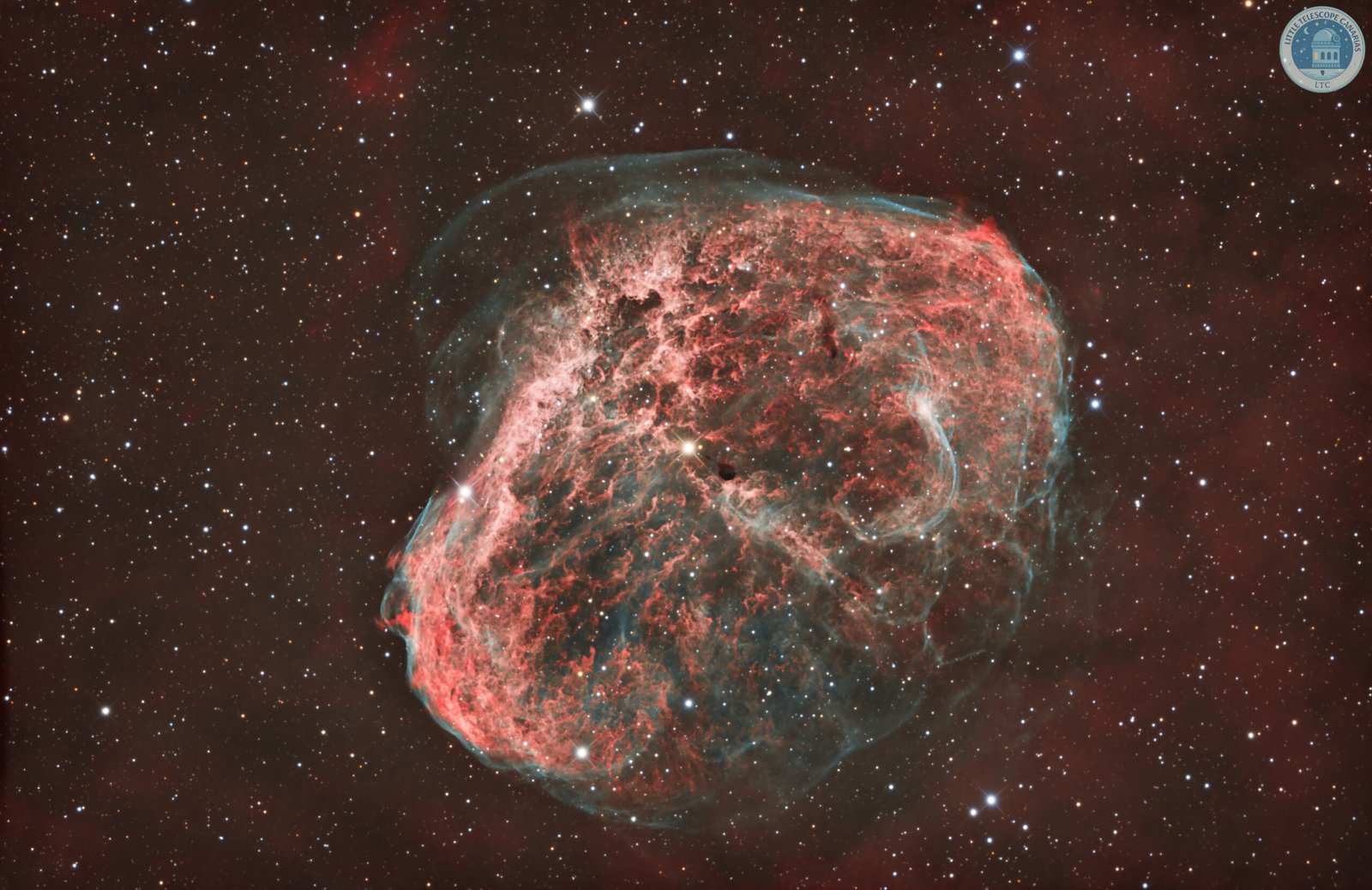
🌟 Structure and Main Characteristics
Observational studies have identified several remarkable properties of this nebula:
- It is an emission nebula associated with a Wolf-Rayet star, not a planetary nebula.
- It is located in the constellation of Cygnus.
- It lies approximately 4,700 light-years from Earth.
- It was discovered by William Herschel in 1792.
- The central star is WR 136, classified as a WN6 Wolf-Rayet star.
- The nebular structure was formed through the interaction of a fast stellar wind with material expelled during an earlier evolutionary phase of the star.
- It exhibits a highly filamentary structure with numerous condensations, particularly prominent in Hα and [N II].
- An outer envelope shows significant [O III] emission.
- The complete structure is approximately 16 × 25 light-years in size, according to Hubble observations.
- The nebula exhibits different kinematic components associated with its expanding gas.
NGC 6888 is an excellent example of how a massive star can transform its surrounding environment before reaching the final stages of its evolution. Its filaments, shells, and expanding gas structures are the visible result of a continuous interaction between the stellar winds of WR 136 and material expelled by the star during earlier stages of its life.
Unlike planetary nebulae, which originate from lower-mass stars during the final stages of their evolution, NGC 6888 belongs to a completely different class of objects: Wolf-Rayet nebulae, associated with massive stars that lose enormous amounts of material through powerful stellar winds.
Observing NGC 6888 is like witnessing a massive star actively transforming its surroundings. The delicate network of filaments and arcs surrounding WR 136 is the visible result of a cosmic battle between different generations of stellar winds.
Each filament of the Crescent Nebula preserves the imprint of material expelled by the star during earlier stages of its life, while the powerful Wolf-Rayet wind continues to reshape that material.