NGC 6210 – The Turtle Nebula
NGC 6210, popularly known as the Turtle Nebula, is a planetary nebula located in the constellation of Hercules, at an estimated distance of 6,000 to 6,500 light-years from Earth. It was discovered by William Herschel on May 25, 1799, and is one of the brightest planetary nebulae in the northern sky, distinguished by its high surface brightness and extraordinary structural complexity.
NGC 6210 represents an advanced stage in the evolution of a star with a mass similar to that of the Sun. After exhausting its nuclear fuel, the progenitor star expelled its outer layers into space, creating an expanding gaseous envelope while its remaining core continues evolving toward a white dwarf. The intense ultraviolet radiation emitted by this central star ionizes the surrounding gas, producing the bright emission lines that characterize planetary nebulae.
💥 A Planetary Nebula with a Complex Three-Dimensional Structure
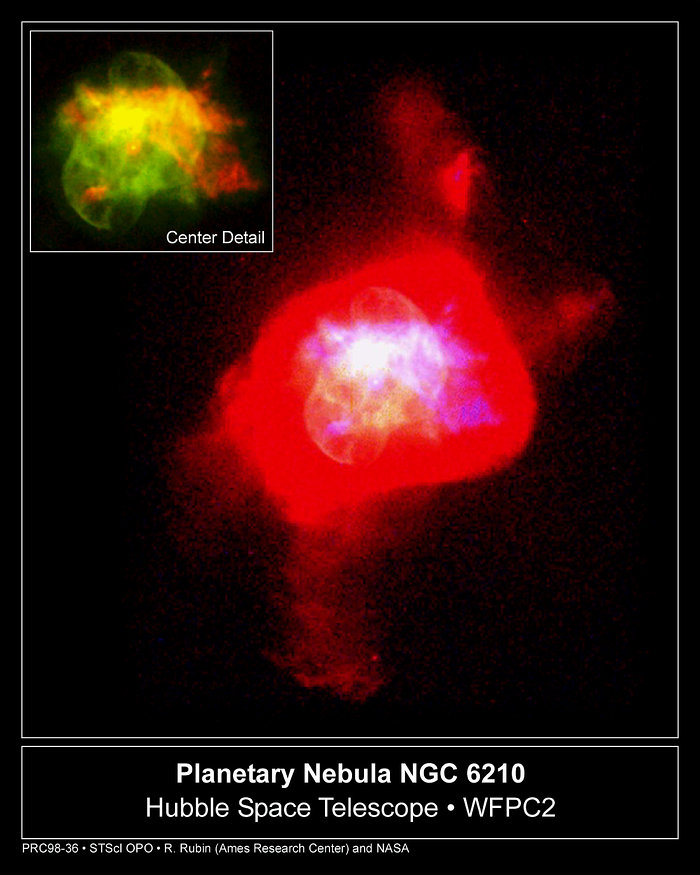
Although it may appear as a small oval nebula through the eyepiece, observations obtained with the Hubble Space Telescope have revealed that NGC 6210 possesses an extraordinarily complex internal structure.
Its central region consists of multiple overlapping gaseous shells, accompanied by filaments, bright arcs, and condensations distributed in an almost symmetrical pattern around the central star. Morphological studies indicate that these structures are the result of multiple episodes of mass loss combined with the action of fast stellar winds that have sculpted the nebula over thousands of years.
Narrowband imaging reveals a clear ionization stratification throughout the nebula. The innermost regions are dominated by the strong emission of doubly ionized oxygen ([O III]), responsible for its characteristic blue-green appearance, while the outer layers display stronger hydrogen (Hα) and ionized nitrogen ([N II]) emission, reflecting the different physical conditions present within the expanding gas.
📸 Images from LilTecan
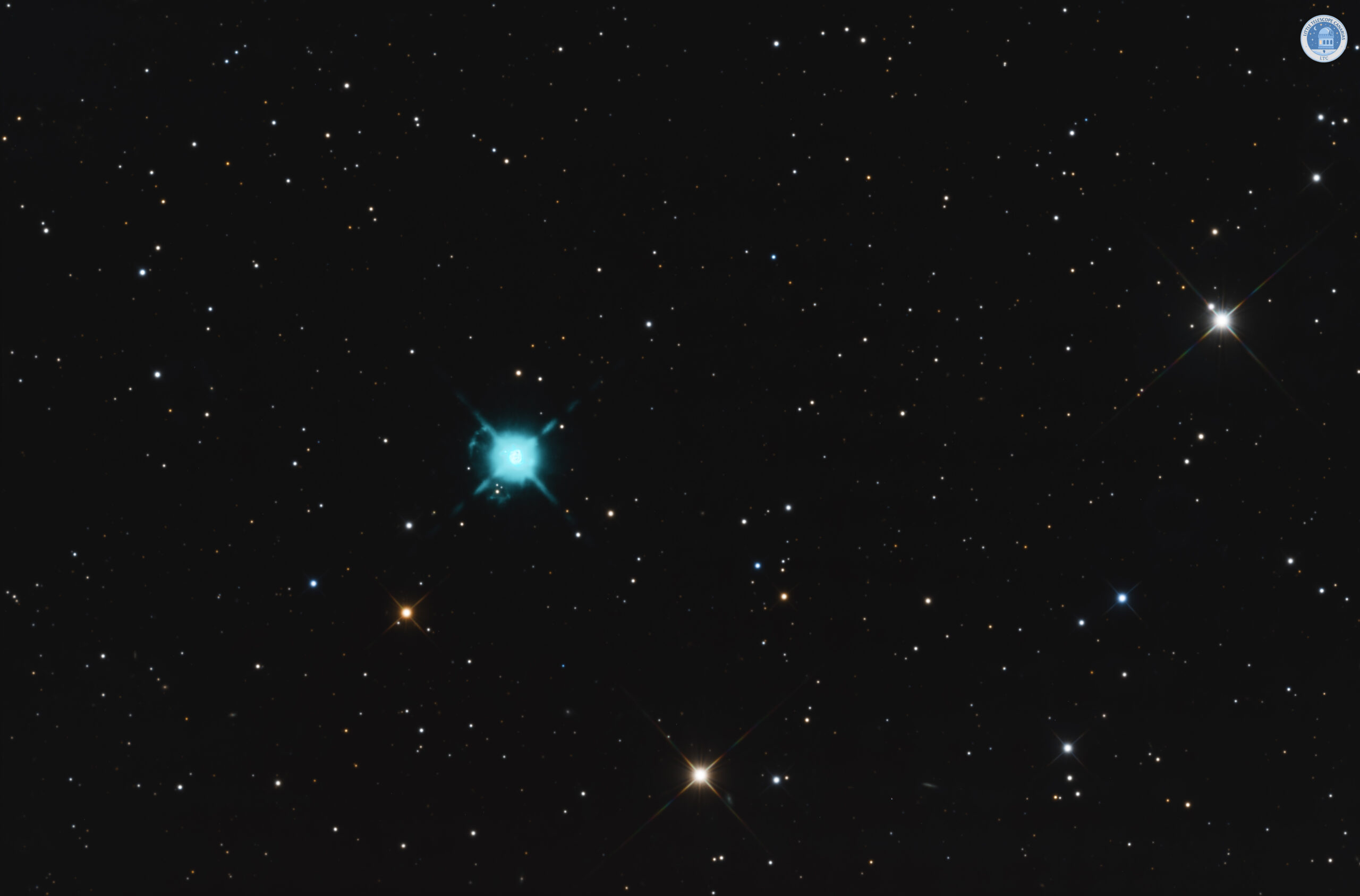
The LilTecan team has captured NGC 6210, revealing its brilliant blue-green core surrounded by delicate gaseous shells and numerous fine filaments. High-resolution imaging brings out the nebula’s intricate internal morphology and the subtle differences between its various emission regions, making it one of the most spectacular planetary nebulae observable from the Northern Hemisphere.
🌟 Structure and Main Characteristics
Observational studies have identified several remarkable properties of this planetary nebula:
- It is classified as a planetary nebula.
- It is located in the constellation of Hercules.
- It was discovered by William Herschel on May 25, 1799.
- Its estimated distance is approximately 6,000–6,500 light-years, although published values vary depending on the measurement method.
- It exhibits a multipolar, highly filamentary structure composed of several expanding gaseous shells.
- Its emission is dominated by [O III], Hα, and [N II], allowing astronomers to study the ionization structure of the nebula.
- The central star is an extremely hot object that continues evolving toward a white dwarf, providing the ultraviolet radiation responsible for ionizing the surrounding gas.
NGC 6210 is one of the finest examples of a planetary nebula with a highly complex structure. Its brilliant core, delicate filaments, and multiple expanding shells demonstrate how stellar mass loss and fast stellar winds can sculpt remarkably intricate forms during the final stages of stellar evolution.
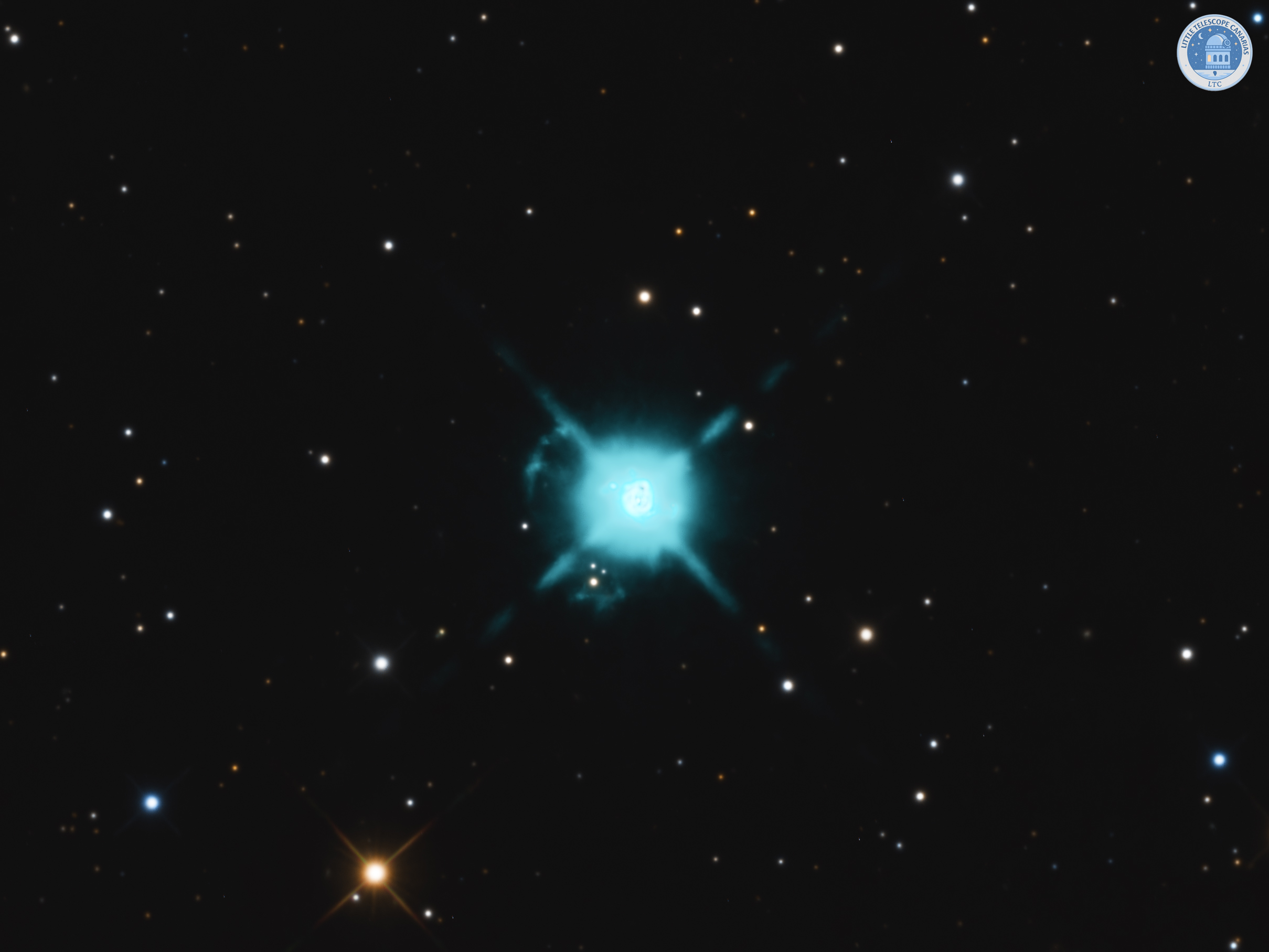
Observing NGC 6210 today is like witnessing a star slowly transforming its surroundings before fading into a white dwarf. Its brilliant shells of glowing gas, illuminated by intense ultraviolet radiation, form a magnificent cosmic sculpture where every filament and every luminous arc preserves the record of the final chapters of a long stellar lifetime.