
NGC 7465 – An Active Galaxy in Interaction
NGC 7465 is a galaxy located in the constellation of Pegasus, at a distance of approximately 22 Mpc, equivalent to about 72 million light-years. SIMBAD currently classifies it as a Seyfert 2 galaxy, although near-infrared spectroscopic studies have found evidence that led to its classification as a Type 1 LINER. This difference reflects the complexity of its active nucleus and the different criteria used to classify it.
NGC 7465 is part of a galaxy group and has a particularly interesting relationship with NGC 7463 and NGC 7464, which form a compact system in its immediate environment. Observations of the gas and stellar components show evidence of a recent or ongoing gravitational interaction between NGC 7465 and its neighboring galaxies.
💥 An Active Galaxy in Interaction
NGC 7465 exhibits a structure influenced by its surroundings. Studies of its stellar component and gas have found different kinematic axes at different scales, a characteristic interpreted as evidence of a recent or ongoing interaction with one or more nearby galaxies.
One of the most interesting pieces of evidence for this interaction is the presence of a neutral hydrogen (H I) arm connecting the southeastern region of NGC 7465 with the southwestern region of NGC 7464. In addition, NGC 7464 displays structural distortions in the direction of NGC 7465. These features support the interpretation that the two galaxies have undergone gravitational interaction.
Studies have also identified gas with different orientations relative to the stellar component, together with unusual chemical properties in the central regions. These results have been interpreted as possible evidence that NGC 7465 has acquired gas from an external source.
📸 Images from LilTecan
The LilTecan team has captured NGC 7465, revealing its galactic structure and the interesting field of galaxies surrounding it.
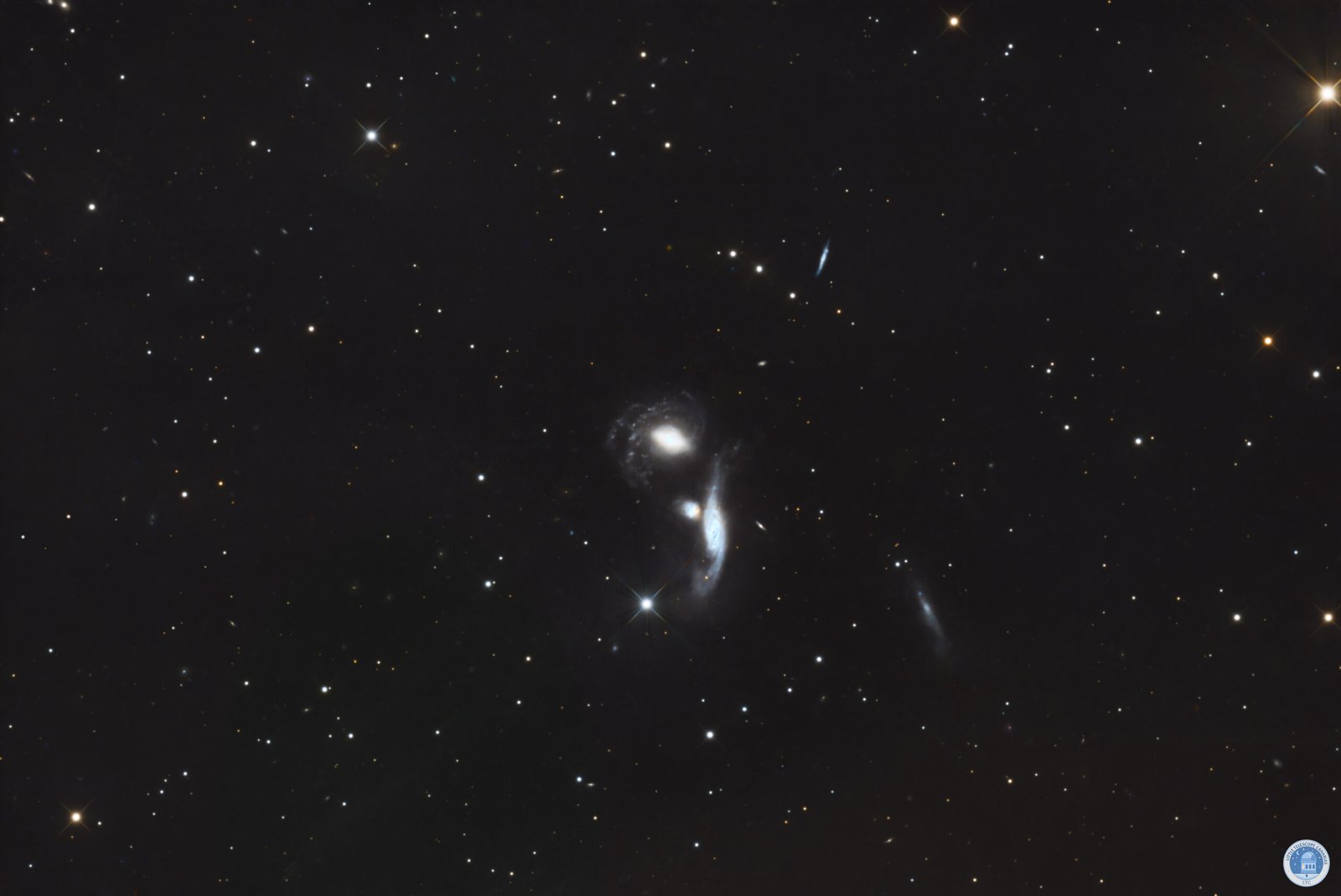
The close presence of NGC 7463 and NGC 7464 makes this region particularly attractive for deep-sky imaging. Long exposures make it possible to record not only the main galaxies but also faint outer structures that can remain hidden in conventional images.
🌟 Structure and Main Characteristics
Astronomical studies have identified several notable properties:
- It is an active galaxy located in the constellation of Pegasus.
- SIMBAD currently classifies it as a Seyfert 2 galaxy.
- Near-infrared spectroscopic studies have classified it as a Type 1 LINER, based on the presence of broad components in certain emission lines.
- It has a redshift of approximately z = 0.00634, corresponding to a radial velocity of roughly 1,900 km/s in SIMBAD data.
- It lies at a distance of approximately 22–25 Mpc, depending on the source and method used.
- It is part of a galaxy group and is closely associated with NGC 7463 and NGC 7464.
- There is evidence of gravitational interaction with neighboring galaxies.
- A neutral hydrogen (H I) arm connects NGC 7465 with NGC 7464, providing evidence of interaction between the two galaxies.
- Studies have found misalignments between the gas and stellar components, consistent with a history of interaction or external gas acquisition.
- X-ray observations indicate a heavily absorbed nucleus, with an estimated hydrogen column density of approximately 5 × 10²³ cm⁻².
NGC 7465 is an excellent example of how the evolution of a galaxy cannot always be understood in isolation. Its active nucleus, the presence of gas with different orientations, and the hydrogen structures connecting it with nearby galaxies reveal a system in which gravitational interaction may play an important role.
Furthermore, the combination of nuclear activity and galactic interaction makes NGC 7465 particularly interesting for studying how gas can be redistributed within a galaxy and how these processes may be connected to activity in its nucleus.
Observing NGC 7465 is like looking at a galaxy whose past and present are written in the movement of its gas and stars. Around it, NGC 7463 and NGC 7464 form part of a dynamic environment in which gravity is slowly reshaping galactic structures.
At approximately 70 million light-years away, the light we capture today began its journey when modern humans did not yet exist on Earth. Every photon arriving from NGC 7465 therefore reveals a small part of the history of an active galaxy that continues to evolve.