
Abell 71 – A Planetary Nebula Shaped by the Interstellar Medium
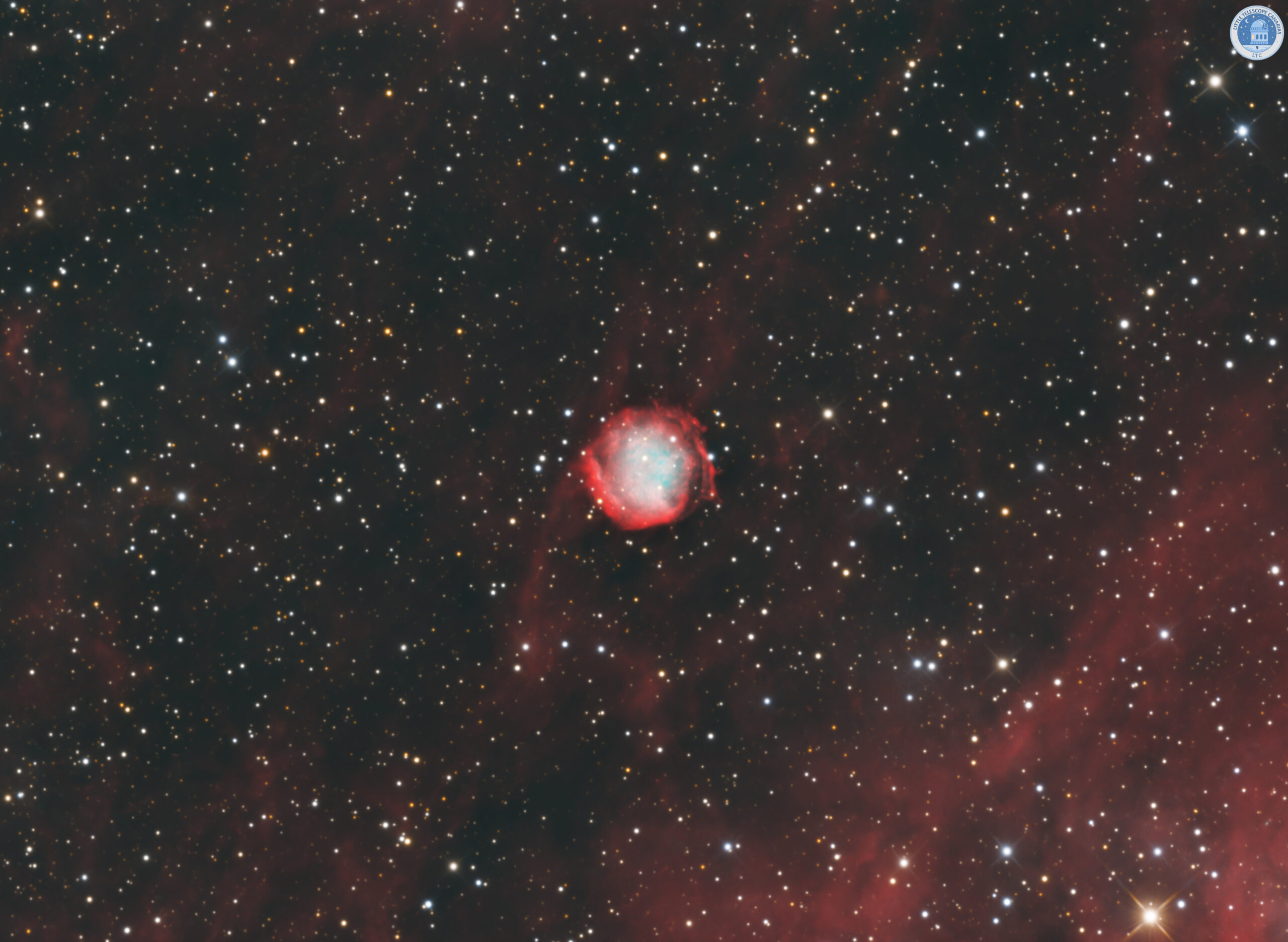
Abell 71, also cataloged as PN G084.9+04.4 and PK 85+4.1, is a planetary nebula located in the constellation of Cygnus. Discovered by George Ogden Abell during the compilation of his catalog of low surface brightness planetary nebulae, it has become one of the most interesting examples of a nebula whose appearance has been profoundly altered by its interaction with the surrounding interstellar medium.
For decades, the true nature of Abell 71 was the subject of considerable debate. Its weak [O III] emission and nearly circular appearance led some researchers to reclassify it as an H II region. However, recent studies based on high-resolution spectroscopy, three-dimensional morphokinematic reconstruction, and distance measurements from the Gaia mission have confirmed that Abell 71 is indeed a genuine planetary nebula in an advanced stage of evolution.
💥 A Nebula Interacting with the Interstellar Medium
Abell 71 represents a late stage in the evolution of a Sun-like star. After ejecting its outer layers, the nebula has continued expanding until it began interacting with the diffuse gas of the interstellar medium.
Spectroscopic observations reveal an expansion velocity of approximately 23 km/s and a structure considerably more complex than suggested by the earliest images. Rather than being a simple spherical shell, the nebula consists of a main ellipsoidal body accompanied by several extensions or “arms,” which appear to have been shaped both by successive episodes of mass loss and by interaction with the surrounding interstellar environment.
One of its most remarkable features is a region where [N II] emission is particularly intense. Current models interpret this as the location where the expanding nebular shell is colliding with the interstellar medium, generating shock fronts that are gradually reshaping its morphology.
📸 Images from LilTecan
The LilTecan team has captured Abell 71, revealing its delicate gaseous envelope and the faint outer structures that are barely visible in short exposures. Narrowband imaging highlights the nebula’s asymmetries and the regions where interaction with the interstellar medium has become the dominant force shaping its evolution.
🌟 Structure and Main Characteristics
Recent observational studies have identified several remarkable properties of this planetary nebula:
- It is classified as a low surface brightness planetary nebula.
- It is located in the constellation of Cygnus.
- Its estimated distance, derived from Gaia measurements, is approximately 970 parsecs (969 ± 96 pc).
- It exhibits an expansion velocity of 23 ± 2 km/s.
- Its apparent angular diameter is approximately 156 arcseconds.
- Three-dimensional morphokinematic reconstruction reveals an ellipsoidal structure with several extensions and distortions produced by successive mass-loss events.
- Strong [N II] emission in one region provides clear evidence of interaction with the interstellar medium through shock waves.
Abell 71 is an outstanding example of how planetary nebulae continue to evolve long after their central stars have expelled their outer envelopes. Far from being static structures, these nebulae are continuously reshaped by their interaction with the surrounding interstellar gas, gradually changing both their morphology and appearance over time.
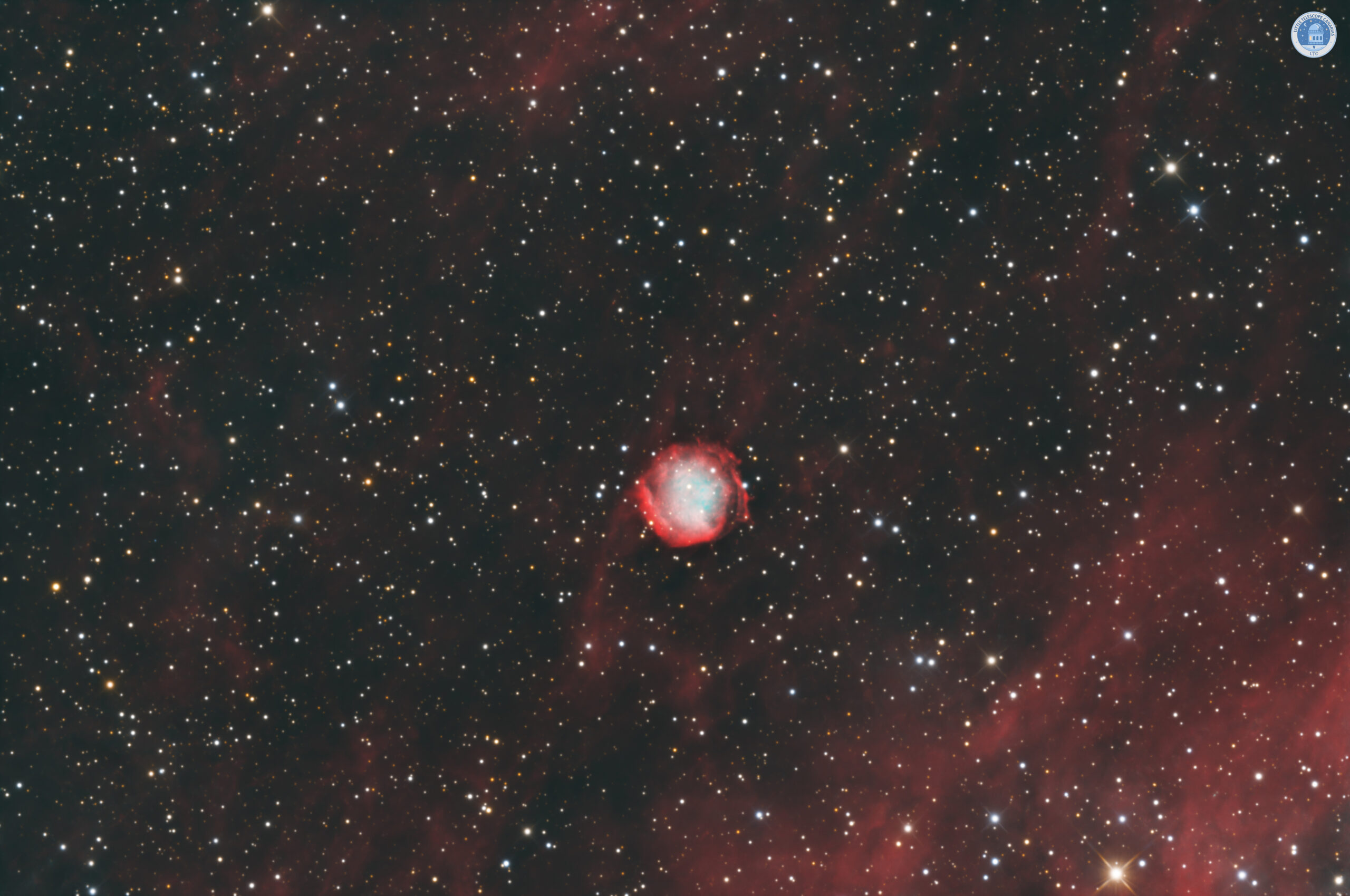
Observing Abell 71 today is like witnessing a nebula that preserves the imprint of millions of years of stellar evolution. Its delicate gaseous structures, sculpted by their encounter with the interstellar medium, demonstrate that even during the final stages of a star’s life, gravity, gas, and shock waves continue to create some of the universe’s most subtle and fascinating forms.