
Hickson 90 – An Interacting Group of Galaxies
Hickson 90 (HCG 90) is a compact group of galaxies located in the constellation of Piscis Austrinus, at a distance of approximately 110 million light-years. The group consists of several galaxies that are very close to one another and show evidence of gravitational interactions.
The central region of HCG 90 is dominated by three galaxies: NGC 7173, NGC 7174, and NGC 7176. NGC 7173 and NGC 7176 are elliptical galaxies, while NGC 7174 is a strongly disturbed spiral galaxy, with distorted dust structures and a long tidal tail.
To the north of the core lies NGC 7172, a spiral galaxy classified as a Seyfert 2, which constitutes the fourth major galaxy in the group.
The proximity between the galaxies has resulted in intense gravitational interactions. These interactions have stripped stars from the galaxies and produced a faint component of diffuse light extending throughout the group.
🌌 A Compact Group of Galaxies
The Hickson Compact Groups are systems consisting of several galaxies that appear extremely close together in the sky. They were catalogued by Canadian astronomer Paul Hickson during the 1980s.
Hickson 90 is entry number 90 in this catalogue and is one of the relatively nearby compact groups accessible from the Southern Hemisphere. A study published in the Monthly Notices of the Royal Astronomical Society places the group at a distance of 33.1 Mpc, equivalent to approximately 108 million light-years.
ESO uses an approximate distance of 110 million light-years for the three central galaxies.
The central region of HCG 90 consists of the galaxies NGC 7173, NGC 7174, and NGC 7176, which lie within a region only a few arcminutes across. Surrounding this core is a more extended structure containing other galaxies belonging to the system.
📸 Images from LilTecan
Hickson 90 is a particularly interesting target for deep astrophotography.
The three central galaxies appear very close to one another, but the most interesting structures are also the most difficult to record: tidal tails, low-surface-brightness structures, and the faint diffuse light extending around the group.
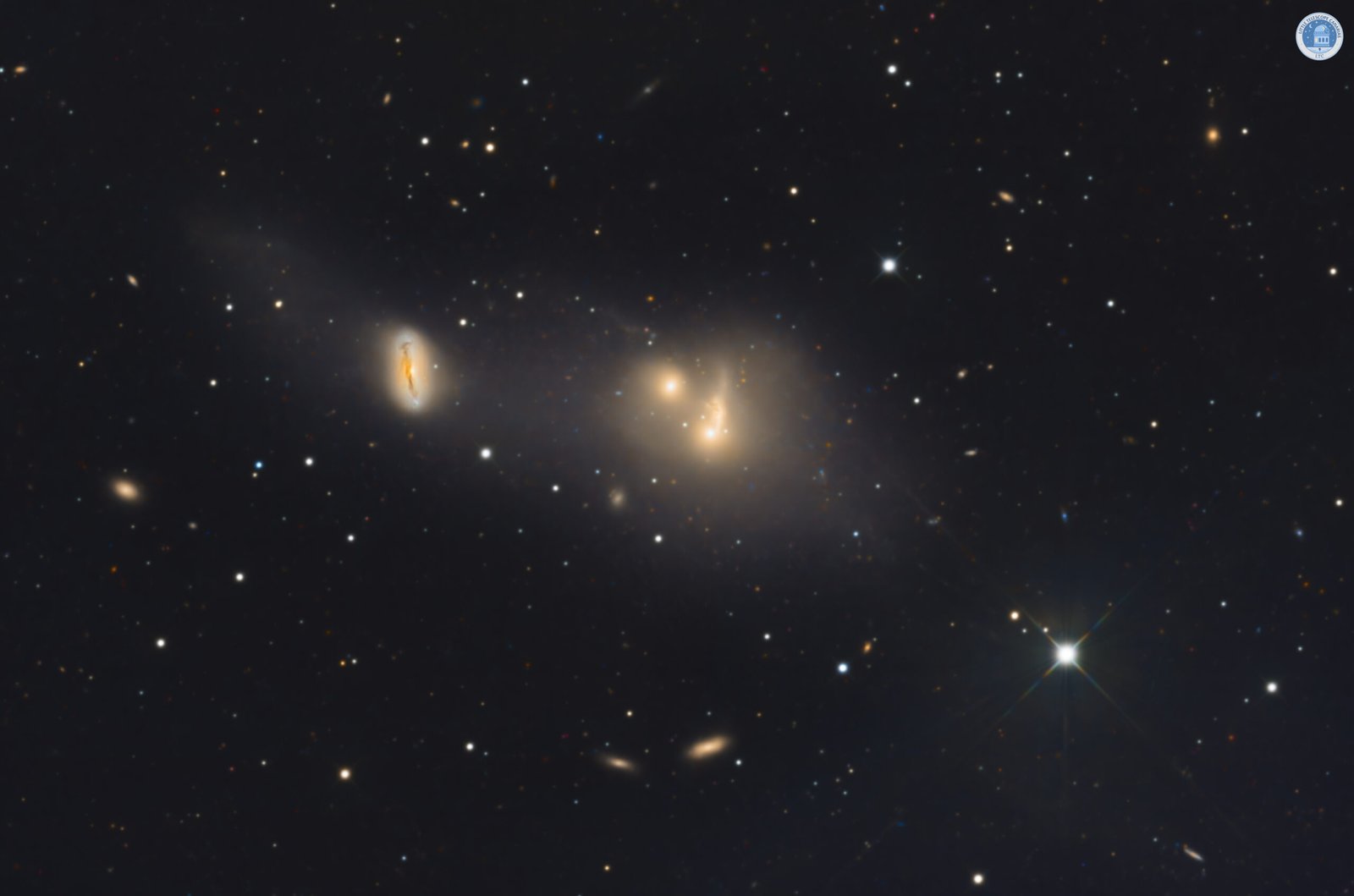
Deep images can reveal structures that are barely visible in conventional exposures and show the enormous complexity of the environment surrounding the main galaxies.
🌟 Structure and Main Characteristics
Studies of Hickson 90 have established several characteristics of the system:
- Hickson 90 (HCG 90) is a compact group of galaxies catalogued by Paul Hickson.
- It is located in the constellation of Piscis Austrinus, the Southern Fish.
- Its distance is approximately 110 million light-years, although different studies use slightly different values.
- The three main galaxies in the core are NGC 7173, NGC 7174, and NGC 7176.
- NGC 7173 and NGC 7176 are elliptical galaxies.
- NGC 7174 is a strongly disturbed spiral galaxy.
- NGC 7172 is another major galaxy in the group and is located north of the core. It is a Seyfert 2 galaxy.
- NGC 7174 exhibits distorted dust structures and a long tidal tail.
- Gravitational interactions have stripped stars from the galaxies, forming a diffuse-light component around the group.
- The core containing the three main galaxies occupies a region of approximately 3 × 3 arcminutes, according to studies of the group.
One of the most important interactions in HCG 90 takes place between NGC 7174 and NGC 7176.
The structure of NGC 7174 has been deeply altered. Its disk and dust lanes show a morphology very different from that expected for an isolated spiral galaxy. The long tail extending from the galaxy is one of the most visible signs of the interaction.
Studies of the central region have found evidence that this interaction has redistributed material between the galaxies. Young star clusters have also been identified in regions where these processes are taking place.
The presence of these young clusters is particularly interesting because interactions between galaxies can compress gas and promote episodes of star formation.
In HCG 90, studies have found populations of both young and old star clusters, providing information about different stages in the evolution of the system.
One of the most interesting characteristics of HCG 90 is the presence of a significant amount of diffuse light.
When galaxies interact gravitationally, tidal forces can strip stars from their original orbits. Some of these stars cease to be clearly associated with a particular galaxy and become part of an extended luminous structure surrounding the group.
Observations of HCG 90 have detected precisely this type of diffuse component. Earlier studies found a considerable amount of extended optical light around the core of the group.
Images obtained with the Hubble Space Telescope also show stars distributed within a faint luminous component around the galaxies, interpreted as the result of strong tidal interactions.
This type of diffuse light provides a record of the dynamic history of the group.