
NGC 2261 – Hubble’s Variable Nebula
NGC 2261, known as Hubble’s Variable Nebula, is a reflection nebula located in the constellation of Monoceros (the Unicorn). Its characteristic fan-shaped form is illuminated by the young star R Monocerotis (R Mon), located at one of its ends. The light from this star is reflected by the dust that forms the nebula, producing its distinctive appearance.
NGC 2261 is approximately 2,500 light-years from Earth and extends for about one light-year. Its appearance can change noticeably over relatively short timescales due to variations in the illumination produced by the dust surrounding R Monocerotis.
The nebula is known as Hubble’s Variable Nebula because of the early studies carried out by astronomer Edwin P. Hubble, who investigated the variations in brightness and structure of this peculiar object.
🌌 A Reflection Nebula
Unlike an emission nebula, NGC 2261 does not produce its characteristic brightness primarily through the emission of light from ionized gas. It is a reflection nebula, in which light from R Monocerotis is scattered by the dust particles surrounding the star.
The visible structure has a characteristic fan shape, with R Monocerotis located at the lower end. From there, the nebula extends northward, forming a region of illuminated dust.
The central star cannot be observed directly in visible light because of the material surrounding it. What we mainly observe is the light from R Mon scattered by the dust particles in the nebula.
The shape and brightness of NGC 2261 are related to the interaction between the young star and the surrounding material. Recent studies have found evidence of a dust structure associated with a cavity around R Mon, probably related to the outflow of material produced by the star.
📸 Images from LilTecan
NGC 2261 is a particularly interesting object for astrophotography because of its fan-shaped appearance and the extremely delicate structure of the dust surrounding R Monocerotis.
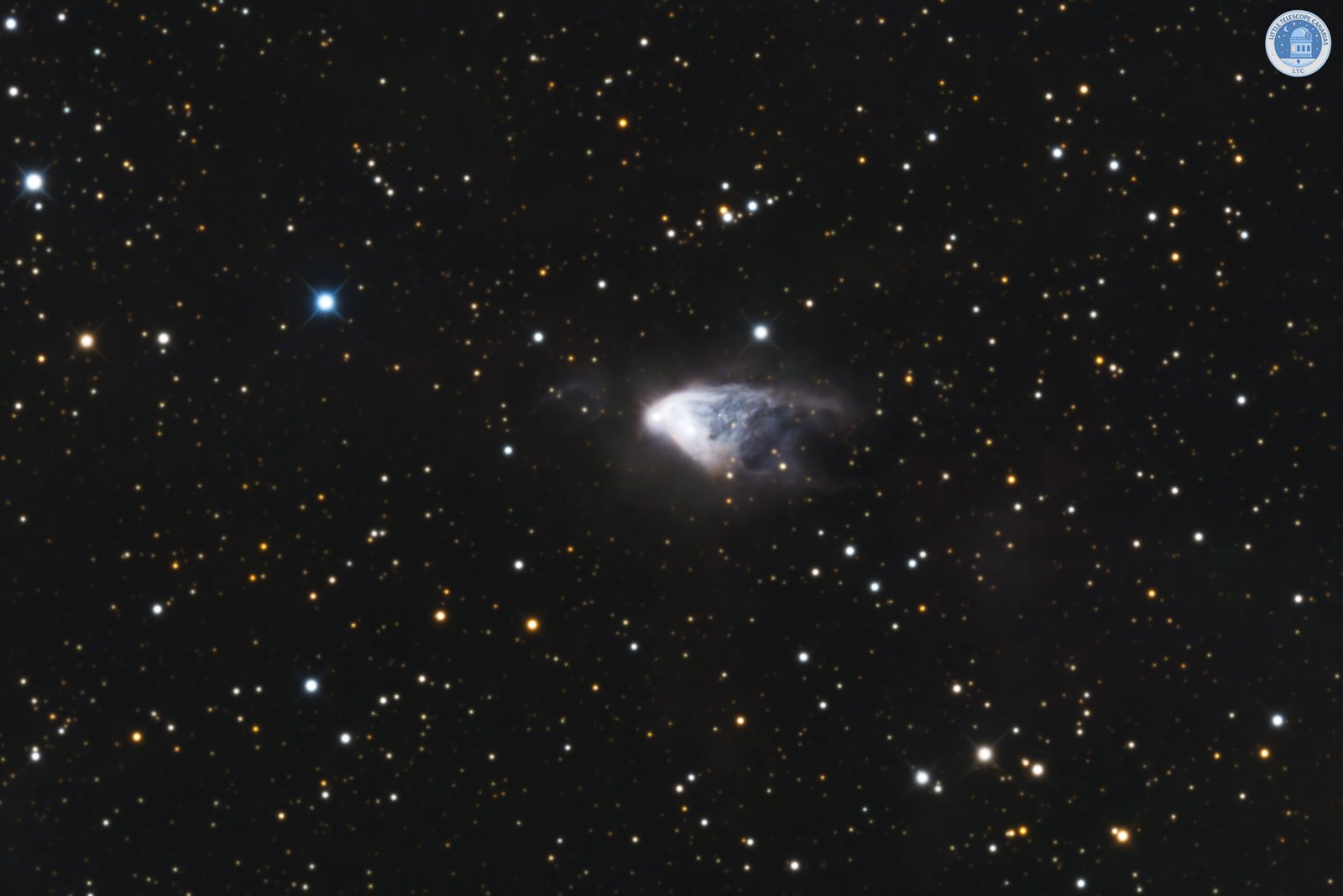
The nebula presents a marked contrast between the star at its end and the reflection material extending from it. Deep images make it possible to study the boundaries of the structure and the variations in brightness that characterize this object.
🌟 Structure and Main Characteristics
Observational studies have identified several notable properties of this nebula:
- It is classified as a reflection nebula.
- It is located in the constellation of Monoceros (the Unicorn).
- It is also known as Hubble’s Variable Nebula.
- Its catalogue designation is NGC 2261 and it is also catalogued as Caldwell 46.
- It is approximately 2,500 light-years from Earth.
- The nebula is approximately one light-year across.
- Its characteristic shape is that of a fan, with R Monocerotis located at its end.
- It is illuminated by the young star R Monocerotis.
One of the most extraordinary characteristics of NGC 2261 is that its appearance changes over time.
The variations occur when dense concentrations of dust close to R Monocerotis partially block its light. These regions of dust cast shadows over the reflective material located farther from the star. As the geometry of the material around R Mon changes, the shadows move across the nebula and alter its appearance.
These variations were one of the reasons why Edwin Hubble devoted some of his early studies to this object.
A seven-year monitoring campaign, beginning in 2017, obtained more than 1,000 images of NGC 2261. The study published in 2025 found not only the large-scale variations for which the nebula is known, but also small ripples of light and darkness that continuously move across the nebula.
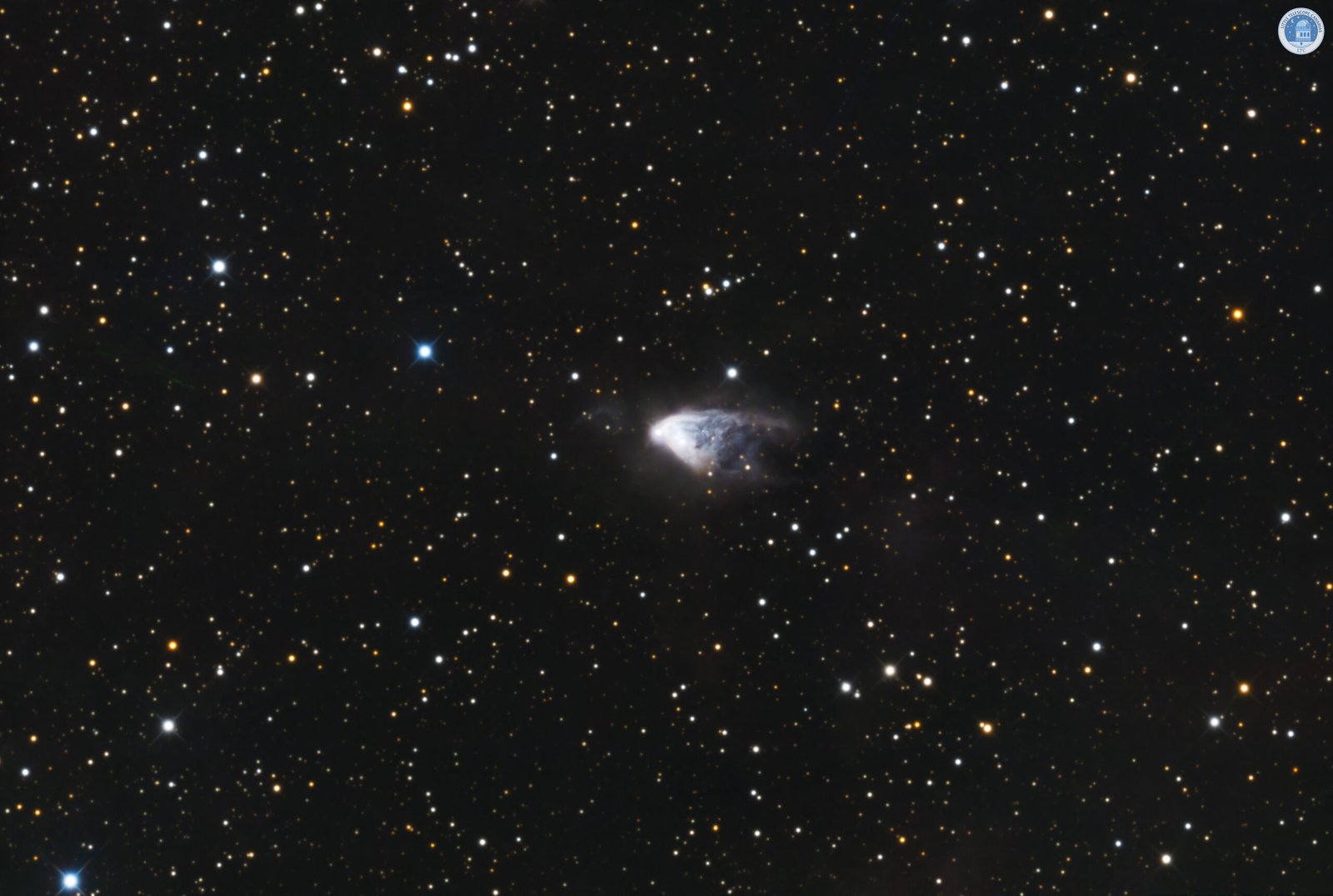
NGC 2261 is one of the most spectacular examples of a variable reflection nebula.
Its fan-shaped appearance is the result of light from R Monocerotis being scattered by the dust surrounding the young star. Structures within this material produce shadows that move and alter the appearance of the nebula.
At approximately 2,500 light-years away, NGC 2261 allows us to directly observe the effects produced by a young star on its surroundings. Its changes in brightness, dust structures, and association with outflows and Herbig-Haro objects show that it is a dynamic and continuously evolving region.
Observing Hubble’s Variable Nebula means looking at an object that does not remain unchanged: its own appearance changes over time, allowing us to study directly the interaction between a young star and the material surrounding it.