
IC 1396 – The Elephant Trunk Nebula
The IC 1396, known for containing the famous Elephant Trunk Nebula, is a vast star-forming region located in the constellation of Cepheus, about 2,400 light-years from Earth. It was cataloged in the 19th century and is part of a much larger complex of gas and dust illuminated by young stars.
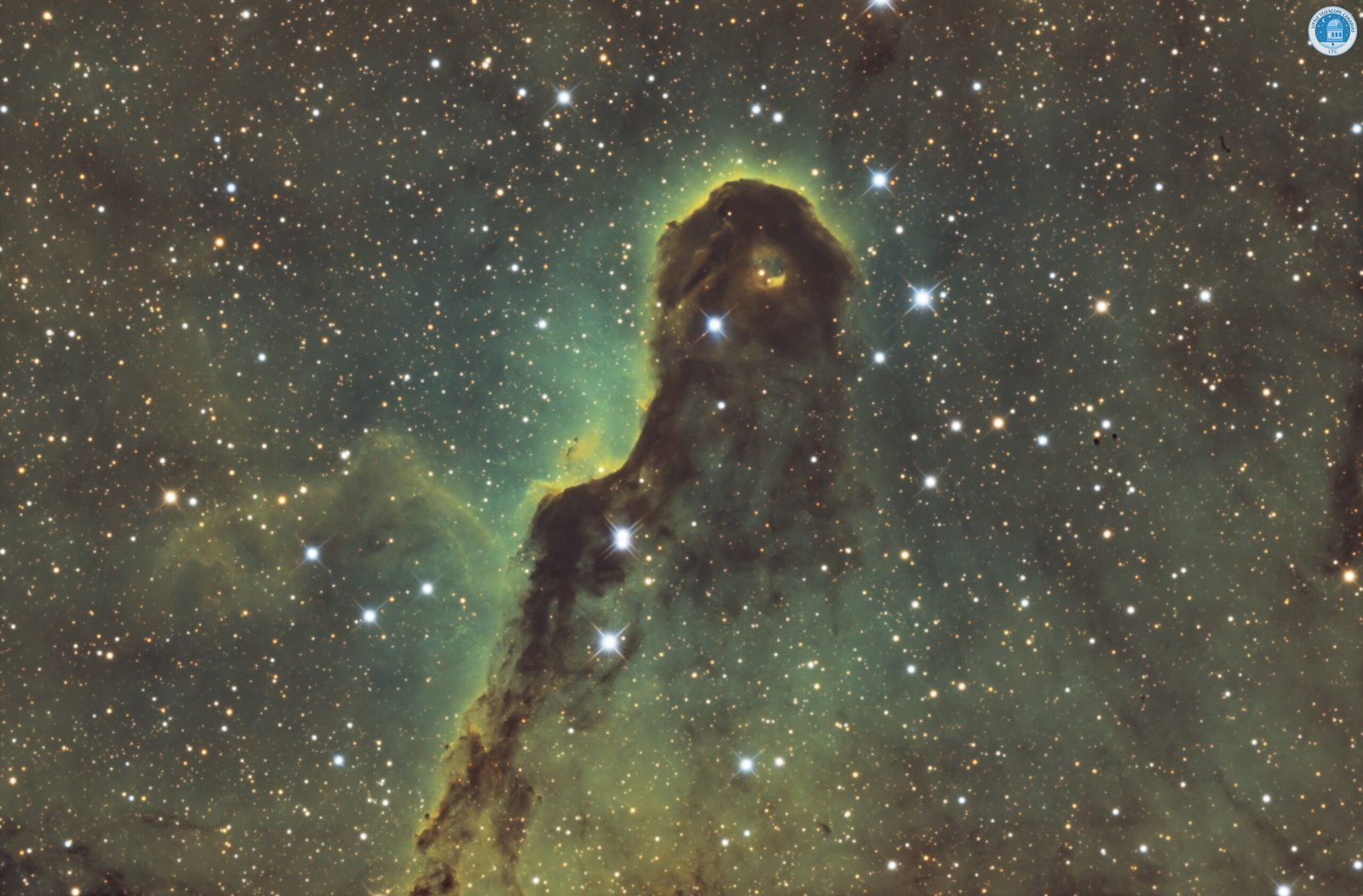
Within it lies the striking structure IC 1396A, a dark column of gas and dust that resembles an elephant’s trunk, sculpted by radiation from nearby stars.
💥 Cradles of new stars
IC 1396 is an active region where new stars are being born. Intense ultraviolet radiation from massive stars, especially HD 206267, ionizes the surrounding hydrogen, causing the nebula to glow in reddish tones.
At the same time, this radiation compresses the gas clouds, triggering gravitational collapse and the formation of new stars within dense structures like the Elephant Trunk.
📸 Images from LilTecan
The LilTecan team has captured this region using different filters, highlighting the contrast between bright ionized gas and dark dust clouds, as well as fine details in star-forming areas.
🌟 Structures sculpted by radiation
Modern studies have revealed key characteristics of this region:
- The Elephant Trunk is a Bok globule, a dense and cold cloud where stars form.
- It features filaments and gas pillars, shaped by radiation and stellar winds.
- Protostars and young stellar objects (YSOs) have been identified within it.
- The full IC 1396 region spans several degrees across the sky, corresponding to tens of light-years.
- The interaction between radiation and matter drives triggered star formation.
IC 1396 —and especially the Elephant Trunk Nebula— is a spectacular example of how massive stars can shape their environment and trigger the birth of new stellar generations.
Observing it today is like looking into a true stellar nursery, where cosmic gas and dust are slowly transformed into new stars, continuing the cycle of matter in the universe.