
M1 – The Crab Nebula
The Messier 1, known as the Crab Nebula, is a supernova remnant located in the constellation of Taurus, about 6,500 light-years from Earth. It was the first object cataloged by Charles Messier in 1758, although its origin dates back to a stellar explosion observed in the year 1054 by Chinese and Arab astronomers.
Its intricate network of glowing filaments and intense energy emission make it one of the most studied objects in the sky.
💥 The explosive death of a star
M1 is the result of a supernova, the violent explosion of a massive star at the end of its life. This event expelled its outer layers at high speed, creating an expanding cloud of gas and particles.
At its center lies the Crab Pulsar, an extremely dense neutron star rotating about 30 times per second. Its powerful magnetic field generates radiation across the entire electromagnetic spectrum, from radio waves to gamma rays.
📸 Images from LilTecan
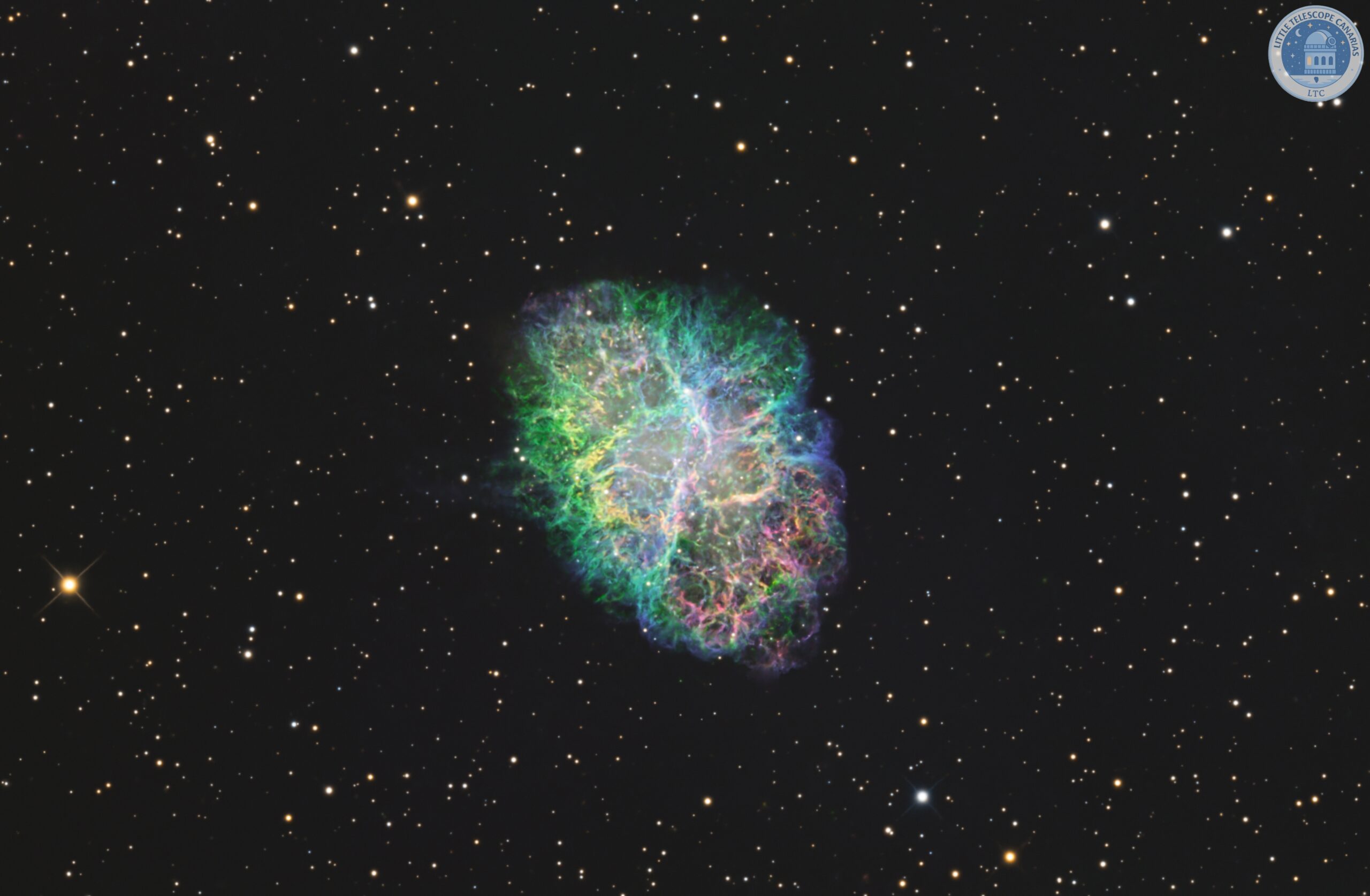
The LilTecan team has captured the Crab Nebula in multiple wavelengths, revealing the intricate filamentary structure and the energetic regions powered by the central pulsar.
🌟 A high-energy laboratory
Modern studies have revealed key aspects of its nature:
- The nebula shows a structure of ionized gas filaments, rich in hydrogen, oxygen, and sulfur.
- It is expanding at a speed of about 1,500 km/s, reaching a current size of roughly 11 light-years.
- The central pulsar powers a pulsar wind nebula, responsible for continuous emission in X-rays and radio.
- Its spectrum displays synchrotron emission, produced by relativistic electrons in strong magnetic fields.
- The energy released by the pulsar drives much of the nebula’s luminosity.
M1 —the Crab Nebula— is one of the most striking examples of the aftermath of a stellar explosion. Its combination of visual beauty and extreme physics makes it a key object for understanding supernovae and neutron stars.
🔭 Messier 1
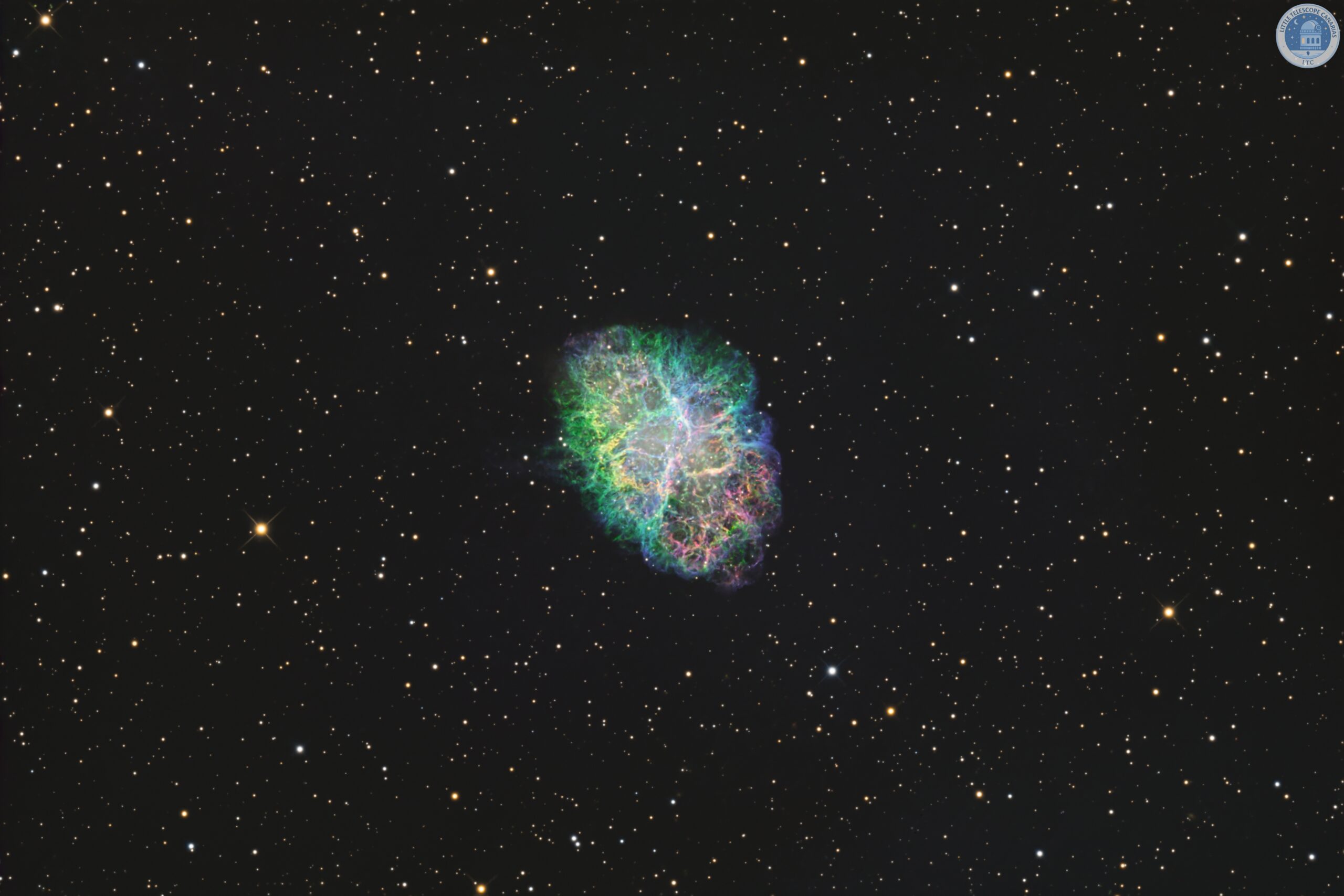
Observing it today is like witnessing an explosion that occurred nearly a thousand years ago, whose effects are still expanding through space, enriching the interstellar medium and reminding us of the dynamic and sometimes violent nature of the universe.