
M78 – A Reflection Nebula in Orion
The Messier 78, known as M78, is one of the brightest reflection nebulae in the sky, located in the constellation of Orion, about 1,350 light-years from Earth. It was discovered by Pierre Méchain in 1780 and later included in the catalog of Charles Messier.
Unlike many spectacular nebulae that shine by emission, M78 stands out for its soft bluish glow, produced by starlight reflected off interstellar dust.
💥 Light reflected in cosmic dust
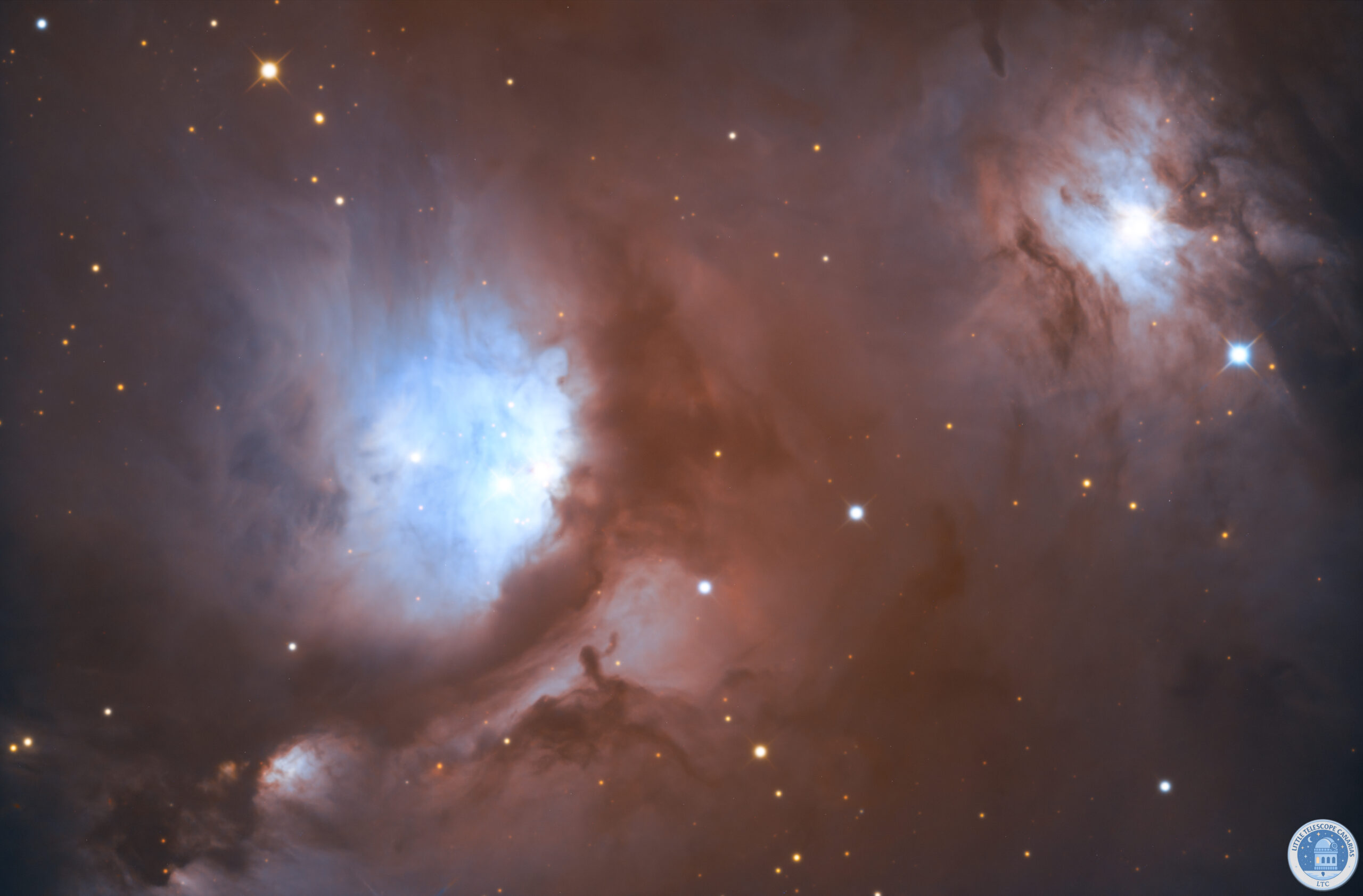
M78 does not significantly emit its own light; instead, it acts as a cosmic mirror. Dust within the nebula scatters light from nearby young stars, particularly HD 38563A and HD 38563B, producing its characteristic blue color, similar to Earth’s sky.
This type of nebula is essential for studying the early stages of star formation and the interaction between young stars and their environment.
📸 Images from LilTecan
The LilTecan team has captured the delicate structure of M78, revealing subtle brightness variations, dark dust regions, and small objects associated with star formation within it.
🌟 An active star-forming region
Modern observations have revealed key features of this object:
- M78 is part of the Orion Molecular Cloud Complex, a vast star-forming region.
- It contains embedded young stars that illuminate the surrounding dust.
- Herbig–Haro objects are present, representing jets of material ejected by forming stars.
- Dark dust regions obscure background light, creating contrast within the nebula.
- Its angular size is about 8 × 6 arcminutes, corresponding to several light-years in actual extent.
M78 is a fascinating example of how interstellar dust can reveal the presence of young stars. Its faint glow and blue color make it a subtle yet scientifically important object.
Observing it today is like peering into a stellar nursery, reminding us that the universe is not only a place of destruction, but also one where new generations of stars are continuously being born.