
M106 – The Galaxy with the Anomalous Arms
Messier 106, also cataloged as NGC 4258, is a remarkable spiral galaxy located in the constellation of Canes Venatici, approximately 23.5 million light-years from Earth. Discovered by Pierre Méchain in 1781, it is one of the brightest and most scientifically significant galaxies in the Messier catalog.
At first glance, M106 appears to be a fairly typical spiral galaxy. However, observations in radio, infrared, and X-ray wavelengths have revealed unique structures that make it one of the most fascinating laboratories for studying the interaction between a supermassive black hole and its host galaxy.
💥 A Supermassive Black Hole Shaping Its Galaxy
At the heart of M106 lies an active supermassive black hole, classified as a Seyfert Type II nucleus. This black hole is accreting surrounding material and producing energetic jets that interact with the gas in the galactic disk.
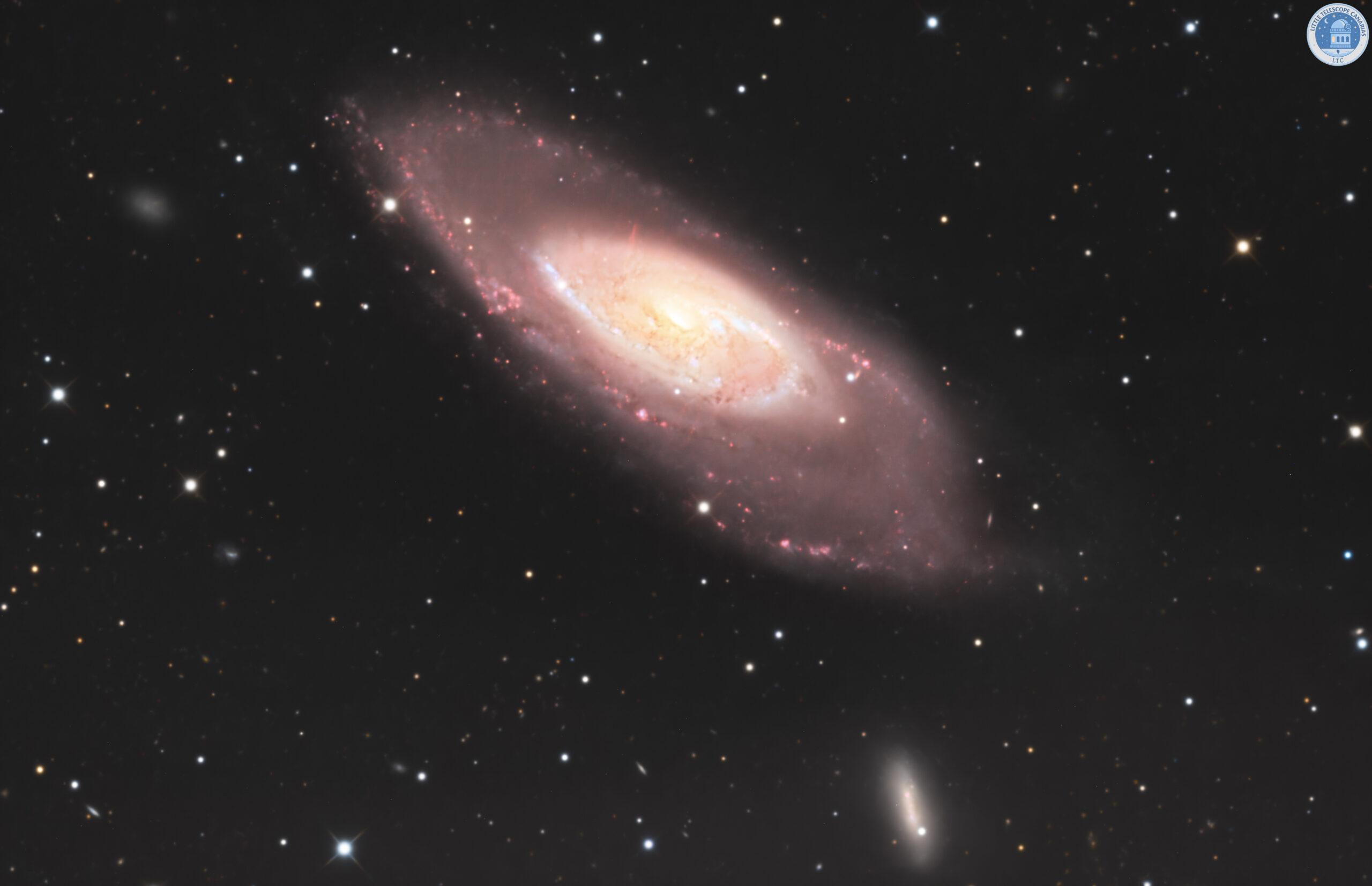
The most distinctive feature of M106 is its “anomalous arms”—two enormous gaseous structures that do not follow the normal pattern of the spiral arms. Unlike the spiral arms, these anomalous arms consist primarily of hot gas and are believed to be an indirect consequence of the jets produced by the central black hole.
In addition, M106 hosts one of the best-studied water megamasers, whose observations have enabled astronomers to measure the galaxy’s distance with exceptional precision using direct geometric methods. This has made M106 a fundamental object for calibrating the extragalactic distance scale.
📸 Images from LilTecan
The LilTecan team has captured M106, revealing its elegant spiral arms, the dark dust lanes crossing the disk, and the subtle traces of the anomalous arms emerging from the galaxy’s central regions.
🌟 Structure and Main Characteristics
Observational studies have revealed numerous remarkable features of this galaxy:
- It is classified as an intermediate spiral galaxy of type SAB(s)bc.
- It lies approximately 23.5 million light-years from Earth.
- It hosts an active supermassive black hole at its center.
- It features two anomalous arms, most prominently visible in radio and X-ray wavelengths.
- It contains a powerful water megamaser, used to calibrate extragalactic distance measurements.
- Its nuclear jets generate shock waves that heat the gas within the galactic disk.
M106 is much more than a beautiful spiral galaxy. It is a cornerstone of modern astronomy, having enabled highly accurate measurements of cosmic distances while providing valuable insights into how a supermassive black hole can influence the evolution of an entire galaxy.
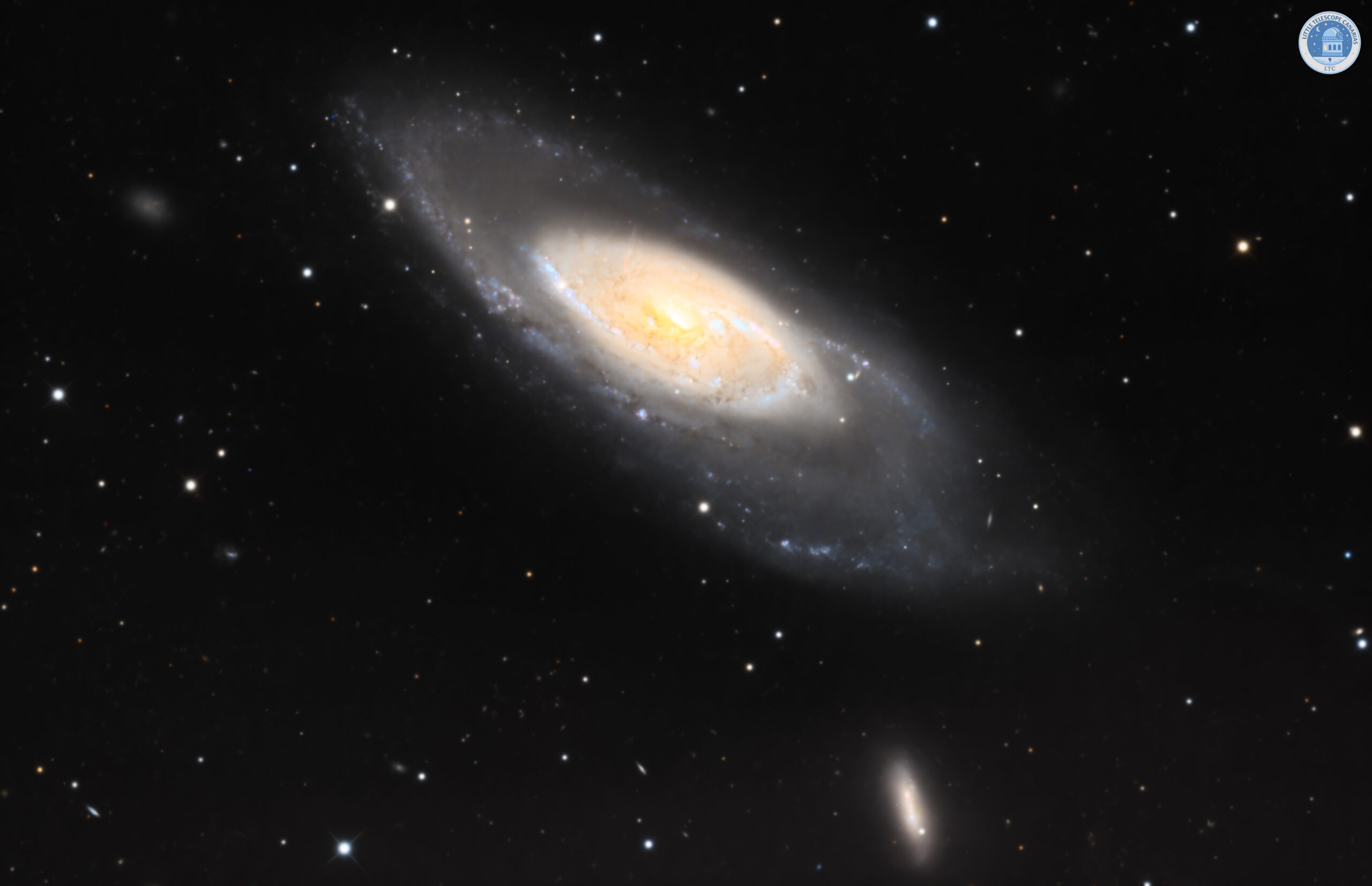
Observing this galaxy today is like witnessing a vast stellar metropolis where a central black hole continues to sculpt its galactic environment. Its mysterious anomalous arms remind us that even across hundreds of thousands of light-years, the universe’s most energetic phenomena can leave a visible imprint.