
Sh2-130 – A Faint H II Region in Cepheus
Sh2-130 (Sharpless 130) is an H II region located in the constellation of Cepheus, approximately 2,000 light-years from Earth. It is part of the catalog published by Stewart Sharpless in 1959, which lists some of the Milky Way’s most prominent ionized hydrogen regions.
Unlike many of the better-known emission nebulae, Sh2-130 has a very low surface brightness, making it a challenging target for both visual observation and long-exposure astrophotography.
💥 A Cloud of Ionized Hydrogen Illuminated by Young Stars
Sh2-130 is a cloud of ionized hydrogen (H II) whose emission is produced by ultraviolet radiation from nearby massive stars. This radiation strips electrons from hydrogen atoms, and when the electrons recombine, they produce the characteristic reddish glow observed in the Hα emission line.
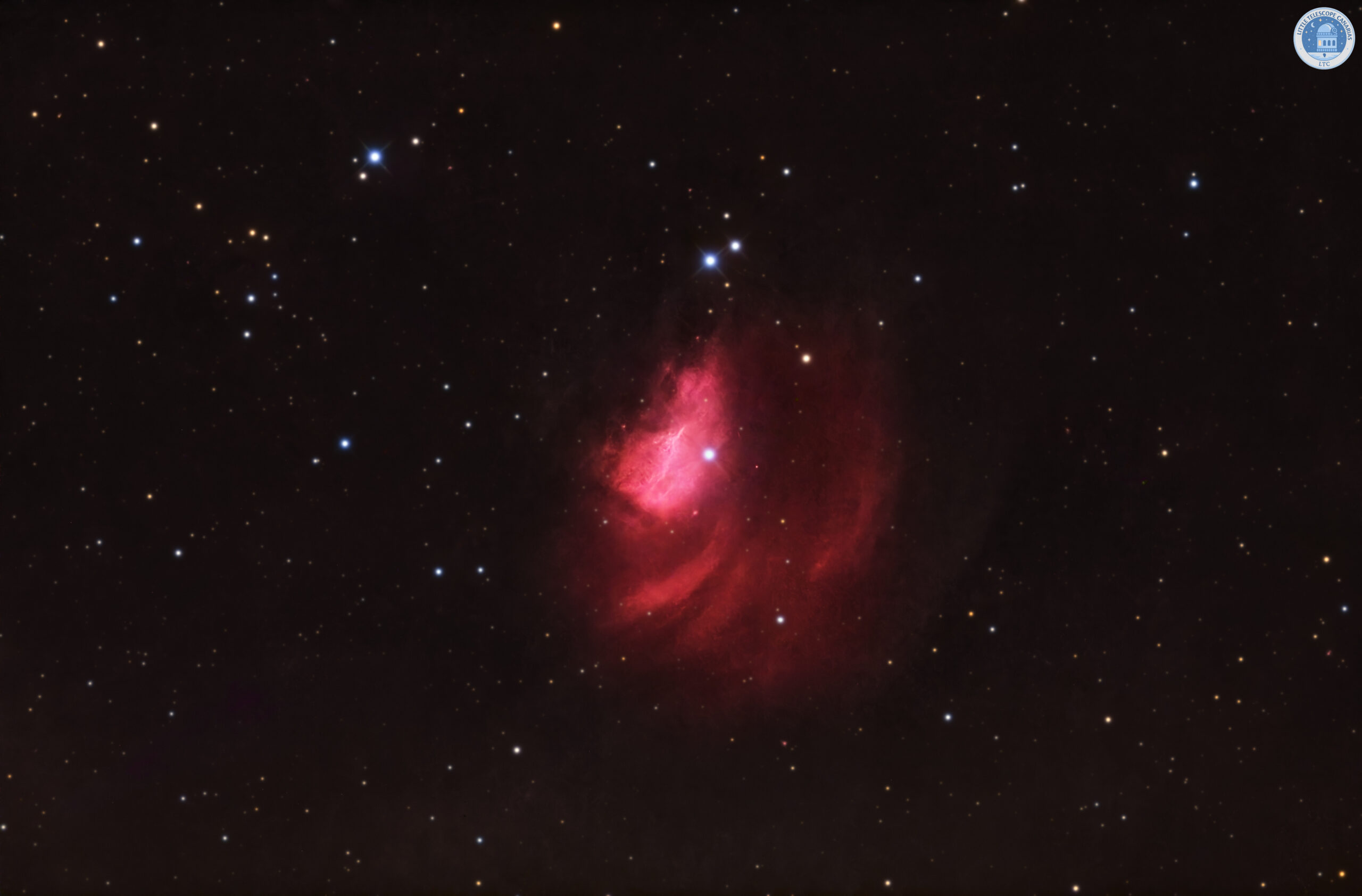
Although it is not one of the largest H II regions in the Sharpless catalog, it displays a delicate internal structure of filaments and condensations that responds exceptionally well to narrowband imaging, particularly in hydrogen-alpha.
📸 Images from LilTecan
The LilTecan team has imaged Sh2-130 using long narrowband exposures, revealing the nebula’s delicate filamentary structure and its faint emission halo, which is virtually invisible in shorter exposures.
🌟 Structure and Main Characteristics
The available observational data allow the following characteristics to be highlighted:
- It is classified as an H II region (emission nebula) in the Sharpless catalog.
- It is located in the constellation of Cepheus.
- Its estimated distance is approximately 2,000 light-years, although this value comes primarily from observational estimates and no widely accepted high-precision measurement currently exists.
- It has a very low surface brightness, making it particularly well suited to long-exposure astrophotography.
- It responds especially well to Hα narrowband filters, which reveal fine filaments and subtle internal structures.
- To date, there are no widely published detailed studies of its physical structure, kinematics, or associated stellar population, meaning that many of its properties remain poorly characterized.
Sh2-130 is one of those subtle objects that often goes unnoticed beside the great emission nebulae. Yet its faint luminosity and delicate structure make it an especially rewarding target for deep-sky astrophotography, where many hours of integration can reveal details that remain completely invisible to the naked eye.
Observing Sh2-130 today is like discovering one of the lesser-known regions of the Sharpless catalog. Its faint glow reminds us that the Milky Way still contains countless clouds of gas that remain only lightly explored, waiting to be revealed by increasingly sensitive telescopes.