
M77 – A Spiral Galaxy with an Exceptionally Active Core
In the constellation of Cetus (the Whale) lies Messier 77 (M77), one of the most interesting spiral galaxies in the deep sky. Also known as NGC 1068, it stands out for its spiral arms, numerous star-forming regions and, above all, for hosting one of the most extensively studied active galactic nuclei in the nearby Universe.
M77 is located approximately 45 million light-years from Earth, according to NASA and ESA data. It was discovered by the French astronomer Pierre Méchain in 1780 and was subsequently included in Charles Messier’s catalogue.
Its extremely bright nucleus conceals a phenomenon of great importance to astrophysics: a supermassive black hole that is actively accreting matter. This activity makes M77 one of the classic examples of a type 2 Seyfert galaxy.
🌌 A barred spiral galaxy
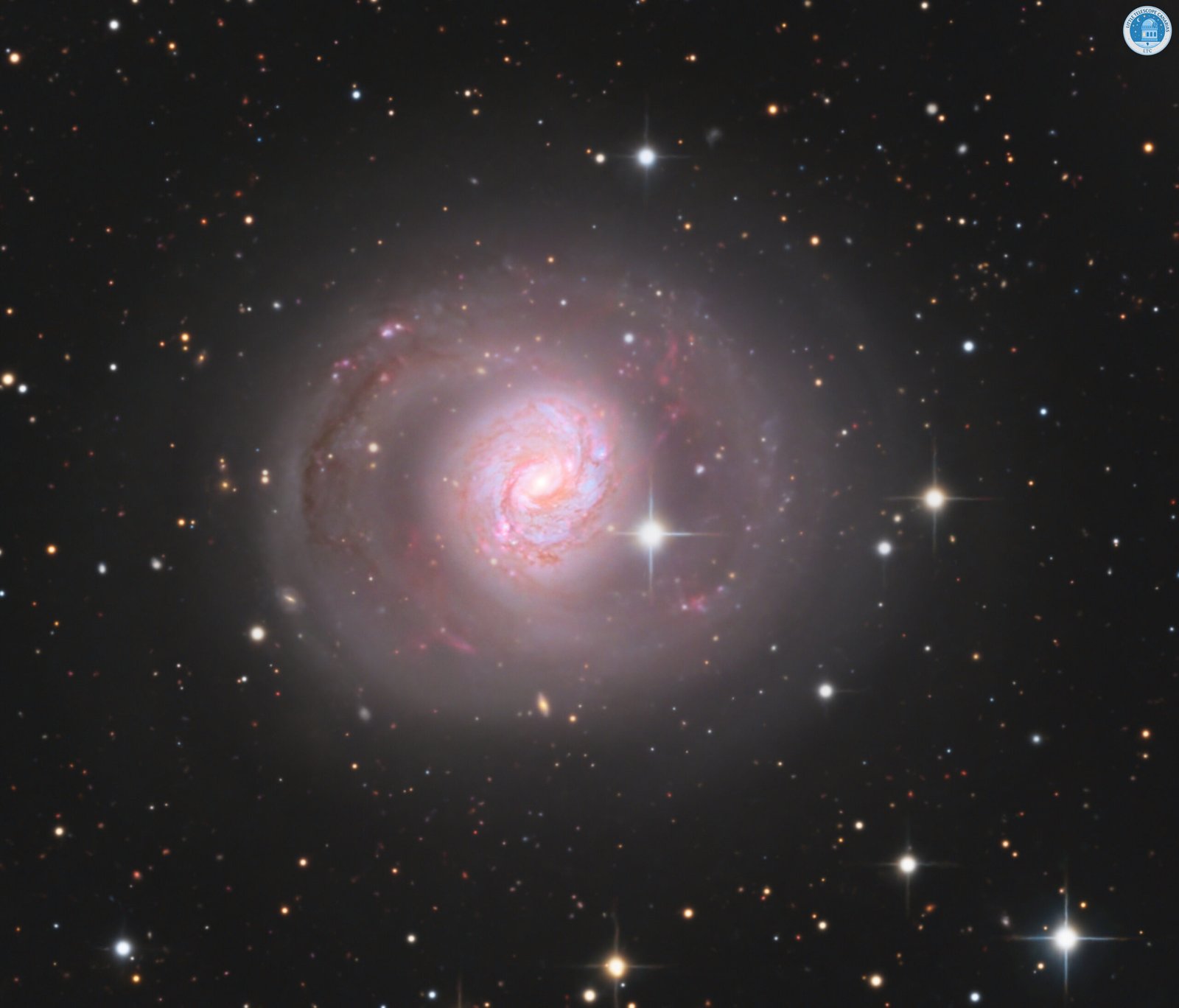
M77 has a spiral structure with a very bright central region and arms extending around the galactic disc. Infrared observations made by the James Webb Space Telescope have revealed a central bar that is less evident in images obtained in visible light.
This bar plays an important role in the galaxy’s dynamics, as it can help transport gas towards the inner regions. Surrounding the central area is a star-forming ring associated with the inner ends of the spiral arms.
High-resolution images also reveal numerous star-forming regions distributed throughout the arms, together with dark dust lanes crossing the disc and surrounding the nucleus.
M77 is an excellent example of how a galaxy’s internal structures can influence the distribution of gas and the formation of new stars.
📸 Images from LilTecan
M77 is an extraordinary target for galaxy astrophotography. Its apparent size, bright nucleus and spiral arms make it possible to capture images rich in detail.
LRGB exposures reveal the galaxy’s overall structure, highlighting the nucleus, spiral arms and dust lanes. The use of narrowband filters, especially Hα, can help bring out star-forming regions where hydrogen is ionised.
A deep integration also makes it possible to capture the fainter regions of the outer arms and improve the separation between bright areas and dark dust structures.
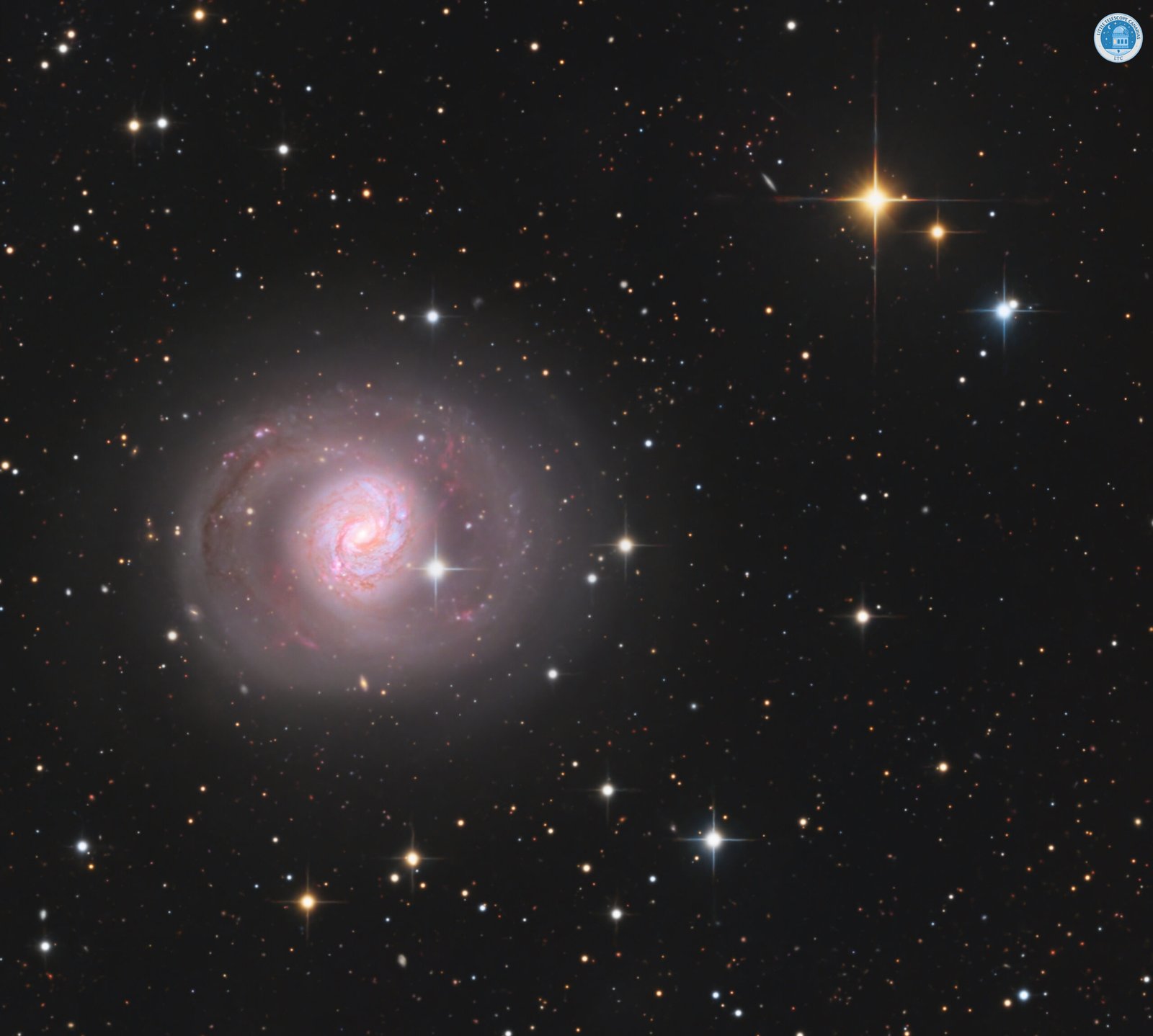
From LilTecan, under the exceptional skies of La Palma, M77 is an excellent target for exploring the structure of an active galaxy and showcasing the diversity of processes taking place within it.
🌟 Main characteristics and structure
M77 brings together several features that make it a particularly interesting galaxy:
- Object type: Barred spiral galaxy and Seyfert type 2 galaxy, located in the constellation of Cetus.
- Distance: Approximately 45 million light-years.
- Nucleus: Hosts a supermassive black hole surrounded by a complex structure of gas and dust.
- Star formation: Features a central ring of intense star-forming activity, as well as active regions distributed throughout its spiral arms.
⭐ An active galactic nucleus: the Seyfert 2 galaxy
One of M77’s most important characteristics is its classification as a Seyfert type 2 galaxy.
Seyfert galaxies are a class of active galaxies whose nuclei emit extraordinary amounts of energy. In M77, this activity is associated with a supermassive black hole located at the centre of the galaxy.
The black hole attracts gas and dust from its surroundings. Some of this material forms an accretion disc which, as it heats up through physical processes associated with its motion and friction, releases large amounts of energy across different wavelengths.
In type 2 Seyfert galaxies, the innermost regions closest to the black hole are partially obscured by gas and dust. For this reason, infrared, X-ray and radio observations are particularly important for studying M77’s nucleus.
Its nuclear activity makes M77 a key object for investigating how supermassive black holes are fuelled and how they interact with their host galaxies.
🔭 The torus of gas and dust surrounding the black hole
At the centre of M77, a compact structure of gas and dust surrounds the region containing the supermassive black hole. This structure is commonly described as a molecular torus, although observations show that its geometry and movements are considerably more complex than those of a simple, uniform ring.
Observations made with the ALMA radio telescope have allowed astronomers to study this environment with extraordinary resolution. The data reveal an asymmetric, turbulent molecular disc, with gas motions that cannot be explained solely by regular rotation.
Studies have also identified gas flows moving outwards. These motions are related to the activity of the galactic nucleus and show how the energy released by the black hole can affect the surrounding material.
In 2025, new high-resolution ALMA observations provided a more detailed view of the structure and kinematics of molecular gas close to the nucleus. The results revealed a dynamic and complex environment, with asymmetries, turbulence and possible inflows of material towards the central region.
🌌 M77 from La Palma
M77 is much more than a relatively nearby spiral galaxy. Its active nucleus provides an opportunity to study some of the most energetic phenomena in the Universe, while its arms and star-forming regions reveal how the galactic disc continues to evolve.
The combination of optical, infrared and radio observations has helped astronomers better understand the relationship between the central black hole, molecular gas and the formation of new stars.
From La Palma, M77 is a particularly attractive target for deep-sky astrophotography. Its bright nucleus and spiral arms offer an interesting contrast that can be explored through long exposures and different filters.
At LilTecan, photographing galaxies such as M77 allows us to get closer to some of the most fascinating processes in galactic evolution: from the birth of new stars to the activity of supermassive black holes.