
NGC 246 – The Skull Nebula
The planetary nebula NGC 246, known as the Skull Nebula and also catalogued as Caldwell 56, is located in the southern constellation of Cetus, the Whale.
Its appearance resembles a skull suspended in space, a shape that stands out particularly in high-resolution astronomical images. This nebula is the result of the outer layers expelled by a star during the final stages of its evolution. At its centre remains a white dwarf, the hot core of the original star, illuminating the expelled material.
🌌 The Final Stages of a Star
Planetary nebulae represent an advanced stage in the evolution of certain stars. When a low- or intermediate-mass star reaches the end of its life, it can expel its outer layers into space. The exposed core becomes a white dwarf, whose radiation ionizes the surrounding gas and causes it to glow.
In NGC 246, the expelled gas forms a slightly elliptical structure. Observations reveal differences in brightness across the nebula: the western envelope is brighter than the eastern one. Researchers have suggested that this asymmetry could be related to the interaction between the nebula and the interstellar medium as it moves through space.
The nebula is located approximately 1,600 light-years from Earth, according to information published by ESO and NASA. However, some scientific studies have obtained shorter distances, around 500 parsecs, so this figure should be considered an estimate rather than a definitive measurement.
📸 Images from LilTecan
NGC 246 is an attractive target for deep-sky astrophotography, thanks to its distinctive shape and the contrast between the bright gas and the fainter regions of its envelope.
High-resolution images allow us to study the distribution of the expelled material and distinguish brightness variations across different parts of the nebula. They also help reveal the central star and its immediate surroundings.
Combining broadband LRGB filters can show the overall appearance of the nebula and the colours of its stars. Narrowband filters such as Hα, OIII and SII, meanwhile, allow us to investigate the emission from different species present in the gas, provided there is sufficient signal in the corresponding emission lines.
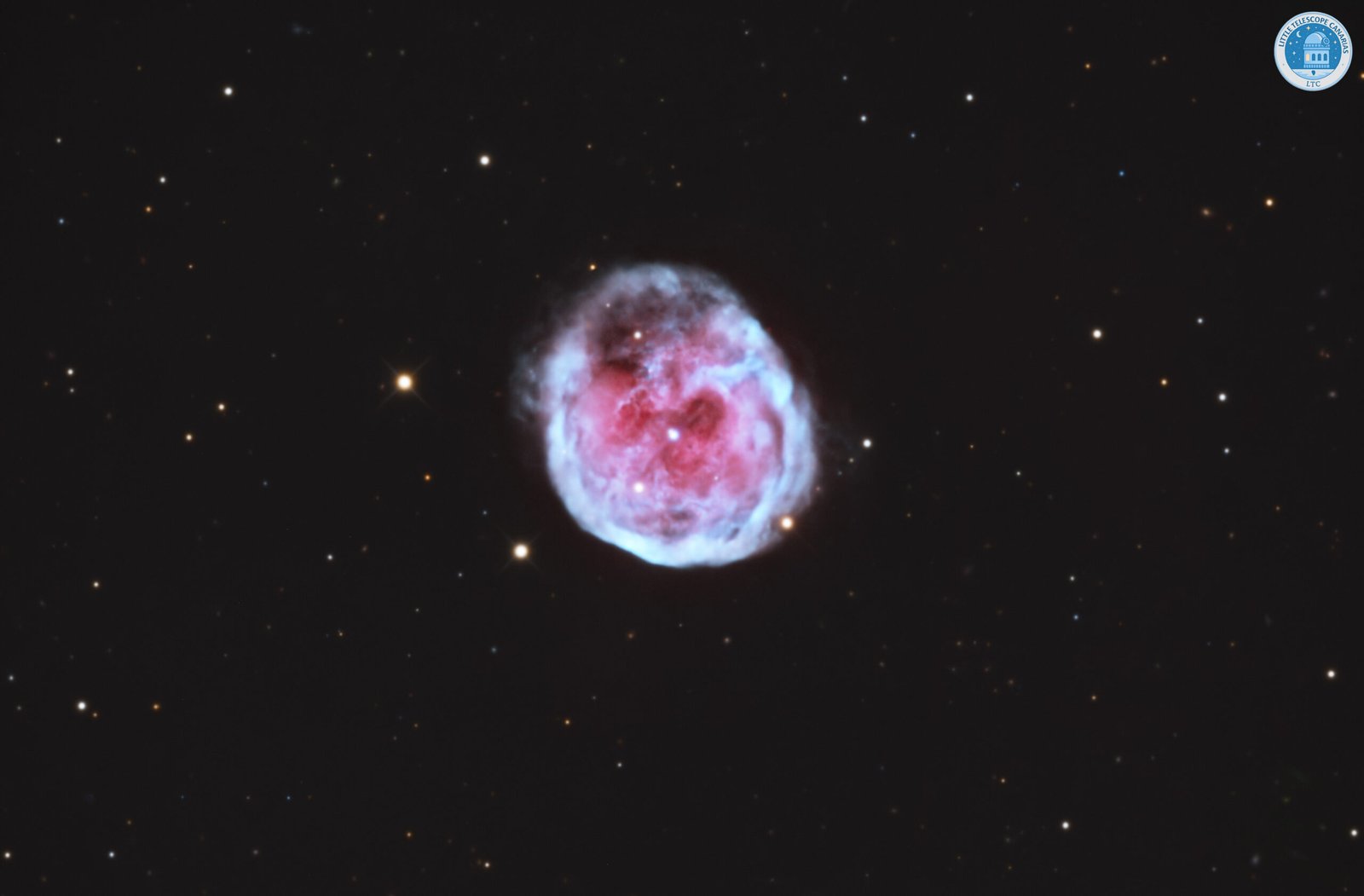
From LilTecan, beneath the exceptional skies of La Palma, deep integration with the 12-inch RC telescope and IMX571 camera offers the opportunity to explore the structure of this nebula and capture faint details that may go unnoticed in short exposures.
⭐ A Triple Star System at Its Centre
One of the most interesting features of NGC 246 is its central star system.
In 2014, a study published in Monthly Notices of the Royal Astronomical Society identified a three-star hierarchical system associated with the centre of the nebula. The main star is a hot white dwarf, accompanied by a nearby star and a third companion located farther away.
This discovery made NGC 246 a particularly interesting case for studying the relationship between multiple-star systems and the formation of planetary nebulae.
The central star has also been studied for its physical properties and pulsations. Research published in Astronomy & Astrophysics identifies it as a PG 1159-type star, a class of hot, hydrogen-deficient objects found at an advanced stage of stellar evolution.
🌟 Main Structure and Characteristics
NGC 246 can be summarized by a few key characteristics:
- Object type: planetary nebula.
- Other names: Skull Nebula and Caldwell 56.
- Constellation: Cetus, the Whale.
- Distance: approximately 1,600 light-years according to ESO and NASA, although different scientific estimates exist.
- Morphology: slightly elliptical structure, with brightness differences between its eastern and western regions.
- Central system: hierarchical triple-star system, with a hot white dwarf as the primary star.

🔭 A Structure That Reveals Stellar Evolution
NGC 246 is much more than a nebula with a striking appearance. Its gaseous envelope allows us to study the material expelled by a star at the end of its evolution, while its central system provides insight into how stellar companions may contribute to the history of a planetary nebula.
The brightness differences observed across the envelope also raise questions about the nebula’s motion and its interaction with the interstellar medium. Although this explanation is consistent with published research, it should not be interpreted as a definitively established cause for every observed structure.
The combination of these features makes NGC 246 an interesting target for both astronomical research and astrophotography.
🌌 NGC 246 from La Palma
From La Palma, NGC 246 is an interesting target for astronomical observation and imaging. Its position in the constellation of Cetus makes it important to plan observations according to its altitude above the horizon and the time of year.
Images acquired with long integrations can help reveal the gaseous envelope and its brightness variations. Combining LRGB and narrowband filters makes it possible to explore different features of the nebula while keeping in mind that each filter records a different part of the signal.
At LilTecan, objects such as NGC 246 offer an opportunity to explore the final stages of stellar evolution and observe how a star transforms its surroundings before leaving behind a white dwarf.