
IC 342 – The Hidden Galaxy
IC 342 is a spiral galaxy located in the constellation of Camelopardalis, the Giraffe. It is one of the relatively nearby galaxies to the Milky Way, yet it is surprisingly difficult to observe because it lies behind the plane of our own galaxy.
The large amount of stars, gas and dust in the Milky Way between us and IC 342 obscures and reddens its light. This has given rise to its popular name, the “Hidden Galaxy.”
Despite this difficulty, observations at infrared wavelengths and images obtained with the Hubble Space Telescope have made it possible to study its spiral arms, star-forming regions and bright central region in considerable detail.
🌌 A Galaxy Hidden Behind the Milky Way
IC 342 lies close to the Galactic equator, a region of the sky where our own galaxy contains large quantities of interstellar dust and numerous stars.
From our perspective, all this material lies between IC 342 and us. As a result, although the galaxy is relatively bright and extended, observing it in visible light is much more difficult than might be expected.
Infrared observations are particularly useful in this case because infrared radiation can pass through much of the dust that blocks visible light. Images obtained with WISE and Spitzer have helped astronomers study the distribution of dust, gas and star-forming regions throughout the galaxy.
NASA notes that, without the obscuration caused by our own galaxy, IC 342 would be one of the most prominent galactic objects in the sky.
📸 Images from LilTecan
IC 342 is a particularly interesting target for deep-sky astrophotography, although its position behind the plane of the Milky Way makes imaging it a real challenge.
In a long-exposure optical image, we can appreciate the galaxy’s spiral arms, but a large number of foreground stars belonging to our own galaxy are also superimposed on the field.
The dust in the Milky Way also reduces IC 342’s apparent brightness and alters its colours, making some of its structures much more difficult to capture.
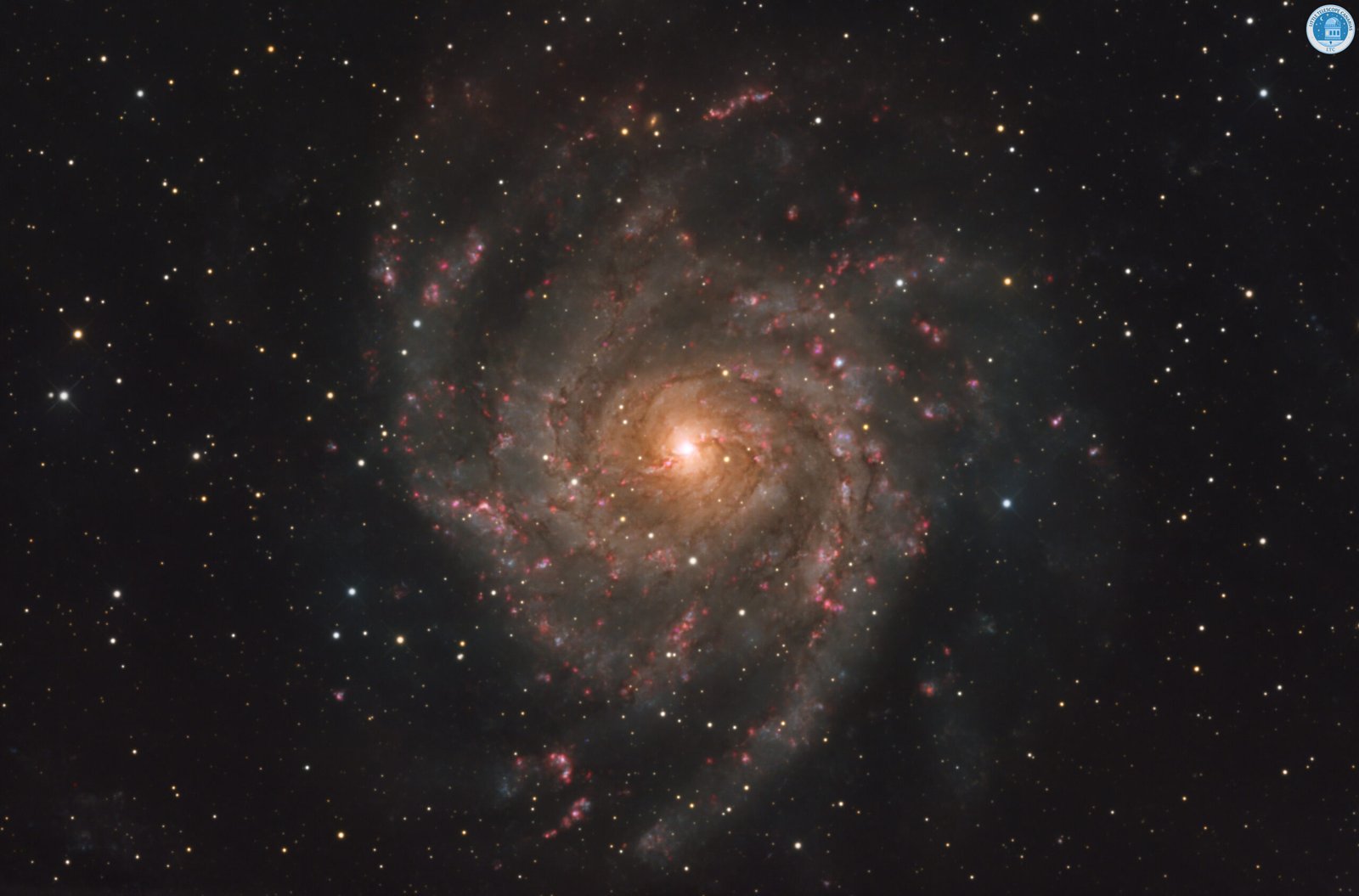
From LilTecan, beneath the exceptional skies of La Palma, a deep integration allows us to try to recover the faintest structures in this galaxy and, as far as possible, separate its delicate features from the multitude of stars and nebulae in the foreground of our own Milky Way.
🌟 Main Structure and Characteristics
IC 342 can be summarized by a few key characteristics:
- It is a spiral galaxy located in the constellation of Camelopardalis.
- SIMBAD lists its morphological classification as Sc.
- It has an optical angular size of approximately 21.9 × 20.9 arcminutes.
- It lies approximately 10–11 million light-years away, although its distance is difficult to determine precisely because of the strong obscuration caused by the Milky Way.
- It contains numerous star-forming regions, both in its arms and in its central region.
- Its nucleus exhibits the characteristics of an H II region.
- It belongs to the same galaxy group as Maffei 2.
🔭 A Galaxy Whose Distance Is Difficult to Measure
Determining the distance to IC 342 has historically been challenging because of the large amount of dust between us and the galaxy.
NASA/JPL reports that published estimates have placed its distance at approximately 6.6 to 11 million light-years, depending on the method used. Other NASA and ESA sources adopt values closer to 10–11 million light-years.
For this reason, it is preferable not to present a single distance as absolutely precise. For general astronomical communication, a distance of around 10 million light-years adequately represents the estimates used by NASA, ESA and other astronomical sources.
🌌 The Heart of IC 342
The central region of IC 342 is particularly active.
Infrared observations made by Spitzer revealed strong emission from the central region, associated with intense star formation. On either side of the centre, a small structure of gas and dust can be seen, which may help channel material towards the inner regions.
Hubble observations also reveal a combination of blue regions associated with young stars, ionized gas and large dark dust lanes.
This mixture of young stars, gas and dust makes IC 342 a natural laboratory for studying the processes that regulate star formation in spiral galaxies.
🌌 IC 342 from La Palma
Observing IC 342 means looking towards a galaxy that is relatively close in cosmological terms, but whose light must first pass through a considerable portion of our own Milky Way.
The galaxy is there, with its enormous spiral arms, star-forming regions and bright nucleus, yet much of its light reaches us weakened and reddened by the interstellar dust in our own galaxy.
This makes IC 342 a particularly attractive target for deep astrophotography. A short exposure may show mainly the Milky Way stars in the foreground, while a long integration begins to reveal the structure of the galaxy behind them.
From LilTecan, the skies of La Palma provide the conditions needed to take on this challenge and capture the delicate structure of one of the great spiral galaxies in our cosmic neighbourhood.
Ultimately, IC 342 is a magnificent example of how a galaxy’s position relative to our own can determine how well we can observe it, even when it is relatively bright and nearby.