
NGC 660 – A Galaxy with a Polar Ring
NGC 660 is a peculiar galaxy located in the constellation of Pisces, at an approximate distance of 40–45 million light-years. Its most extraordinary feature is the presence of a polar ring, a structure made of gas, dust and stars that orbits around the galaxy in a plane strongly inclined relative to its main disk.
Polar-ring galaxies are extremely rare objects and provide an exceptional opportunity to study galactic dynamics, the distribution of matter and the processes involved in galaxy interactions.
In the case of NGC 660, the ring is thought to be related to an ancient gravitational interaction with another galaxy. Observations and models indicate that this encounter may have occurred approximately 1 billion years ago.
🌌 A Galaxy with an Extraordinary Structure
At first glance, NGC 660 may appear to be a relatively normal spiral galaxy. However, when studied in greater detail, a much more complex structure emerges.
The galaxy’s main disk is surrounded by a structure of stars, gas and dust whose plane is strongly inclined relative to the central disk. This configuration is what defines NGC 660 as a polar-ring galaxy.
Polar rings are particularly interesting because they contain material moving in an orientation different from that of the main disk. Their origin may be related to gravitational interactions, mergers or the capture of material from another galaxy.
In NGC 660, the hypothesis of a past interaction is one of the main explanations proposed for the origin of this unusual configuration.
📸 Images from LilTecan
NGC 660 is a particularly attractive target for deep-sky astrophotography.
In a long-exposure image, the main structure of the galaxy can be seen, but deep exposures also make it possible to try to reveal the fainter regions surrounding the disk.
The presence of the polar ring makes NGC 660 a particularly interesting object to image using LRGB, since a long integration can help distinguish the different structures that make up the system.
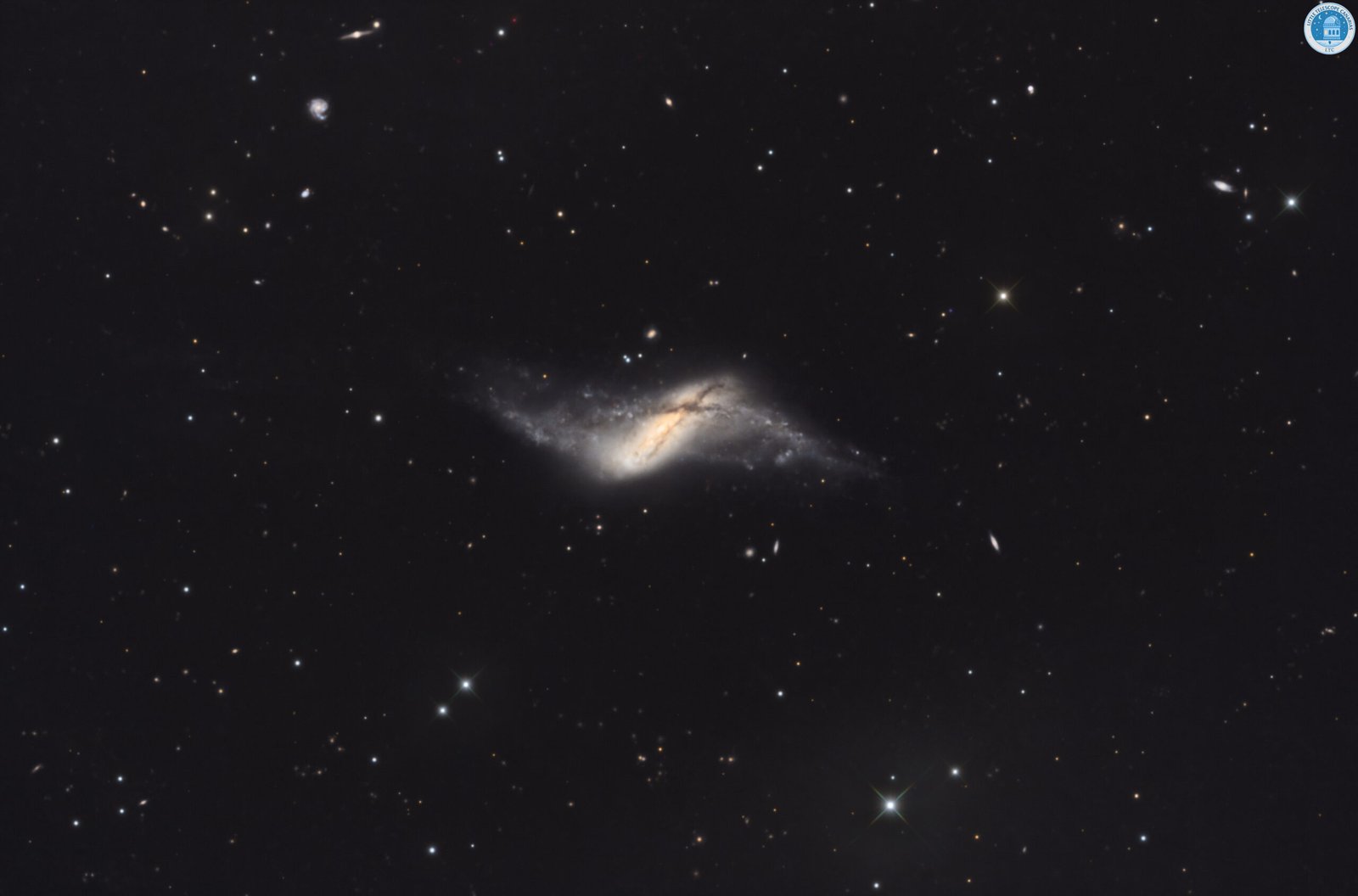
From LilTecan, beneath the exceptional skies of La Palma, a deep integration allows us to explore the structure of this peculiar galaxy and search for the faintest regions of its disk and surroundings.
🌟 Main Structure and Characteristics
NGC 660 can be summarized by a few key characteristics:
- It is a peculiar galaxy located in the constellation of Pisces.
- It is classified as a polar-ring galaxy.
- SIMBAD currently identifies it as a Seyfert 2 galaxy.
- It is located approximately 40–45 million light-years away, depending on the estimate considered.
- Its ring contains stars, gas and dust and is strongly inclined relative to the main disk.
- The ring may extend approximately 50,000 light-years.
- Its structure is probably related to an ancient gravitational interaction.
🔭 A Galaxy Shaped by an Ancient Interaction
The origin of polar rings remains an active subject of study. One of the main explanations proposes that these structures can form when a galaxy captures material from another galaxy during a gravitational interaction.
In NGC 660, ESA/Hubble indicates that the ring may have originated from material stripped from a neighbouring galaxy during an encounter that occurred approximately 1 billion years ago.
The captured material would have eventually become distributed around the galaxy in a plane different from that of its original disk.
This configuration provides an exceptional opportunity to study galactic dynamics. The motion of material in the ring and disk can be used to investigate the distribution of mass within the galaxy and, in particular, to obtain information about its dark matter halo.
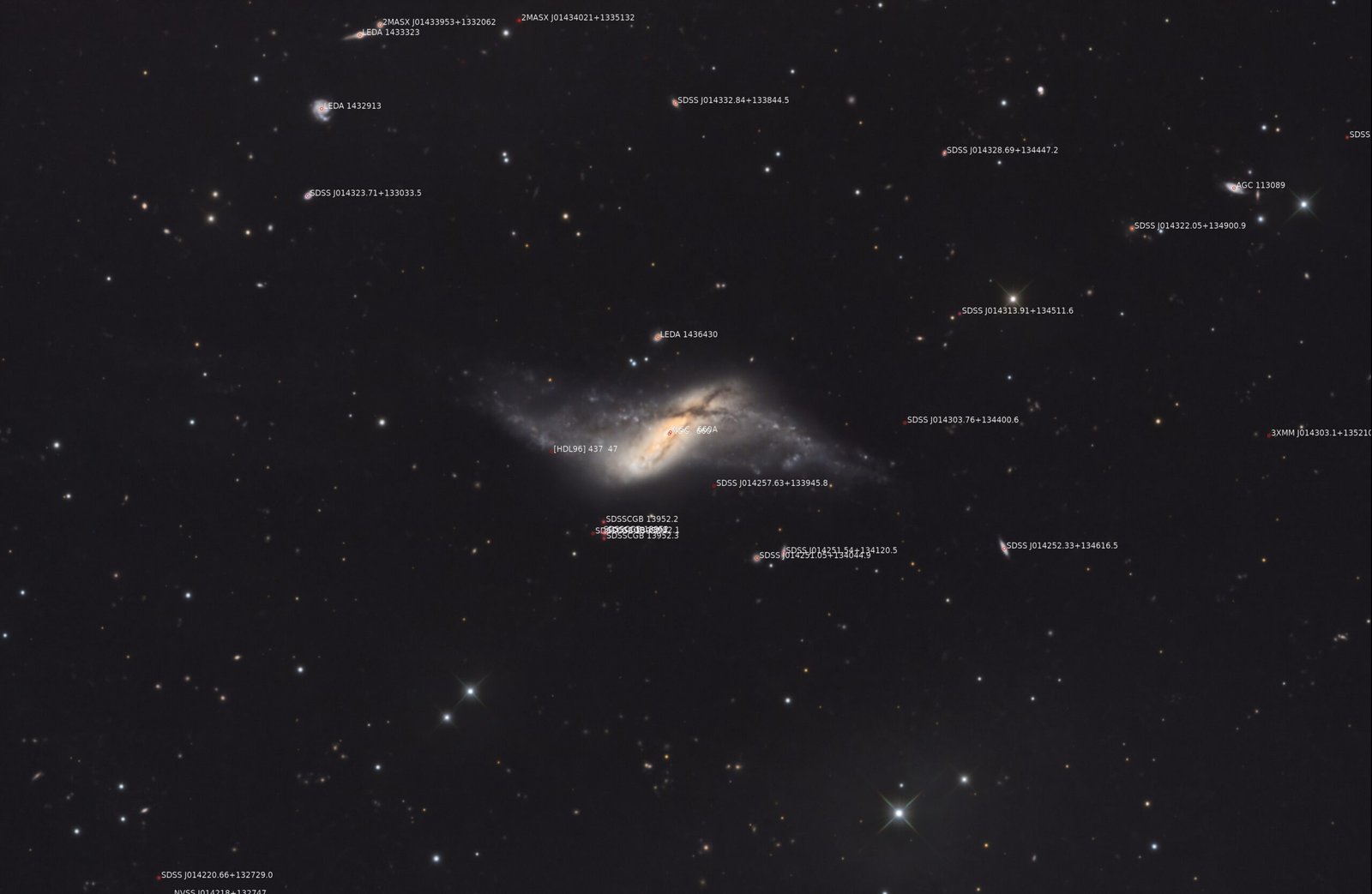
⭐ A Highly Active Central Region
NGC 660 also stands out because of the activity occurring in its central region.
SIMBAD currently classifies the galaxy as a Seyfert 2 galaxy, indicating that its nucleus exhibits characteristics associated with this type of active galaxy.
In 2012, an intense outburst of emission was also observed coming from the central region. ESA/Hubble described this phenomenon as emission approximately ten times more luminous than a supernova explosion, interpreted at the time as possibly being associated with a powerful jet originating from the vicinity of the central supermassive black hole.
This event made NGC 660 an even more interesting object for studying the relationship between nuclear activity and galaxy evolution.
🌌 NGC 660 from La Palma
Observing NGC 660 means looking at a galaxy whose structure preserves the consequences of an interaction that took place hundreds of millions of years ago.
Its main disk, peculiar polar ring, star-forming regions and active nucleus form an extraordinarily complex system.
For astrophotography, the challenge is to record both the bright central region and the much fainter structures extending around it.
From LilTecan, a deep integration beneath the skies of La Palma allows us to explore this system and reveal the complex architecture of one of the most interesting polar-ring galaxies in our cosmic neighbourhood.
NGC 660 is, ultimately, a magnificent example of how gravitational interactions can transform the structure of a galaxy and leave a visible imprint for billions of years.