
NGC 672 and IC 1727 – A Pair of Interacting Galaxies
NGC 672 and IC 1727 form a remarkable pair of interacting galaxies located in the constellation of Triangulum. At a distance of roughly 7 million parsecs, or around 23 million light-years, they are close enough for their mutual gravity to have significantly affected their structures.
Far from being two isolated galaxies, observations reveal bridges and distortions in their neutral hydrogen, as well as asymmetric structures and episodes of enhanced star formation. Their interaction provides an excellent example of how gravitational encounters can reshape galaxies over astronomical timescales.
🌌 Two Galaxies Bound by Gravity
NGC 672 and IC 1727 are a well-studied interacting pair. Radio observations of neutral hydrogen have revealed a connection between the two galaxies in the form of an extended H I bridge, together with disturbed velocity fields.
These observations indicate that their gravitational interaction has significantly influenced their interstellar gas. The galaxies are also relatively isolated from much more massive systems, making this pair particularly interesting for studying galaxy–galaxy interactions without the dominant influence of a large galaxy.
Studies based on Hubble Space Telescope observations have found evidence that both galaxies experienced enhanced star formation during similar periods, approximately 20–30 million years ago and again several hundred million years ago. These episodes are consistent with repeated close encounters between the two galaxies.
📸 Images from LilTecan
NGC 672 and IC 1727 are a particularly attractive target for deep-sky astrophotography.
In a long-exposure image, the two galaxies immediately stand out, but deep imaging also allows us to explore their fainter structures and the outer regions affected by their interaction.
NGC 672 shows its spiral arms relatively clearly, while IC 1727 has a more irregular and asymmetric appearance.
Broadband LRGB imaging is particularly well suited to showing the contrast between the two galaxies and revealing their different stellar structures.
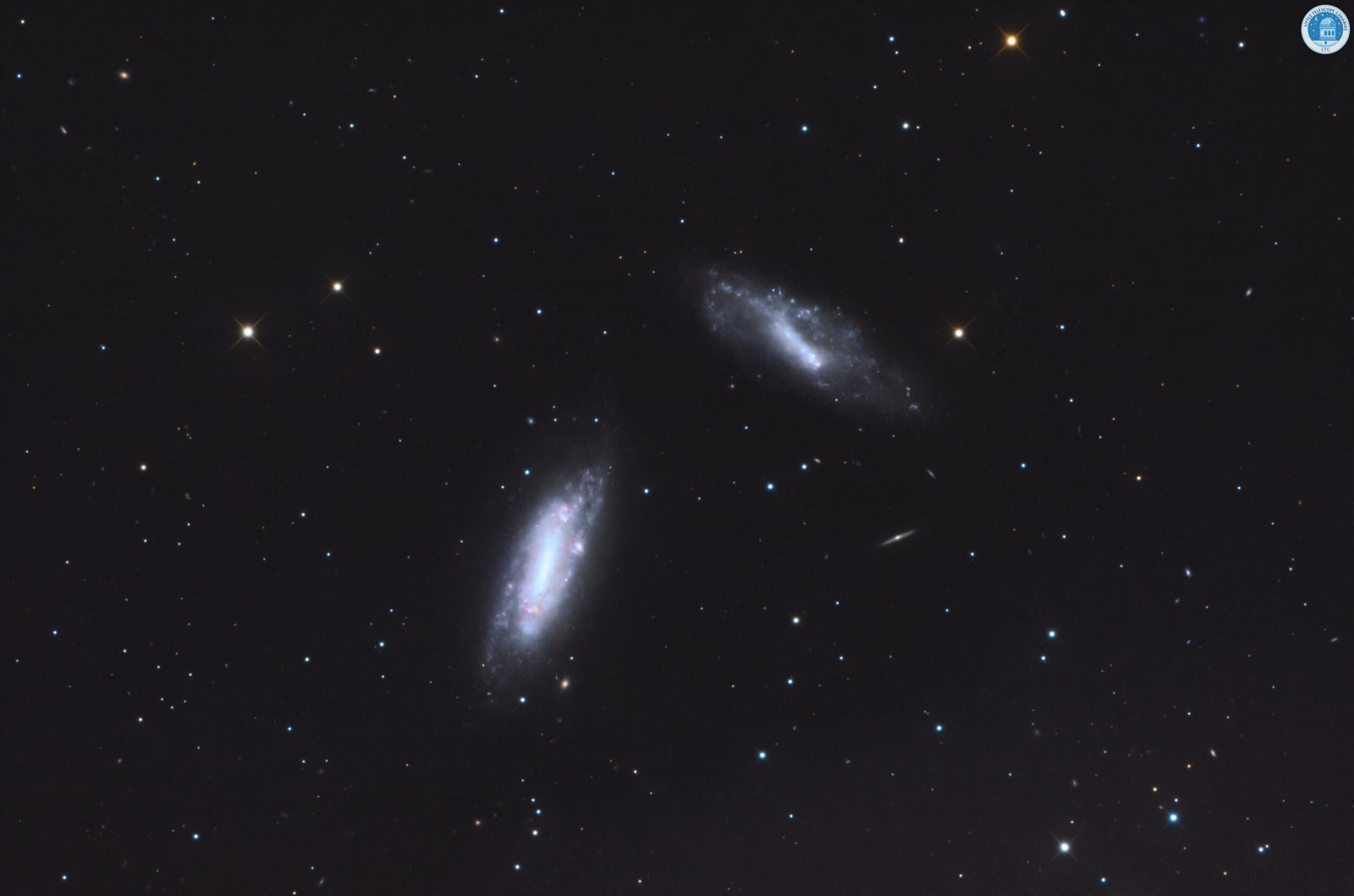
From LilTecan, beneath the exceptional skies of La Palma, a deep integration allows us to study this galaxy system and search for the faint structures extending around its main components.
🌟 Main Structure and Characteristics
The NGC 672 / IC 1727 system can be summarized by a few key characteristics:
- NGC 672 is a barred spiral galaxy classified as SB(s)cd.
- IC 1727 is a late-type barred spiral galaxy with a notably disturbed structure.
- Both galaxies are located approximately 7.2 Mpc away.
- Their centers are separated by about 19 kpc.
- A bridge of neutral hydrogen (H I) exists between the two galaxies.
- The interaction has produced significant structural disturbances, particularly visible in IC 1727.
🔭 An Interaction That Leaves Its Mark
The interaction between NGC 672 and IC 1727 is not merely a visual alignment. Multiple independent observations provide evidence of a genuine gravitational encounter.
The H I bridge connecting the galaxies, the disturbed gas velocities, the asymmetric stellar structures and the enhanced episodes of star formation all point toward a long-lasting interaction.
In particular, IC 1727 appears to have been strongly affected. Its distorted morphology and displaced nucleus illustrate how gravitational forces can redistribute both stars and gas within a galaxy.
These interactions are important in galaxy evolution because they can redistribute material, trigger new generations of stars and modify the morphology of the galaxies involved.
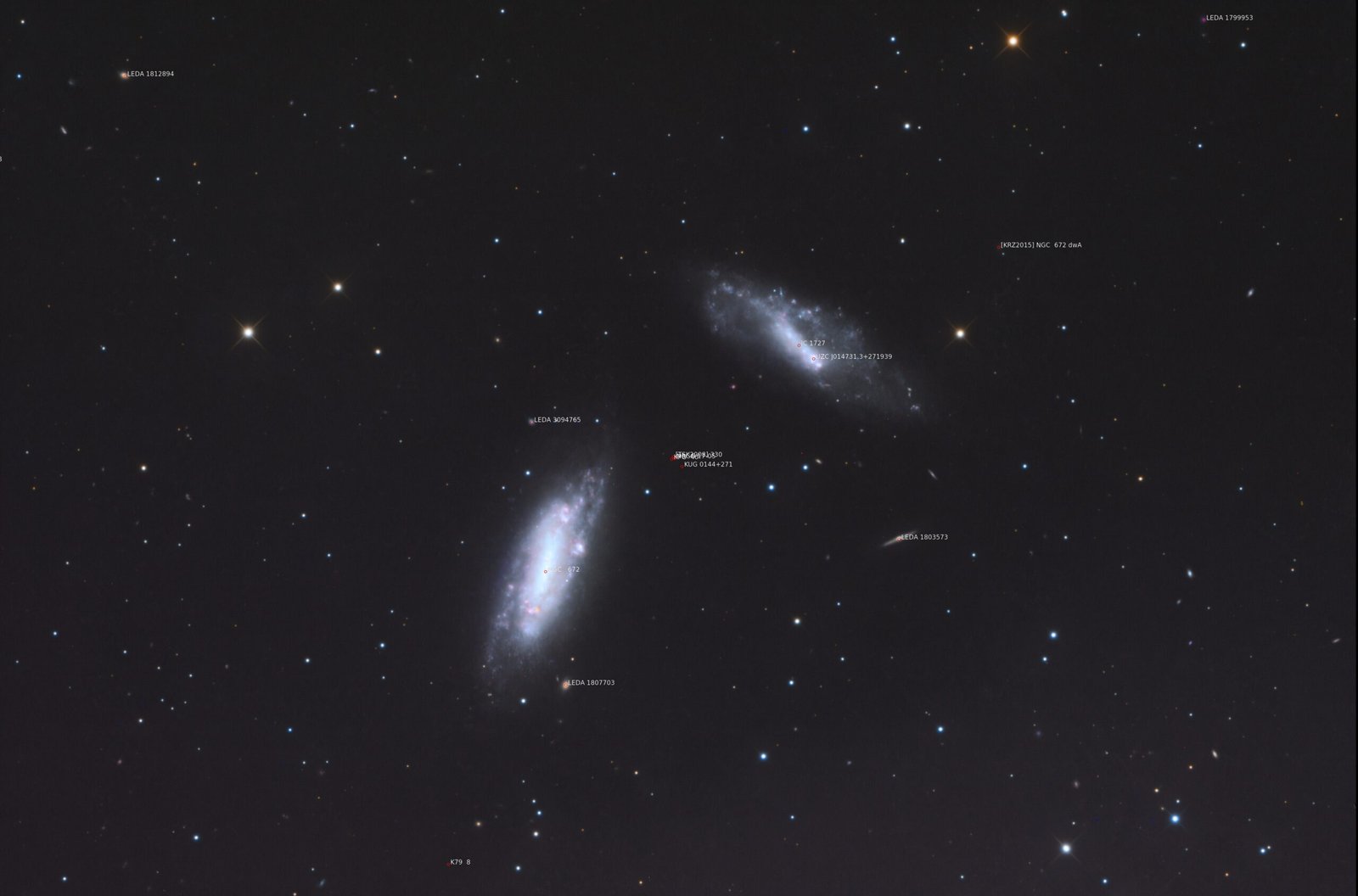
🌀 NGC 672 and IC 1727
NGC 672 is a late-type spiral galaxy, while IC 1727 has a more irregular and disturbed appearance. Their present-day structures show clear evidence of gravitational interaction.
IC 1727 is particularly striking. Its stellar distribution is highly asymmetric, and its nucleus is displaced from the apparent center of the galaxy. The galaxy also shows distorted arms and extended structures, features that are consistent with the effects of its interaction with NGC 672.
Neutral-hydrogen observations provide an even clearer picture of the encounter. The H I distribution shows significant distortions and a bridge between the two galaxies, while the velocity field is also strongly perturbed. Early modelling demonstrated that a gravitational interaction could reproduce many of these characteristics.
🌌 NGC 672 and IC 1727 from La Palma
From La Palma, NGC 672 and IC 1727 are an excellent target for deep-sky astrophotography. Their relatively large angular dimensions and the presence of faint structures make them especially interesting for long integrations under dark skies.
At LilTecan, our goal is to capture not only the bright central regions of galaxies, but also the extremely faint structures that reveal their history.
NGC 672 and IC 1727 are a beautiful example of this: two galaxies apparently separated by millions of light-years, yet connected by gravity and by a history of encounters written into their stars and interstellar gas.