
Sh2-188 – A Planetary Nebula Moving Through the Interstellar Medium
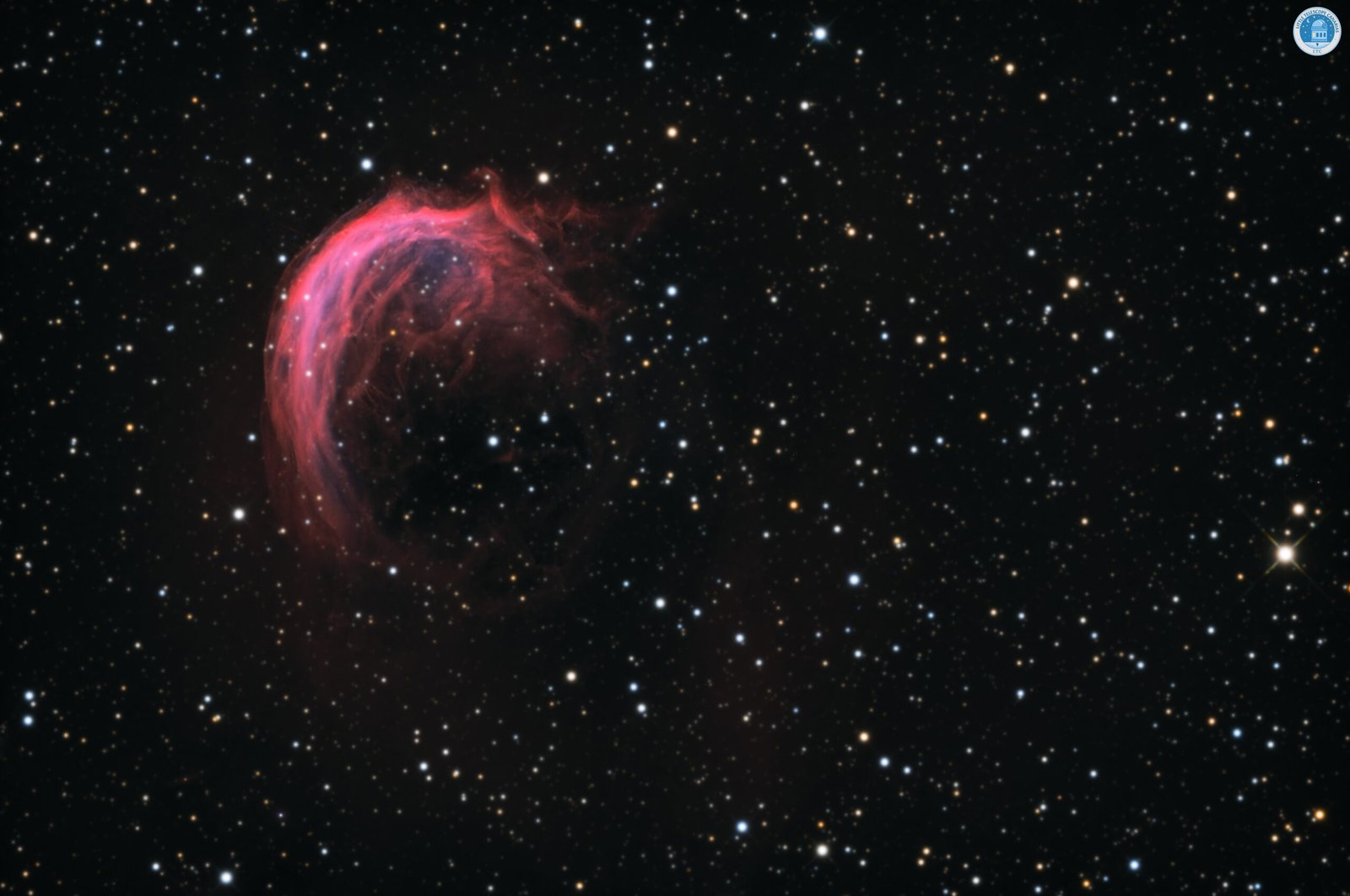
Sh2-188 is a planetary nebula located in the constellation of Cassiopeia, also catalogued as PN G128.0−04.1 and Simeiz 22. Its appearance is particularly striking: a bright filamentary arc dominates one side, while much fainter emission extends in the opposite direction.
This morphology makes Sh2-188 one of the most interesting examples of interaction between a planetary nebula and the interstellar medium (ISM). Observations in Hα from the Isaac Newton Telescope Photometric Hα Survey of the Northern Galactic Plane (IPHAS) revealed that the structure does not end at the bright arc initially visible, but continues through a much fainter region and an extended tail of material.
The shape of Sh2-188 is interpreted as the result of the interaction between material expelled by the progenitor star and the interstellar medium through which the nebula is moving.
🌌 A Nebula with an Extraordinary Shape
Sh2-188 was initially identified as a planetary nebula through spectroscopic and radio observations. Studies found a high ratio of [N II] to Hα emission lines, together with abundances consistent with a Type I planetary nebula. Radio observations also revealed weak thermal emission, helping to distinguish it from a supernova remnant.
However, it was detailed Hα imaging that revealed the true complexity of this object.
The bright arc that characterizes Sh2-188 is composed of numerous filaments. On the opposite side, a faint arc was detected which, together with the bright arc, forms an approximately annular structure. Beyond this region, an extensive emission tail extends the nebula even farther.
The complete structure spans approximately 15 arcminutes on the sky, considerably more than suggested by the bright region that initially attracted observers’ attention.
📸 Images from LilTecan
Sh2-188 is an exceptional target for narrowband astrophotography.
Its emission is dominated by extremely faint structures that can easily go unnoticed in conventional exposures. The use of filters such as Hα, O III, and S II allows different components of the emission to be separated and reveals both the bright filamentary front and the much fainter regions extending around the nebula.
One of the most spectacular features of Sh2-188 is precisely the contrast between its bright arc and the faint tail extending behind it. Capturing this structure requires dark skies and sufficiently long integrations.
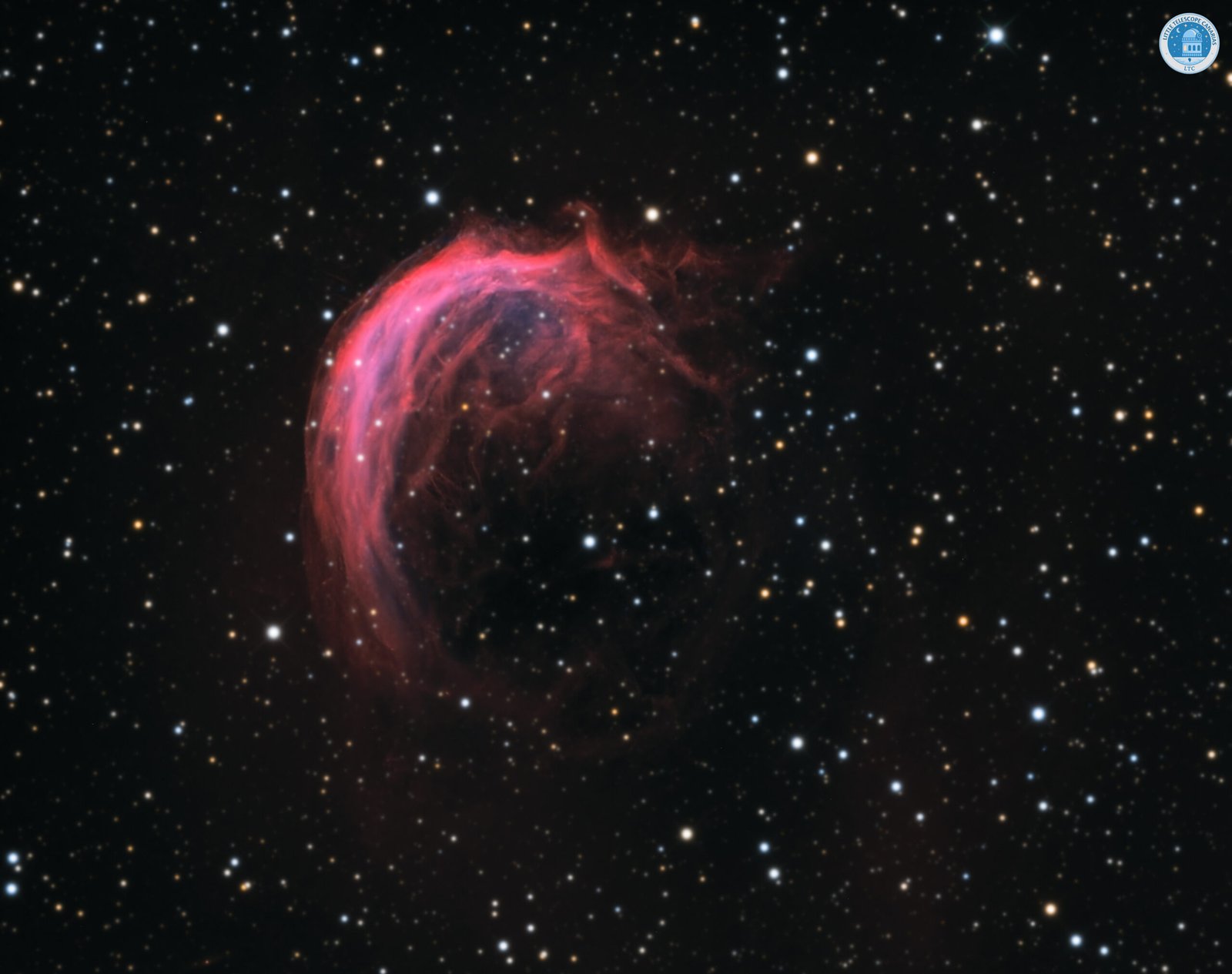
From LilTecan, beneath the skies of La Palma, this type of object allows us to explore the limits of deep-sky astrophotography and reveal structures that are barely perceptible in short exposures.
💫 A Star Moving Through Interstellar Space
One of the main hypotheses explaining the shape of Sh2-188 is that the central star and its nebula are moving through the interstellar medium.
As the star moves, the gas expelled during the different stages of its evolution interacts with the surrounding material. This interaction can compress and redistribute the nebular gas, producing the asymmetric structure we observe today.
Wareing and collaborators developed a hydrodynamic model based on three winds: the slow wind produced during the star’s asymptotic giant branch (AGB) phase, the subsequent fast stellar wind, and a third component associated with the star’s motion relative to the interstellar medium.
In their simulations, a relative velocity of approximately 125 km/s reproduced the observed structure reasonably well. This value corresponds to the proposed model and should not be interpreted as an independent direct measurement of the nebula’s velocity.
🌟 Structure and Main Characteristics
Sh2-188 can be summarized through a few key characteristics:
- It is a planetary nebula located in the constellation of Cassiopeia.
- It is also catalogued as PN G128.0−04.1 and Simeiz 22.
- It displays a prominent bright filamentary arc.
- Hα observations reveal a much fainter arc on the opposite side and an extended tail of material.
- The observed structure is interpreted as a consequence of interaction with the interstellar medium.
- The nebula extends approximately 15 arcminutes across in the observations described by Wareing and collaborators.
🔭 The Birth of an Asymmetric Structure
Planetary nebulae form during the final stages in the evolution of low- and intermediate-mass stars. Before becoming a white dwarf, the star expels large amounts of material into space.
In Sh2-188, this material does not appear to evolve in a static environment. The star’s motion through the interstellar medium modifies the distribution of the expelled gas and can create a compressed and brighter region in the direction of motion, while material becomes extended toward the trailing region.
The model proposed by Wareing and collaborators suggests that much of the observed structure began forming during the star’s AGB phase. Later, the interaction between the different stellar winds and the interstellar medium contributed to producing its present-day shape.
The simulations also provide a possible explanation for some of the material that appears to have been displaced toward the trailing region of the nebula.
🌌 Sh2-188 from La Palma
Sh2-188 is one of those objects that demonstrates that a planetary nebula can be far more complex than it initially appears in an image.
The bright structure dominating its appearance is only part of a much larger system. Behind it lies an extremely faint region that can approximately double the apparent extent of the main structure.
Observing this nebula means looking at the remains of a star that, after expelling its outer layers, continues to interact with the surrounding interstellar environment while its core evolves toward a white dwarf.
From LilTecan, long integrations and narrowband filters make it possible to reveal this faint structure and show the spectacular interaction between a dying star and the medium surrounding it.
Sh2-188 is therefore an excellent example of how the evolution of a star and its motion through the Galaxy can become imprinted on the shape of a planetary nebula.