Sh2-142 – The Wizard Nebula
Sh2-142 is an H II region located in the constellation of Cepheus. It is commonly known as the Wizard Nebula, a name inspired by the shape that its clouds of gas and dust appear to form in astronomical images.
At the heart of the nebula lies the young open star cluster NGC 7380. The relationship between the cluster and the surrounding nebula is particularly interesting: the young stars of NGC 7380 formed within the same complex of gas and dust and now interact with their surrounding environment through their radiation and stellar winds.
Sh2-142 is therefore not simply a cloud illuminated by distant stars. It is an active stellar nursery where ionized gas, molecular material, young stars, and stellar radiation interact.
🌌 A Stellar Nursery in Cepheus
Sh2-142 is located in Cepheus, a constellation rich in emission nebulae and star-forming regions.
The nebula surrounds the young open cluster NGC 7380. The cluster was discovered by Caroline Herschel in 1787, while William Herschel subsequently observed the object and included it in his catalogue. The designation Sh2-142 comes from Stewart Sharpless’s second catalogue of H II regions, published in 1959.
The distinction between the two designations is important. NGC 7380 refers to the open star cluster, whereas Sh2-142 identifies the surrounding ionized nebula. In astrophotography, however, the entire complex is very often referred to simply as the Wizard Nebula.
The nebula is a region of ionized hydrogen. Its characteristic emission is produced when energetic ultraviolet radiation from young, massive stars ionizes the surrounding gas, which subsequently emits light as the electrons recombine with the ions.
📸 Images from LilTecan
Sh2-142 is an exceptionally attractive target for deep-sky astrophotography.
The combination of bright emission regions, dark dust lanes, and the dense stellar population of NGC 7380 creates a remarkably complex field.
Narrowband filters are particularly effective for photographing this nebula. Hα, O III, and S II reveal different components of the ionized gas and allow the structure of the nebula to be explored in considerably greater detail than with broadband imaging alone.
From LilTecan, beneath the dark skies of La Palma, long integrations can reveal the faint outer structures of Sh2-142 together with the brighter regions surrounding NGC 7380.
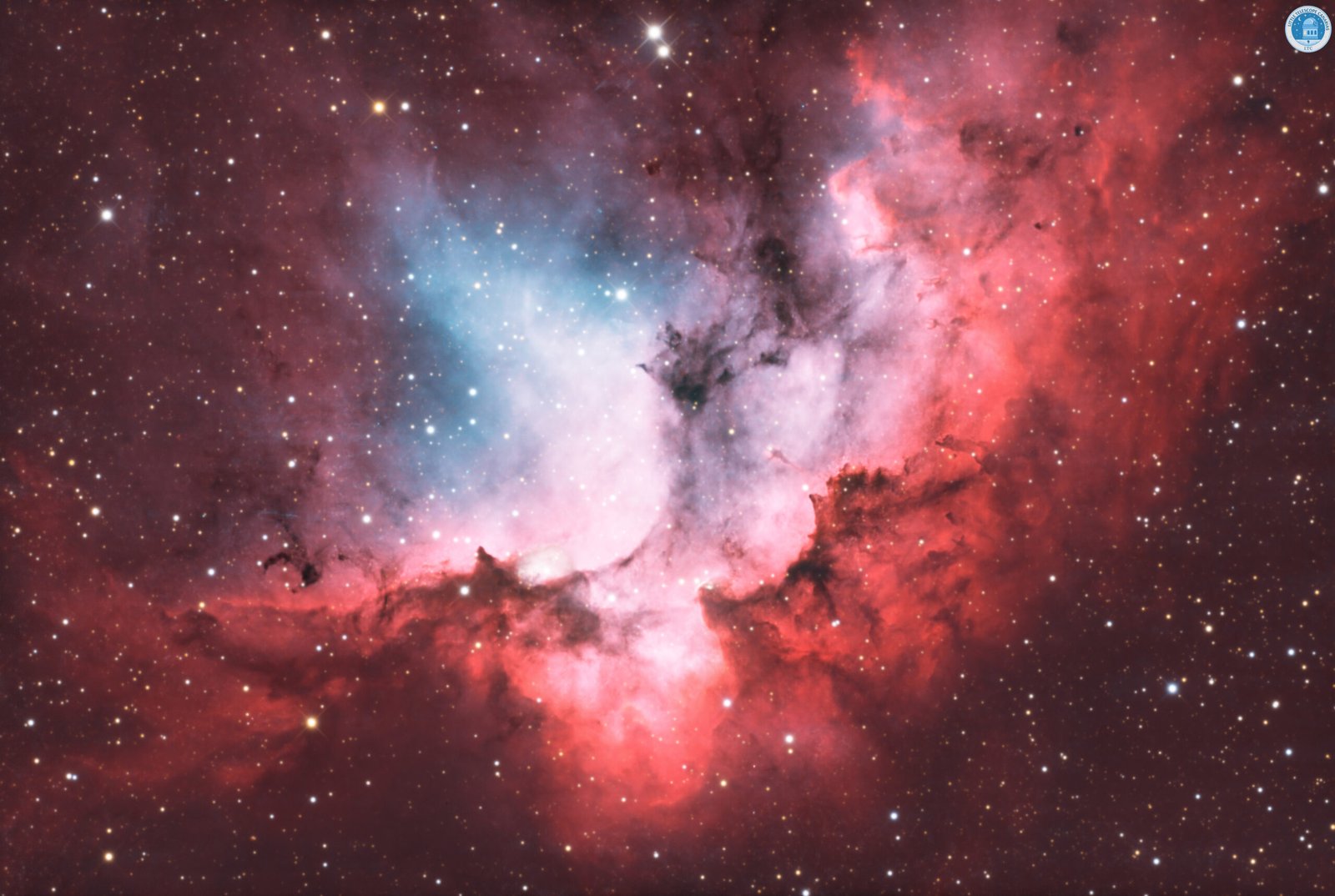
The characteristic appearance of the Wizard Nebula is produced by the combination of emission from the ionized gas, obscuring dust, and the stellar population embedded within the complex.
🌟 Structure and Main Characteristics
Sh2-142 can be summarized through a few key features:
- It is an H II region in the constellation of Cepheus.
- It is commonly known as the Wizard Nebula.
- The young open cluster NGC 7380 is embedded within the nebula.
- The region contains massive young stars, including the DH Cephei binary system.
- The surrounding gas is ionized by the ultraviolet radiation from young massive stars.
- The complex contains molecular material and young stellar objects associated with ongoing or recent star formation.
SIMBAD gives Sh2-142 an angular size of approximately 30 arcminutes and lists a kinematic distance measurement of 3.48 ± 0.24 kpc. Other studies of the NGC 7380 complex have adopted distances around 2.6 kpc, so it is preferable not to treat a single distance value as definitive without specifying the source.
🔭 The Interaction Between Stars and Gas
One of the most fascinating aspects of Sh2-142 is the interaction between its young stars and the surrounding interstellar material.
Massive stars emit enormous amounts of ultraviolet radiation. This radiation creates an ionized region around them, while their stellar winds push against the surrounding gas and dust.
Studies of Sh2-142 have investigated whether these processes may have influenced the formation of subsequent generations of stars in the region. Observations have identified dense molecular structures and young stellar objects around the nebula, providing an environment in which the relationship between massive stars and star formation can be studied.
However, establishing that a particular generation of stars was triggered by the expansion of the H II region requires more than simply finding young stars near an ionization front. This remains an area of scientific study, and it is therefore preferable to distinguish observational evidence from interpretations of the star-formation history.
🌌 Sh2-142 from La Palma
Looking at Sh2-142 is like observing a snapshot of a stellar nursery.
The light captured by a telescope comes from a complex where massive young stars are illuminating and interacting with the material from which stars formed.
The characteristic shape that gave the nebula its nickname is particularly striking in long-exposure astrophotography. Dark dust structures cut through the glowing gas, while the stars of NGC 7380 appear scattered across the center of the image.
From LilTecan, the exceptional skies of La Palma provide the opportunity to capture this faint emission and reveal structures that are difficult to appreciate through visual observation alone.
Sh2-142 is a beautiful example of the continuous interaction between young stars, ionized gas, molecular clouds, and the processes of star formation within our Galaxy.