
Sh2-71 – A Planetary Nebula of Enigmatic Origins
Located in the constellation of Aquila, Sh2-71 is a planetary nebula whose irregular and complex structure has attracted considerable interest from astronomers. Unlike other planetary nebulae with more symmetrical shapes, Sh2-71 displays an unusual morphology that may be related to interactions between several stars.
The object was discovered by astronomer Rudolph Minkowski in 1946. Although it was initially described as a peculiar, diffuse nebula, subsequent spectroscopic studies confirmed its classification as a planetary nebula.
Distance estimates have varied depending on the method used. A study based on the relationship between the Hα surface brightness and the nebula’s radius obtained a distance of approximately 1.52 kiloparsecs, equivalent to around 4,960 light-years, with a substantial uncertainty of ±0.54 kpc. This estimate is more informative than assigning a single distance without acknowledging its uncertainty.
🌌 A Peculiar Planetary Nebula
Sh2-71 is a planetary nebula formed during the final stages of a star’s evolution. When a low- or intermediate-mass star ejects its outer layers, the exposed hot core emits radiation capable of ionizing the surrounding gas.
The nebula displays an irregular morphology and features associated with a bipolar structure. Spectroscopic observations have identified variations in the gas density and signs of shock excitation, indicating that the physical processes taking place in this region are more complex than those of a simple expanding gas envelope.
High-resolution studies have also identified an expanding emission region with a disk-like geometry surrounding a central zone of high excitation. These observations help astronomers understand the complex distribution of material ejected by the progenitor star.
📸 Images from LilTecan
Sh2-71 is an attractive target for deep-sky astrophotography because of its irregular structure and regions of emission with different intensities.
Narrowband images can highlight emission from the ionized gas and reveal the contrasts between different parts of the nebula. Hα and [O III] filters are particularly useful for investigating its structure, while broadband images can provide information about the surrounding stars and the object’s overall appearance.
Deep exposures are also important for detecting the fainter emission regions extending beyond the central nebula. A study using the Wide Field Camera on the Isaac Newton Telescope, located at the Roque de los Muchachos Observatory on La Palma, identified filamentary emission structures several arcminutes away from the main nebula.
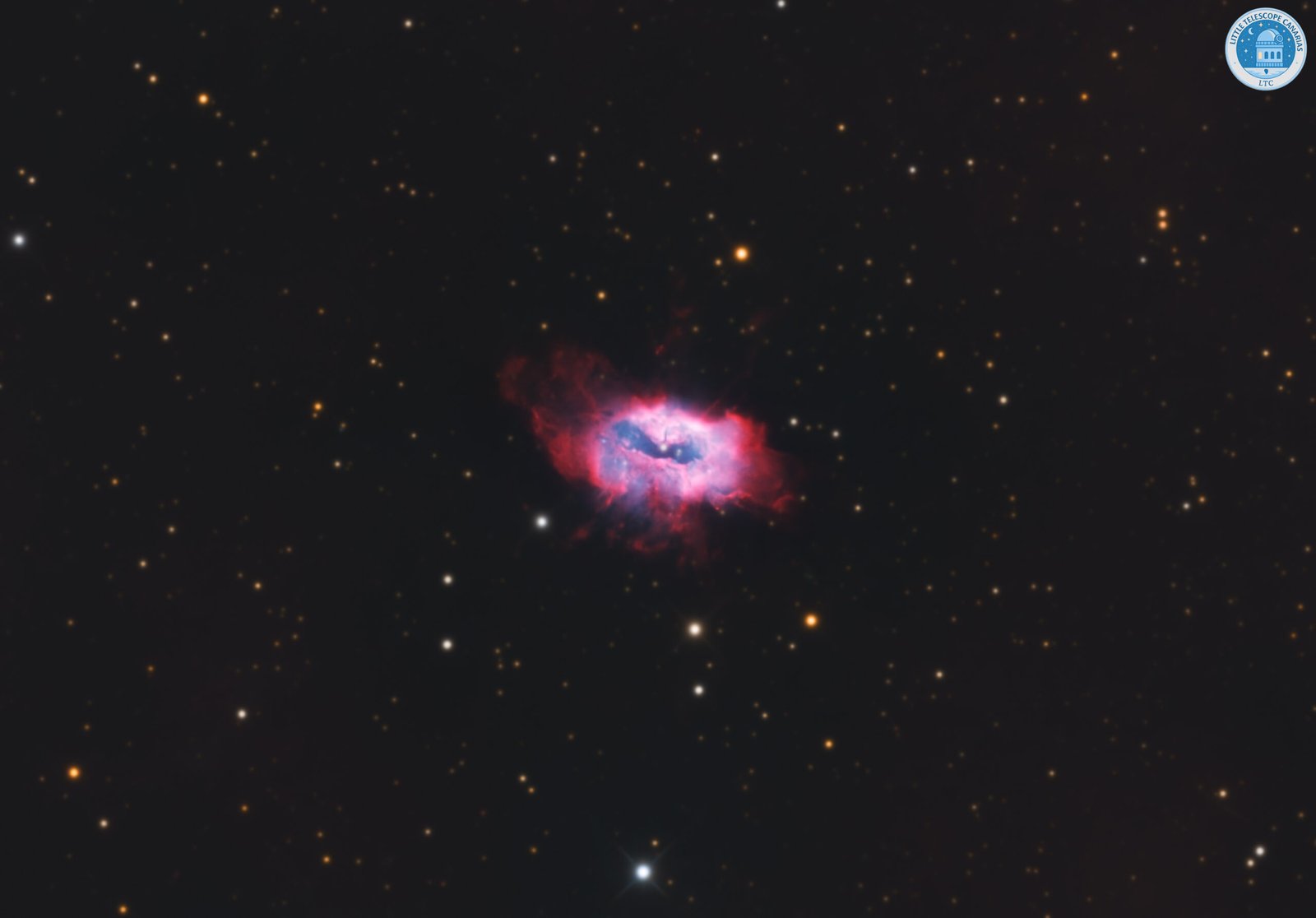
From LilTecan, deep integration and the combination of different filters can help explore the details of Sh2-71 and reveal the complexity of this planetary nebula.
⭐ The Mystery of the Central Star
One of the most intriguing aspects of Sh2-71 is that the identity of its true central star has been the subject of debate.
For many years, the relatively bright star located near the centre of the nebula was considered responsible for its ionization. However, subsequent studies suggested that another, fainter and bluer star, located to the northwest, might actually be the central star.
The brighter star exhibits variations in luminosity and spectroscopic changes that have led researchers to propose that it may belong to a peculiar binary system. However, these characteristics alone do not prove that it is the star responsible for the nebula.
For this reason, researchers have investigated different possibilities to explain the relationship between the nearby stars and the observed structure. Definitively identifying the progenitor star remains essential to understanding the origin of Sh2-71.
🌟 Main Structure and Characteristics
Sh2-71 stands out for three main characteristics:
- Object type: Planetary nebula located in the constellation of Aquila, also catalogued as PN G035.9−01.1.
- Morphology: It displays an irregular structure with bipolar features, as well as extended and filamentary emission regions.
- Origin: Interactions between several stars have been proposed as a possible influence on its formation, although this hypothesis remains unconfirmed.
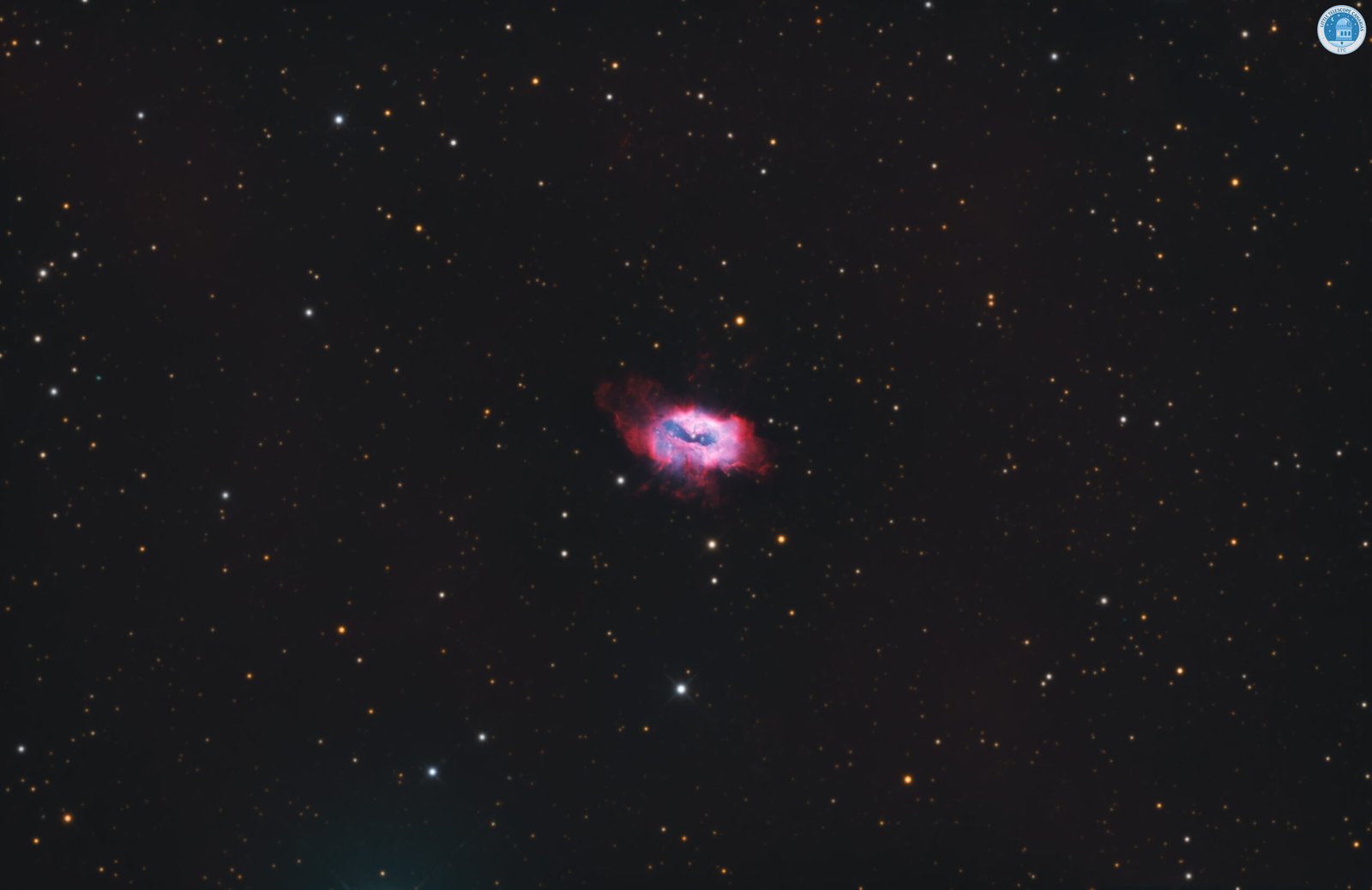
🔭 Could It Have Formed Through a Three-Star System?
One of the most interesting hypotheses suggests that Sh2-71 may have formed under the influence of a triple-star system.
In a study published in 2019 in Monthly Notices of the Royal Astronomical Society, David Jones, Ondřej Pejcha and Romano L. M. Corradi analysed the properties of candidate stars located near the centre of the nebula. They identified two extended emission regions that appeared to be related to the geometry proposed for the system.
The researchers investigated the stars’ positions, radial velocities, distances and proper motions. Their results provided evidence supporting the hypothesis that interactions between several stars may have influenced the formation of the nebula.
However, the authors also noted that several questions remained unanswered. Therefore, a triple-star origin is a hypothesis supported by observational evidence, but it has not been definitively proven.
This possible scenario is particularly interesting because gravitational interactions between stars can influence the ejection of material and contribute to the formation of asymmetric or bipolar structures.
🌌 Sh2-71 from La Palma
Sh2-71 demonstrates that planetary nebulae can have structures far more complex than a simple envelope of gas surrounding a central star.
A combination of optical, spectroscopic and high-resolution observations makes it possible to investigate how the ejected material is distributed and what role multiple-star systems may play in the evolution of these nebulae.
Observations from the Roque de los Muchachos Observatory also demonstrate that La Palma is an excellent location for studying these objects. Detecting faint, extended structures requires deep imaging and careful data processing.
At LilTecan, photographing Sh2-71 provides an opportunity to explore a nebula whose appearance and origin still pose scientific questions. Its study reminds us that even during the final stages of stellar evolution, the Universe continues to reveal complex structures that deserve further investigation.