
NGC 7662 – The Blue Snowball Nebula
Located in the constellation of Andromeda, NGC 7662 is a planetary nebula popularly known as the Blue Snowball Nebula. Its distinctive compact appearance and bluish hue make it one of the most interesting objects for deep-sky observing and astrophotography.
NGC 7662 lies approximately 2,500 light-years from Earth, according to NASA, and is also catalogued as Caldwell 22. Like other planetary nebulae, it represents a stage in the evolution of a low- or intermediate-mass star, during which the star expels its outer layers, exposing a hot core that illuminates the ejected material.
Despite its name, a planetary nebula has no connection with planets. The term originated because these objects resembled planets when viewed through early telescopes.
🌌 The Origin of a Planetary Nebula
NGC 7662 formed from the outer layers expelled by a star during the final stages of its evolution. After losing much of its envelope, the star leaves behind an extremely hot core that emits ultraviolet radiation.
This radiation ionizes the surrounding gas, causing different chemical elements to emit light at specific wavelengths. The result is a bright nebula whose structure allows astronomers to study how stars transform and return material to the interstellar medium.
The Blue Snowball Nebula therefore provides a window into a brief but important stage in the life cycle of stars.
📸 Images from LilTecan
NGC 7662 is a particularly interesting target for planetary nebula astrophotography. Its relatively small angular size makes a long focal length desirable for revealing its internal details.
Images obtained with LRGB filters can reproduce the object’s overall appearance, while narrowband filters help investigate emissions from elements such as ionized hydrogen, oxygen and sulphur.
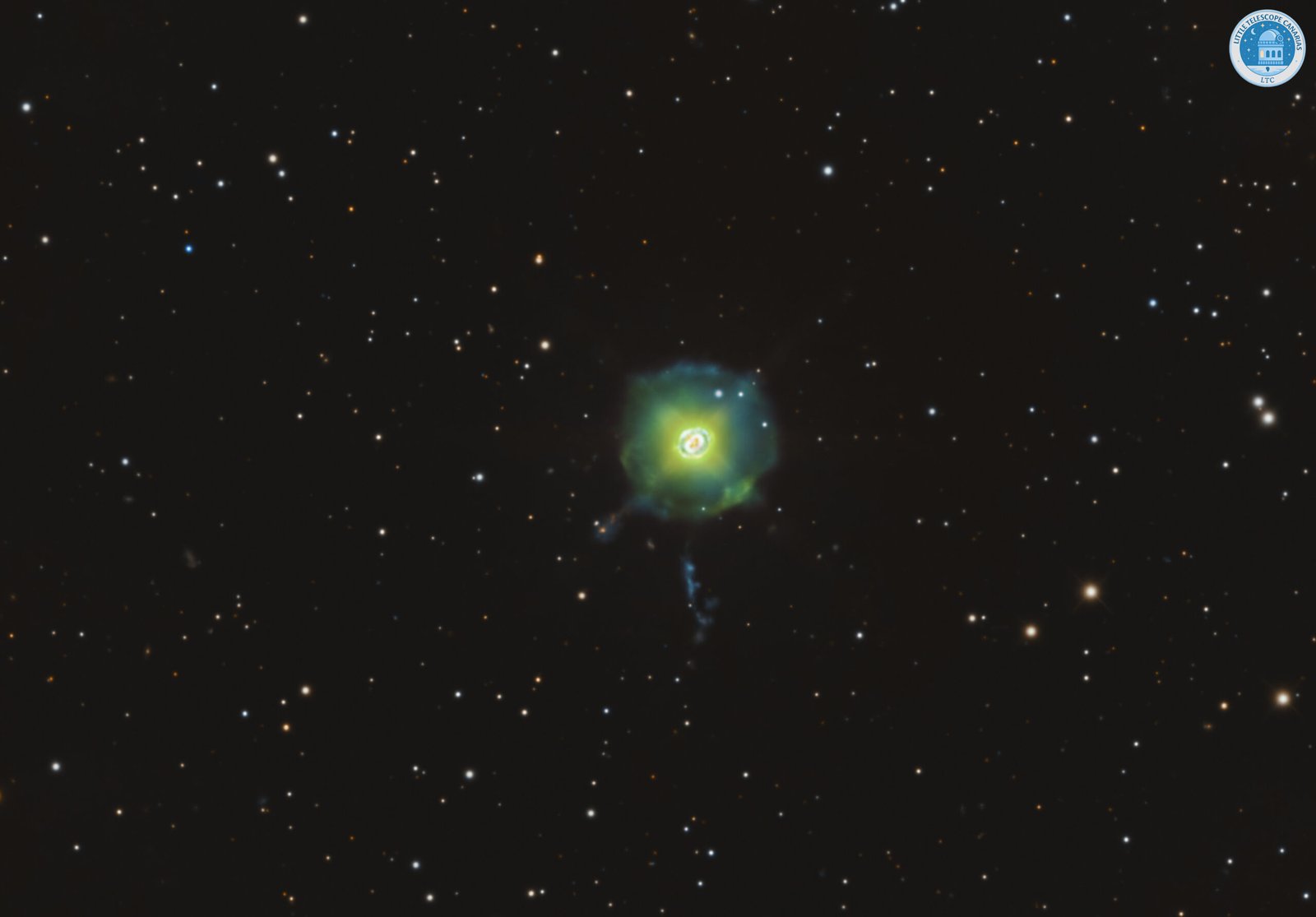
From LilTecan, beneath the skies of La Palma, combining long exposures with different filters can help reveal variations in brightness and the structures that make up this nebula.
⭐ The Central Star
At the centre of NGC 7662 lies the remnant of the star that formed the nebula. This extremely hot star continues to illuminate and ionize the expelled gas.
Spectroscopic studies and nebular models have estimated temperatures of around 95,000–100,000 kelvin for the central star, although the results depend on the model used.
The star’s ultraviolet radiation is essential to explaining the nebula’s intense emission and its different structures. As the gas expands and evolves, the interaction between stellar radiation and the ejected material progressively changes the nebula’s appearance.
🌟 Main Structure and Characteristics
NGC 7662 has a more complex structure than its compact appearance might suggest:
- Object type: Planetary nebula located in the constellation of Andromeda, also known as Caldwell 22.
- Distance: Approximately 2,500 light-years, according to NASA, although estimates may vary between studies.
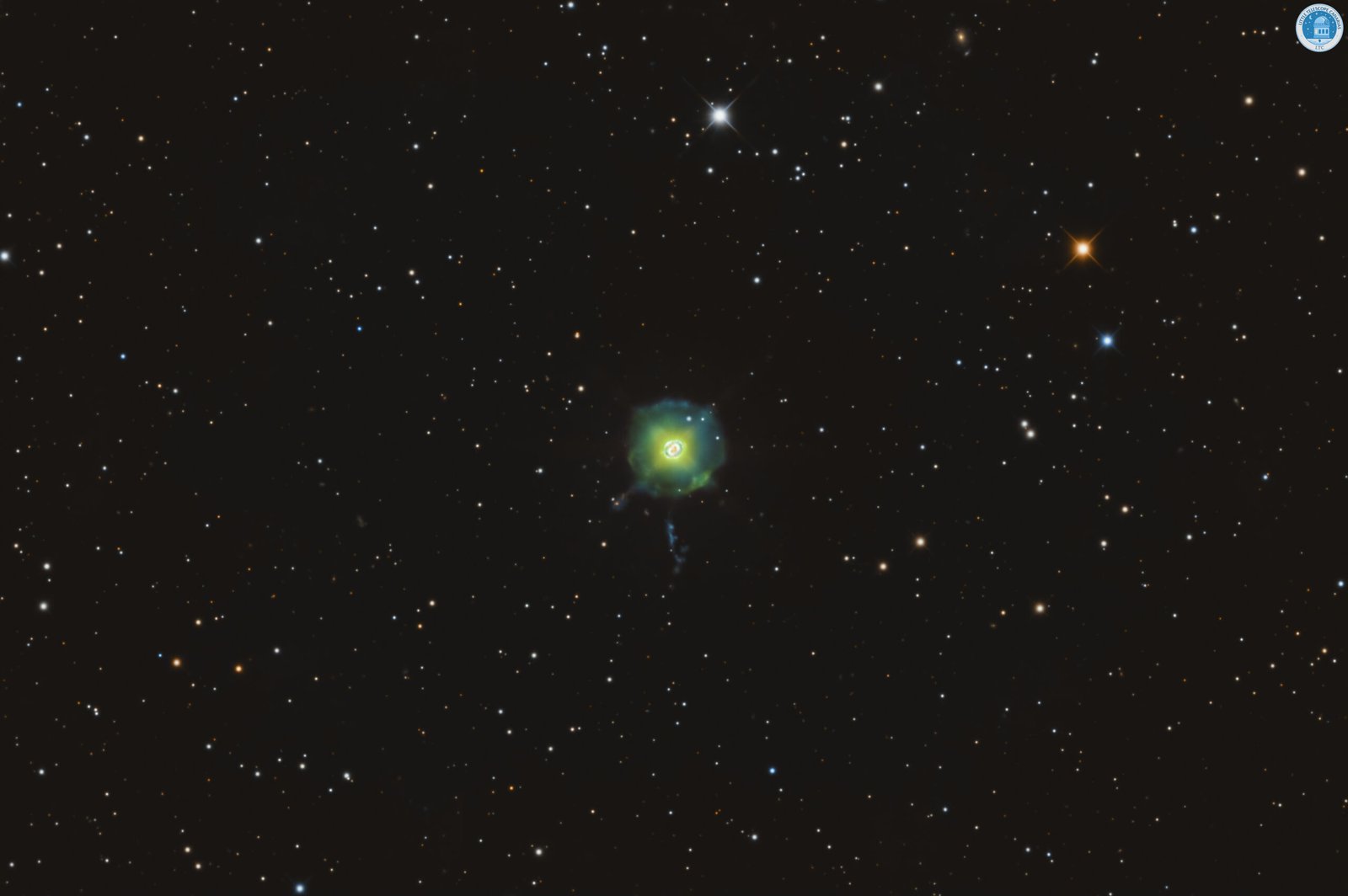
- Morphology: It features a bright inner envelope, a fainter outer layer and an extended halo. Low-ionization knots and a jet-like structure have also been studied.
🔭 An Expanding Nebula
Planetary nebulae are not static structures. The gas expelled by the central star continues to expand while stellar radiation and winds interact with the different layers of material.
Observations made with the Hubble Space Telescope have allowed astronomers to compare images of NGC 7662 taken at different times to study changes in its structure. High-resolution images have also revealed details that are not apparent in conventional observations, including small gas knots and elongated structures.
Studying these features helps astronomers understand how the expelled material is distributed and which physical processes influence the evolution of planetary nebulae.
🌌 NGC 7662 from La Palma
NGC 7662 reveals one of the final stages in the evolution of a low- or intermediate-mass star. The hot core left behind after the outer layers are expelled illuminates the gas, producing a structure that continues to change over time.
Although its apparent size is small, this nebula offers many details for observers using long-focal-length telescopes and high-resolution imaging techniques.
From La Palma, NGC 7662 is an excellent target for exploring the structures of a planetary nebula and experimenting with combinations of broadband and narrowband filters.
At LilTecan, astrophotography of objects such as the Blue Snowball Nebula allows us to explore the processes that mark the end of the evolution of many stars and the return of their material to the interstellar medium.