NGC 7129 – A Stellar Nursery Among Gas and Dust
In the constellation of Cepheus lies NGC 7129, a spectacular star-forming region surrounded by gas and dust. Its nebulous appearance is mainly caused by the light from young stars illuminating the clouds of interstellar material around them.
Located approximately 3,300 light-years from Earth, NGC 7129 contains a young stellar cluster and numerous stars at different stages of formation. Infrared observations have revealed objects that remain hidden behind the dense clouds of dust characteristic of this region.
NGC 7129 is therefore much more than a reflection nebula: it is a true stellar nursery, where we can observe young stars interacting with the gas and dust surrounding them.
🌌 A Reflection Nebula
NGC 7129 is classified as a reflection nebula. In this type of nebula, the gas and dust do not necessarily produce their own visible light, but instead scatter light from nearby stars.
In the case of NGC 7129, several young stars illuminate the molecular cloud surrounding them. This interaction produces the characteristic bright and colourful appearance of the nebula.
Observations made with the Spitzer Space Telescope in infrared wavelengths allowed astronomers to study the region and reveal numerous young stars hidden by dust. These observations identified around 130 young stars associated with the cluster.
📸 Imágenes desde LilTecan
NGC 7129 is a particularly attractive target for deep-sky astrophotography.
Its combination of reflection nebulosity, young stars and dark dust clouds produces a complex structure that can be appreciated particularly well through long exposures.
LRGB imaging allows the overall appearance of the nebula and its associated stellar cluster to be captured. The use of narrowband filters can provide additional information about regions where the gas is being excited by young stars.
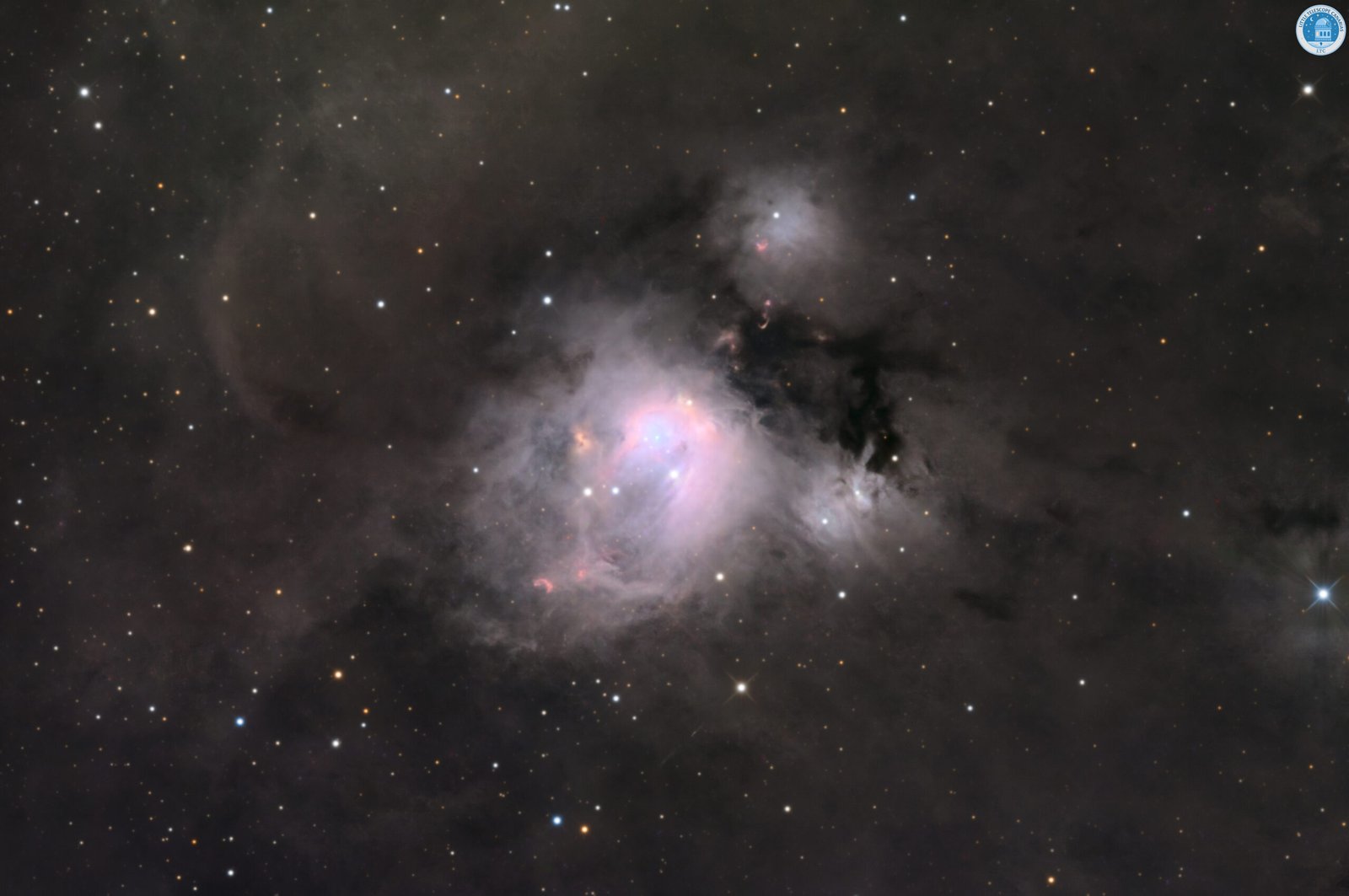
From LilTecan, beneath the exceptional skies of La Palma, a deep integration allows us to explore the faintest areas of this region and highlight the gas and dust structures surrounding the cluster.
⭐ A Star-Forming Region
The interior of NGC 7129 contains a young stellar cluster embedded within the molecular cloud. Among the dominant stars in the region are BD+65 1637, BD+65 1638, SVS 13 and LkHα 234.
Many other lower-mass stars are also part of the young population of the region. Optical and infrared observations have made it possible to identify numerous young stars, some of them still in the earliest stages of their evolution.
The extremely young age of this population makes NGC 7129 a particularly interesting place for studying how stars are born and evolve.
🌟 Main Structure and Characteristics
NGC 7129 can be summarized by a few key characteristics:
- It is a reflection nebula and star-forming region located in the constellation of Cepheus.
- It lies approximately 3,300 light-years from Earth.
- It contains a young stellar cluster with numerous stars at different stages of evolution.
- The region contains young stars producing jets and outflows of material capable of modifying the surrounding gas.
🔭 The Birth of Stars
NGC 7129 allows us to observe different stages of star formation within the same region.
Stars form through the gravitational collapse of dense regions of gas and dust. During their earliest stages, many remain deeply embedded within the molecular clouds from which they formed.
Infrared observations are essential for studying these objects because they can penetrate some of the material that blocks visible light. The James Webb Space Telescope has revealed numerous protostars and stars that were previously hidden, as well as showing the filaments of gas and dust and the jets produced by young stars in remarkable detail.
Webb’s images also reveal different environments within the nebula: regions of hot atomic hydrogen, areas of colder molecular hydrogen, and zones where jets from protostars generate shock waves.
🌌 NGC 7129 from La Palma
Observing NGC 7129 means looking at a region where stars are still in the earliest stages of their existence.
The nebula reveals the ongoing interaction between young stars and the cloud of gas and dust surrounding them. Some stars illuminate the material, while others eject jets capable of altering their environment.
From La Palma, NGC 7129 is an excellent target for deep astrophotography. The combination of dark skies and long integrations makes it possible to reveal faint structures that can remain hidden in individual exposures.
At LilTecan, photographing regions such as NGC 7129 allows us to visually explore one of the fundamental processes in the Universe: the birth of stars.