
Abell 2147 – A Galaxy Cluster in the Heart of the Hercules Supercluster
Abell 2147 is a galaxy cluster belonging to the catalog compiled by George O. Abell, located within the region of the Hercules Supercluster, about 500 million light-years from Earth. Although some sources place it in the area of Serpens Caput, observationally it is associated with the Hercules cluster region and lies close to other clusters such as Abell 2151 and Abell 2152.
It is a system composed of numerous faint and dispersed galaxies immersed in a vast halo of extremely hot gas detectable in X-rays.
💥 A gigantic structure dominated by gravity and hot plasma
Abell 2147 is one of the great gravitationally bound systems in the nearby universe. As in other galaxy clusters, most of its mass does not come from the visible galaxies themselves, but from the hot intracluster gas and dark matter.
X-ray observations have revealed gas temperatures of several million degrees Kelvin, produced by the cluster’s enormous gravitational energy.
Its brightest galaxy is UGC 10143, a giant elliptical galaxy located near the center of the cluster.
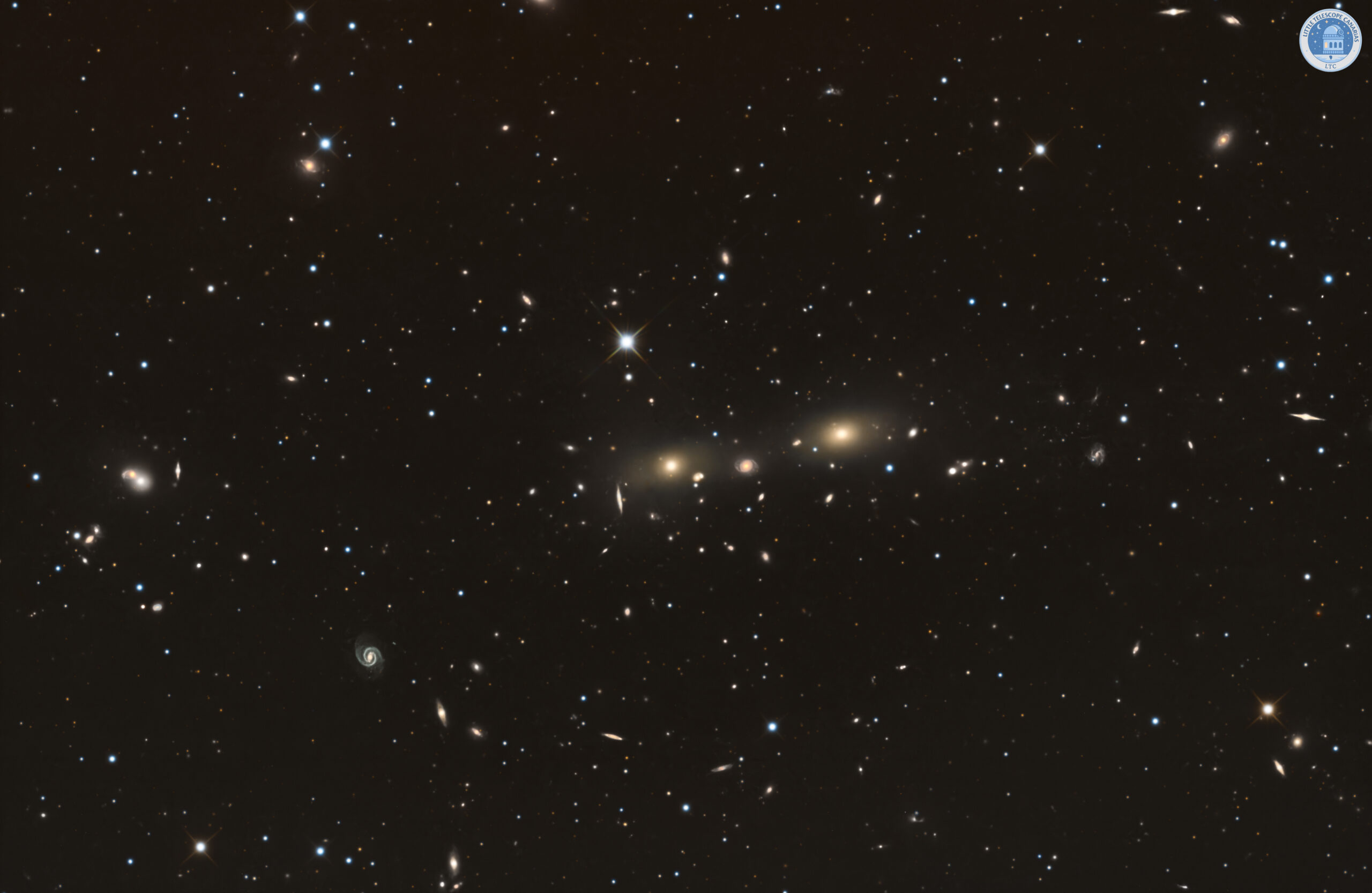
📸 Images from LilTecan
The LilTecan team has captured the region of Abell 2147, revealing a dense field of distant galaxies where small elliptical and spiral systems dominate the environment of the supercluster.
🌟 Structure and characteristics of the cluster
Observational studies have identified several important properties:
- It is part of the Hercules Supercluster, together with Abell 2151 and Abell 2152.
- It exhibits a significant X-ray emission halo, generated by hot intracluster gas.
- The gas reaches temperatures of several million degrees Kelvin.
- It contains numerous faint and compact galaxies distributed across a region spanning millions of light-years.
- The dominant galaxy in the cluster is the giant elliptical UGC 10143.
- Dynamical studies suggest possible gravitational interactions between neighboring clusters within the supercluster.
Abell 2147 is an excellent example of the largest structures in the universe bound together by gravity. Its study helps astronomers understand how galaxy clusters evolve and interact within the enormous cosmic web.
Observing this cluster today is like looking into one of the great architectures of the cosmos, where hundreds of galaxies, immense halos of hot gas, and enormous quantities of dark matter form a colossal structure in continuous evolution.