
NGC 6302 – The Spectacular Butterfly Nebula
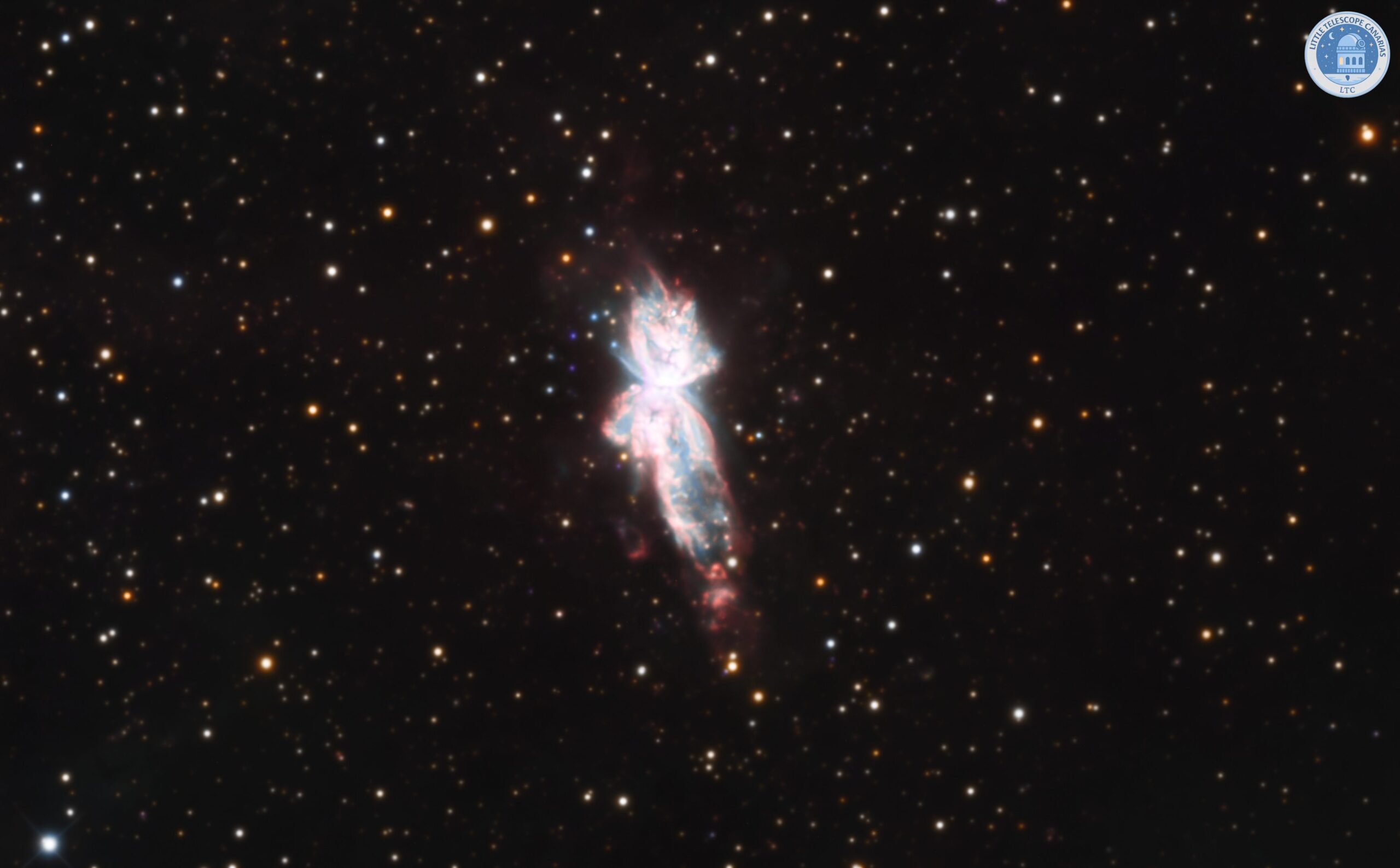
NGC 6302, commonly known as the Butterfly Nebula or Bug Nebula, is one of the most impressive and complex planetary nebulae known. Located in the constellation of Scorpius, at an approximate distance of 3,800 light-years, it was discovered by Edward Emerson Barnard in 1880.
Its enormous bipolar lobes, resembling the wings of a butterfly, extend more than two light-years from tip to tip, making it one of the most spectacular planetary nebulae in the southern sky.
💥 The Violent Death of a Massive Star
NGC 6302 represents an extremely brief phase of stellar evolution. The nebula was formed when a star several times more massive than the Sun expelled its outer layers during the final stages of its life.
The remnant core remains hidden behind a dense torus of dust and gas that cuts across the nebula. Ultraviolet radiation emitted by this dying star ionizes the expelled material, producing the intense glow observed at different wavelengths.
Most remarkable of all, its central star is among the hottest known in our galaxy, with estimated temperatures exceeding 200,000 K and possibly approaching 250,000 K, or even higher according to some models.
📸 Images from LilTecan
The LilTecan team has captured NGC 6302, revealing the extraordinary complexity of its bipolar lobes, the dark dust regions that conceal the central star, and the delicate filaments extending throughout the nebula.
🌟 Structure and Main Characteristics
Observational studies have revealed numerous fascinating aspects of this nebula:
- It is classified as an extreme bipolar planetary nebula.
- Its lobes expand at velocities exceeding 600 km/s in some regions.
- The central star remains partially obscured by a dense equatorial disk of dust and gas.
- It exhibits some of the most extreme ionization conditions observed in planetary nebulae.
- It contains complex internal structures, including multiple lobes, jets, knots, and filaments.
- Infrared observations have revealed a rich composition of dust, crystalline silicates, and complex molecules.
NGC 6302 is one of the finest natural laboratories for studying the final evolutionary stages of intermediate-mass stars. Its extraordinary morphology demonstrates that the death of a star can be far more complex and energetic than astronomers once imagined.
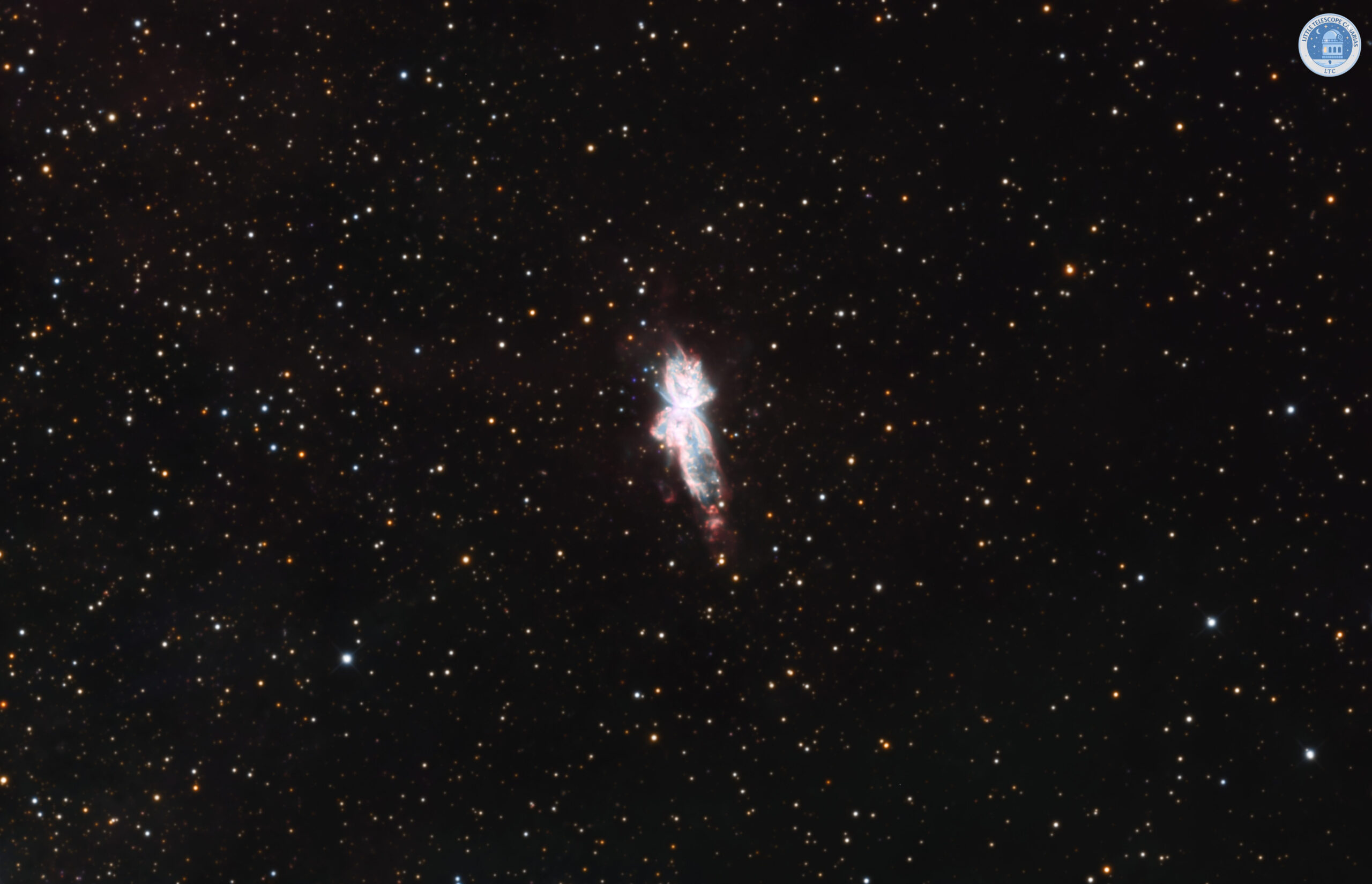
Observing this nebula today is like witnessing an explosion of beauty and energy, where a dying star sculpts gigantic wings of gas into interstellar space. Its chaotic shapes and intense radiation reveal one of the most spectacular chapters in the life cycle of stars.