
NGC 4725 – A One-Armed Spiral Galaxy
NGC 4725 is a spiral galaxy located in the constellation of Coma Berenices, approximately 40–50 million light-years from Earth. Discovered by William Herschel on April 6, 1785, it is one of the most remarkable nearby spiral galaxies due to its striking morphology: it possesses a single prominent spiral arm, an exceptionally rare feature among spiral galaxies. This unusual characteristic makes NGC 4725 an important object for studying how spiral structures evolve under the influence of both internal dynamical processes and past gravitational interactions.
NGC 4725 is a member of the Coma I Group, a relatively nearby galaxy association that also includes well-known systems such as NGC 4565 and NGC 4494.
💥 An Asymmetric Spiral with a Dynamic Past
Unlike most spiral galaxies, whose spiral arms are distributed approximately symmetrically around the nucleus, NGC 4725 is dominated by a single large-scale spiral arm that wraps around much of the galactic disk.
Observational studies suggest that this remarkable structure may be related to resonances generated by the galaxy’s central bar, as well as to the gravitational influence of its companion galaxy NGC 4747. This interaction is thought to have altered the distribution of gas and stars, contributing to the galaxy’s unusual morphology. Although the interaction between the two galaxies is well documented, the exact origin of the single spiral arm remains an active area of research.
Radio observations also reveal a substantial reservoir of neutral hydrogen (H I) distributed throughout the disk and in extended outer structures, providing further evidence of the system’s dynamic evolutionary history.
📸 Images from LilTecan
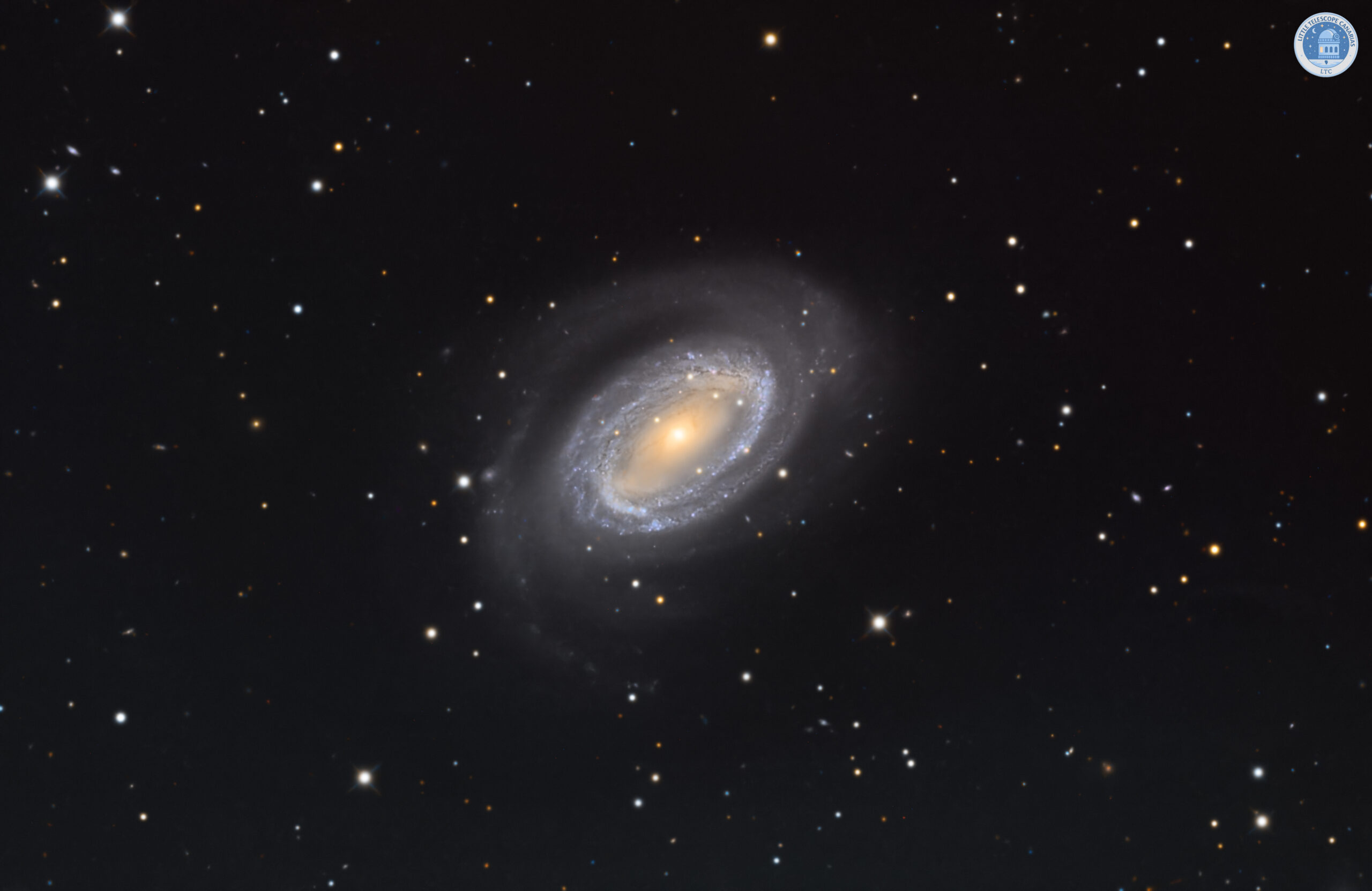
The LilTecan team has captured NGC 4725, revealing its bright yellowish nucleus, prominent central bar, and spectacular spiral arm encircling the galaxy. Long-exposure imaging also highlights numerous bluish star-forming regions distributed along the main arm, emphasizing the contrast between the young stellar populations and the older central bulge.
🌟 Structure and Main Characteristics
Observational studies have identified several remarkable properties of this galaxy:
- It is classified as an intermediate barred spiral galaxy of type (R)SAB(r)ab pec.
- It is located in the constellation of Coma Berenices, approximately 40–50 million light-years from Earth.
- It was discovered by William Herschel on April 6, 1785.
- It exhibits a single prominent spiral arm, a very unusual characteristic among spiral galaxies.
- It contains a central bar and a system of inner rings associated with dynamical resonances.
- It forms a physically associated system with the nearby galaxy NGC 4747, whose gravitational interaction has likely influenced its evolution.
- It contains abundant neutral hydrogen (H I) and numerous active star-forming regions distributed along its main spiral arm.
NGC 4725 is one of the finest nearby laboratories for studying the formation and evolution of spiral arms. Its extraordinary morphology demonstrates that galaxies can develop structures very different from the classical two- or four-armed spirals, providing valuable insight into the role of bars, resonances, and gravitational interactions in galactic evolution.
Observing NGC 4725 today is like witnessing a galaxy that defies the universe’s usual symmetry. Its solitary spiral arm gracefully wraps around the brilliant nucleus, reminding us that even under the same laws of gravity, nature is capable of creating remarkably diverse and elegant structures.