
vdB 141 – The Ghost Nebula
In the constellation of Cepheus lies one of the most striking and delicate regions of the deep sky: vdB 141, popularly known as the Ghost Nebula, and also identified as Sh 2-136.
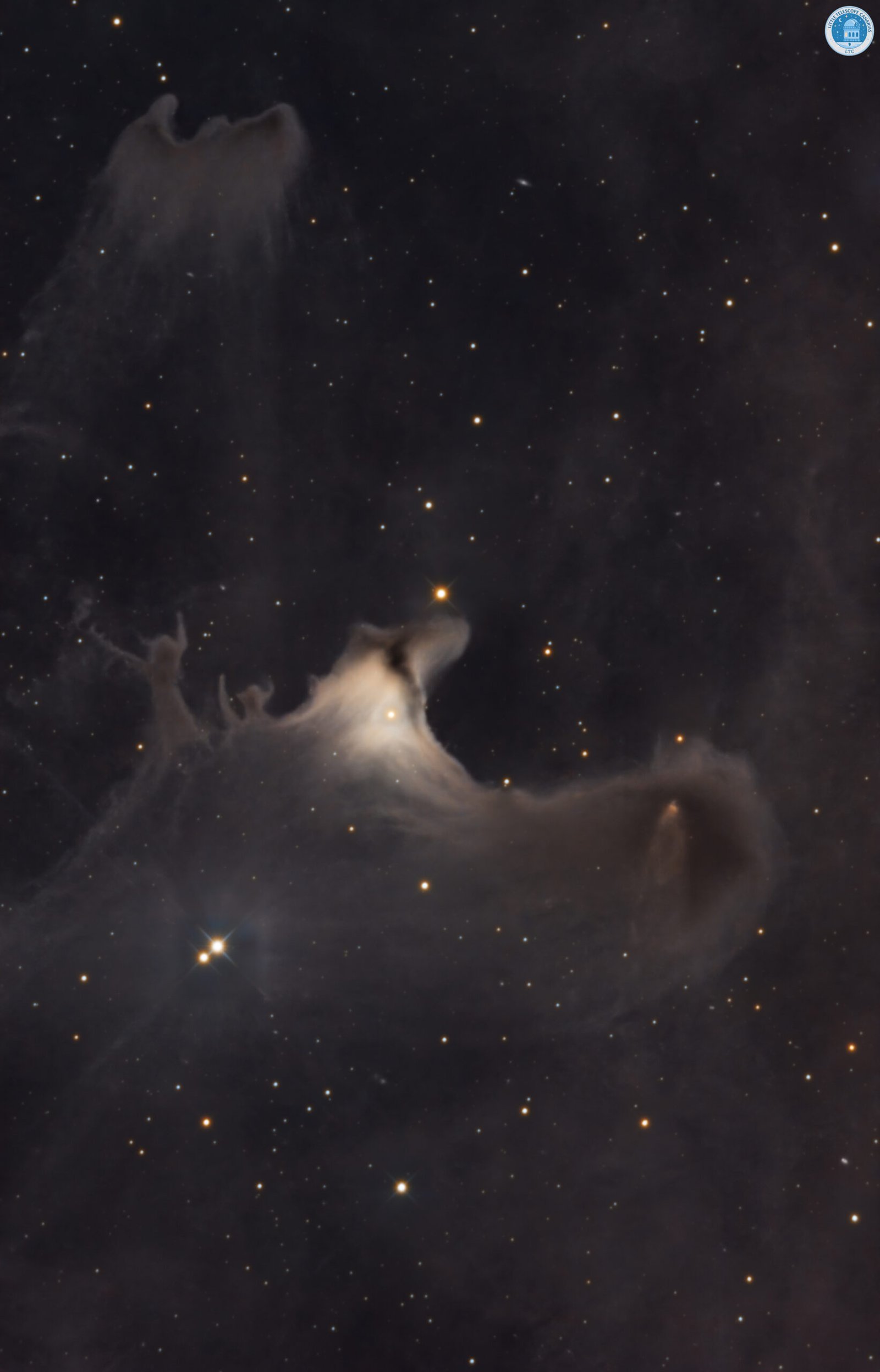
Its characteristic appearance comes from clouds of dust that reflect the light of stars located within and around them. The dark, curved shapes appearing against the luminous background resemble two ghostly figures, giving rise to its popular name.
vdB 141 is part of a much larger molecular region associated with the cloud complex known as Cepheus Flare, an area of our galaxy containing several regions related to star formation.
🌌 A Nebula Illuminated by Starlight
Unlike an emission nebula, whose luminosity comes mainly from the emission of ionized gas, vdB 141 is fundamentally a reflection nebula.
Interstellar dust scatters the light coming from stars and makes the cloud visible. In long-exposure images, this interaction between starlight and dust produces the characteristic tones of the nebula and allows extremely faint structures to be distinguished.
The star BD+67 1300, classified as spectral type G8 according to SIMBAD, is associated with the reflection region that gives rise to vdB 141.
The region is also located near CB 230, a dense concentration of gas and dust also catalogued as LDN 1177. CB 230 contains material associated with star-formation processes.
📸 Images from LilTecan
vdB 141 is a particularly interesting target for deep-sky astrophotography, but also one of the most challenging because of the low surface brightness of its structures.
Deep images reveal not only the main reflection nebula, but also the extensive clouds of dust surrounding it.
LRGB imaging is particularly well suited to this object, as it preserves the variations in brightness and color produced by starlight scattered by the dust.
Scientific images of the CB 230 region have also used LRGB combinations, clearly showing the Sh 2-136/vdB 141 reflection nebula and the dark structures of CB 230.
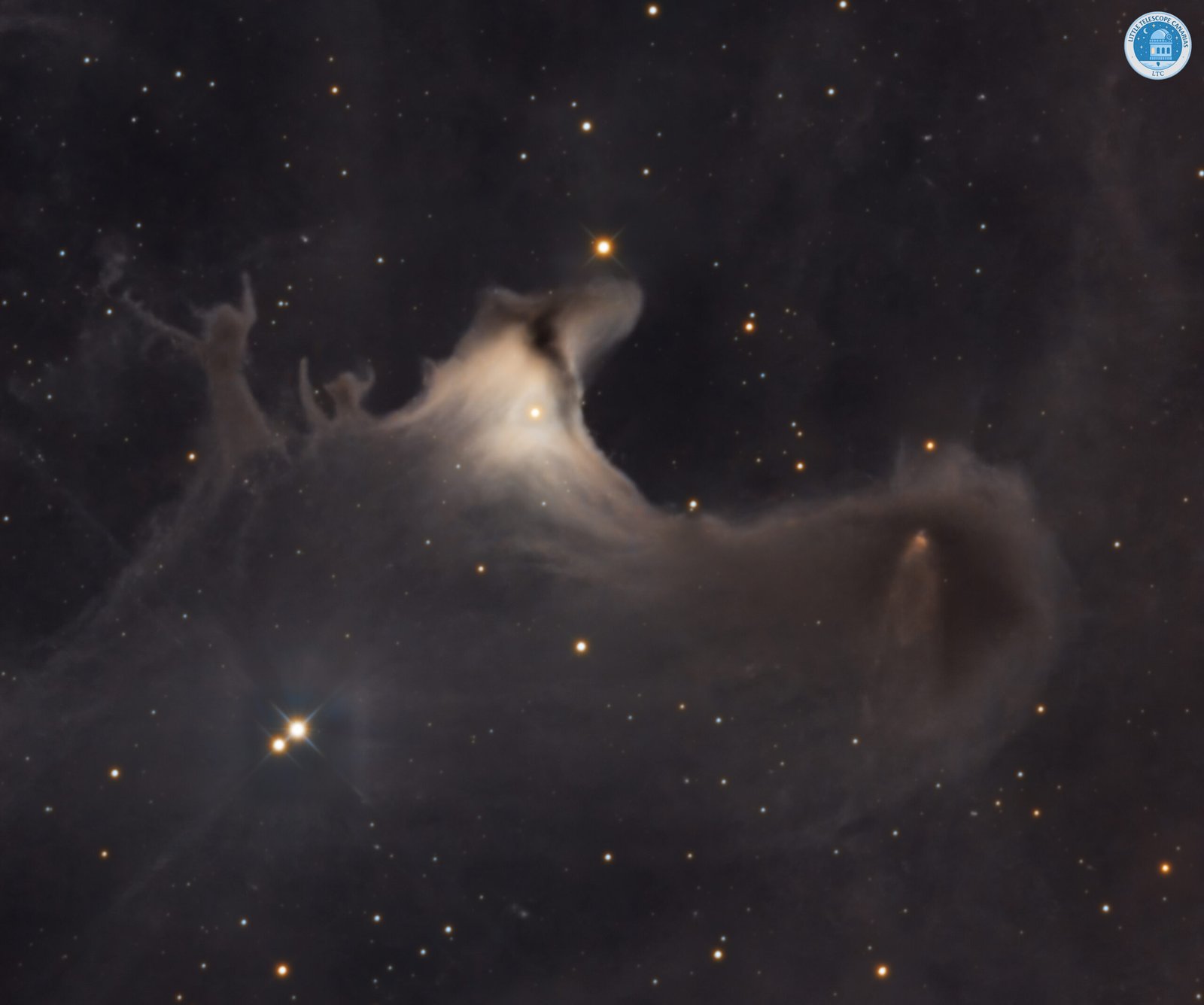
From LilTecan, under the exceptional skies of La Palma, a deep integration allows us to bring out the faintest structures in this region, which can remain completely hidden in short exposures.
🌟 Main Structure and Characteristics
The vdB 141 region can be summarized in a few key characteristics:
- vdB 141 is a reflection nebula located in the constellation of Cepheus.
- It is also catalogued as Sh 2-136.
- It is associated with the molecular cloud CB 230 / LDN 1177, within the molecular region known as Cepheus Flare.
- The reflection nebula is associated with the star BD+67 1300, classified as spectral type G8 according to SIMBAD.
- CB 230 contains a young stellar object associated with the infrared source IRAS 21169+6804.
- The region contains dense structures related to star-formation processes.
👻 The Origin of the Name “Ghost Nebula”
The appearance of vdB 141 is particularly recognizable in deep images. Two dark structures appear projected against the nebulosity, creating the impression of two figures with their arms raised.
The object was catalogued by Sidney van den Bergh in 1966 as part of his catalogue of reflection nebulae, from which the designation vdB 141 originates. On the other hand, Sh 2-136 comes from the Sharpless catalogue of emission nebulae.
The identification of Sh 2-136 with the vdB 141 region means that both names are frequently used to refer to the same area of the sky.
⭐ A Region Where Stars Are Born
Although the nebula we observe is primarily a reflection nebula, the surrounding region contains much denser and colder structures.
Within CB 230 there is a young stellar object associated with the infrared source IRAS 21169+6804. Observations at different wavelengths have allowed astronomers to study a bipolar outflow originating from this young object.
A study published in Astronomy & Astrophysics identified the young object associated with CB 230 as a Class 0/I source, meaning a star at an extremely early stage of its evolution. The study also found evidence of a very close companion, consistent with the presence of circumstellar material.
This makes the region more than just a spectacular reflection nebula: it is also a laboratory for studying the earliest stages of low-mass star formation.
🌌 vdB 141 from La Palma
From La Palma, vdB 141 is an exceptional target for deep astrophotography.
Its low surface brightness makes dark skies particularly important for recording the dust structures that extend far beyond the main nebula.
A deep LRGB integration makes it possible to create an image that not only shows the characteristic silhouette of the Ghost Nebula, but also the complex network of dust surrounding it.
At LilTecan, objects like this represent one of the great challenges of astrophotography: recording structures that are practically imperceptible in a single exposure and, through many hours of integration, transforming them into an image capable of revealing the complexity of our own galactic neighborhood.