
Sh2-155 – The Cave Nebula
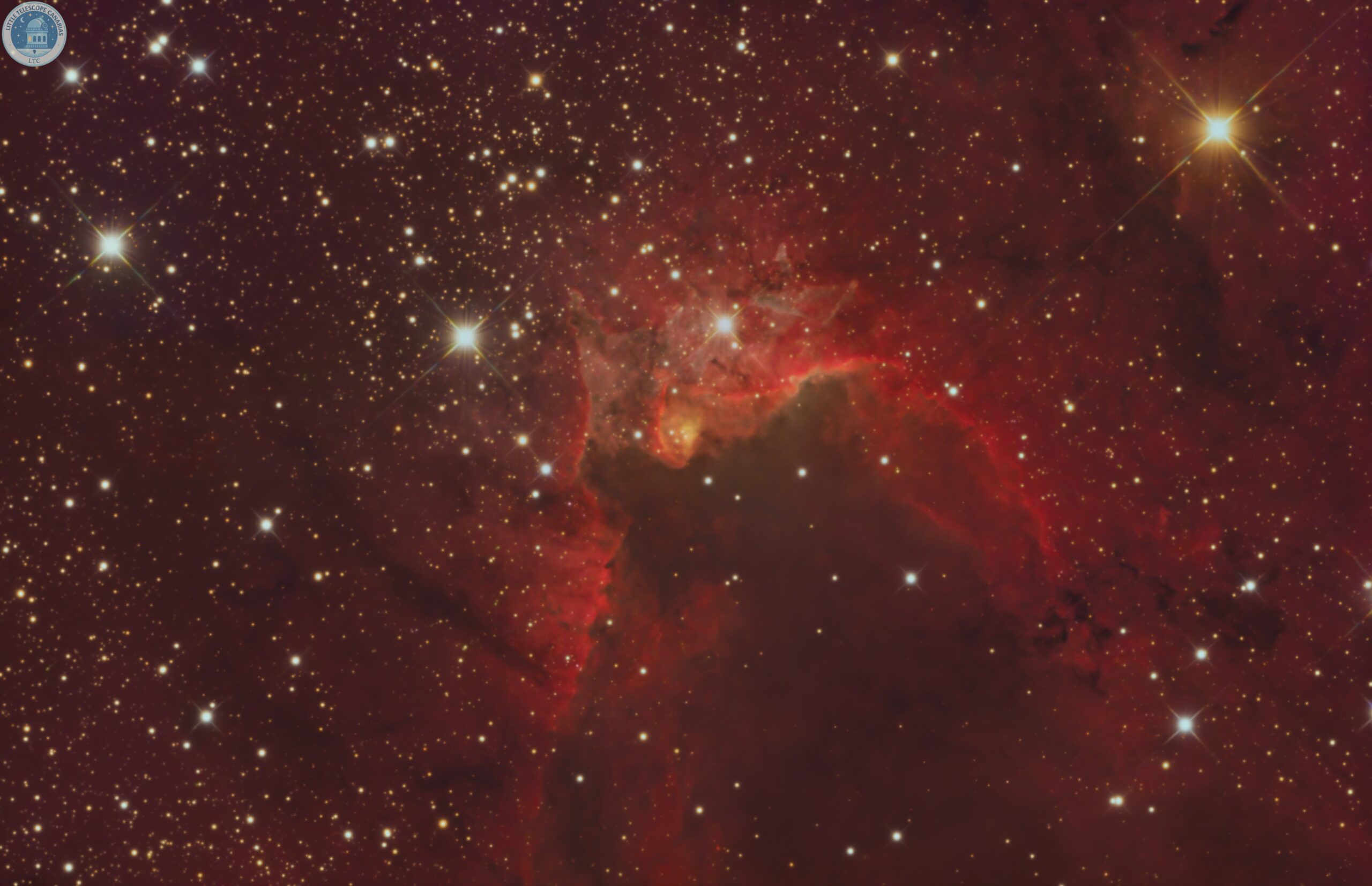
Sh2-155, known as the Cave Nebula, is an emission region located in the constellation of Cepheus, about 2,400 light-years from Earth. It is part of the Cepheus molecular cloud complex and stands out for its dark, sculpted appearance, resembling the entrance of a cave illuminated from the outside.
Its combination of glowing gas and dark dust makes it a fascinating object both visually and scientifically.
💥 Star formation in action
Sh2-155 is an active star-forming region, where radiation from young, massive stars interacts with the interstellar medium. In particular, the star HD 217086 plays a key role by emitting intense ultraviolet radiation that ionizes the surrounding hydrogen.
This process not only makes the nebula shine, but also compresses gas and dust, triggering the birth of new stars within it.
📸 Images from LilTecan
The LilTecan team has captured the Cave Nebula, highlighting the contrast between bright emission regions and dark dust clouds, as well as fine structures along ionization fronts.
🌟 A boundary between light and darkness
Modern studies have revealed key characteristics of this region:
- It shows a well-defined ionization front, where radiation interacts with the molecular cloud.
- It contains dense dust clouds that block light and create its characteristic “cave” shape.
- Protostars and young stellar objects (YSOs) are present within it.
- It is part of a larger star-forming complex in Cepheus.
- The interaction between radiation and matter drives triggered star formation.
Sh2-155 —the Cave Nebula— is a spectacular example of how light from massive stars sculpts the interstellar medium and triggers new star formation processes.
Observing it today is like looking into a region where light and darkness intertwine, revealing the birth of new stars and the continuous recycling of matter in the universe.